
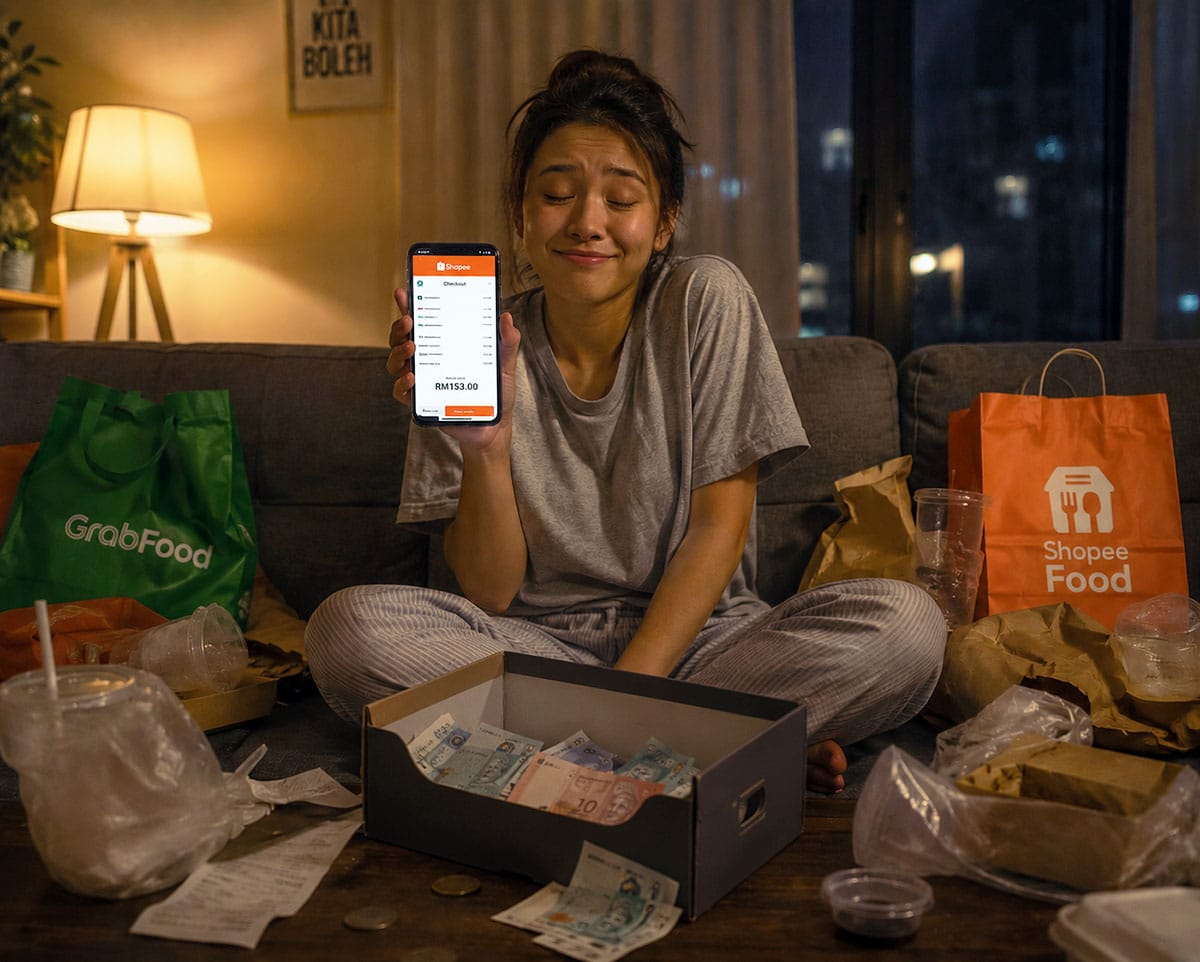
Most Malaysians are not bad at earning money. We are just suspiciously good at spending it before the saving part ever gets a turn.
Three out of five Malaysians have cut back on non-essential spending. Yet more than 40% still struggle to cover basic expenses every month. So either we are very bad at cutting back, or we have a completely different definition of what "non-essential" means.
Spoiler: it is both.
The Saving Problem Is Not What You Think
Most people assume Malaysians do not save because they do not earn enough. And yes, with a median monthly salary sitting at around RM2,864, money is genuinely tight for a lot of households. But here is the uncomfortable truth that nobody wants to say out loud at the mamak table: a big chunk of our saving problem is not an income problem. It is a decision problem.
We do not fail to save because we have nothing left over. We fail to save because by the time we think about saving, we have already spent it. On food delivery. On that Shopee flash sale at 12am. On the new café that just opened in Mont Kiara that everybody is posting about. On the phone upgrade we did not need but somehow convinced ourselves we deserved.
I know this because I do it too. Grab and Foodpanda are practically household members at my place. Do I know it is cheaper to cook? Obviously. Do I still open the app when my wife and I have had a long day and nobody wants to stand near a hot stove? Every single time. And TikTok Shop has a genuinely sinister talent for showing you something you did not know you needed right up until the moment you bought it.
We are not uniquely weak-willed. We are just living in an era specifically engineered to make spending easier than saving.
The "Nanti Lah" Savings Strategy
Here is the most common Malaysian savings plan: get paid, pay bills, eat, spend a little here and there, and then save whatever is left at the end of the month.
The problem is that there is almost never anything left at the end of the month. Because life happens in the middle. The car needs servicing. The kids need new shoes. There is a birthday dinner. There is a sale. There is always something.
This approach to saving is what financial people politely call "residual saving." What the rest of us should call it is saving as an afterthought, which is basically the same as not saving at all, just with more optimism involved.
The shift that actually works is flipping the order entirely. Save first. Spend what remains. Even if the amount feels embarrassingly small, the habit of moving money out before you can touch it changes everything. Your lifestyle adjusts to what is left. It always does.
Saving for the Wrong Things
Here is the other thing Malaysians get quietly wrong: we treat savings like a holding account for the next big purchase.
Save RM3,000. Buy the new iPhone. Account back to zero. Repeat.
That is not saving. That is just delayed spending with extra steps.
Real saving is money you put away with the genuine intention of not touching it unless something genuinely serious happens. And beyond that, real wealth-building is money that goes to work for you while you sleep. ASB. EPF top-ups. unit trusts. REITs. Fixed deposits at the very minimum. Money sitting in a regular savings account earning zero something percent interest is not saving. It is just money that is slowly losing value to inflation while you feel responsible about it.
The new iPhone depreciates the moment you take it out of the box. An investment compounds. These are not the same thing, and the sooner we stop treating our savings account like a shopping fund with a longer waiting period, the better.
The "Nampak Cool" Tax
Now, the social pressure angle. Because we cannot have this conversation without talking about it.
There is a very real and very expensive pressure in Malaysian culture to be seen spending in the right places. The new brunch spot. The overpriced bubble tea everyone is queuing for. The concert ticket. The travel post. Keeping up with what your friends are doing on Instagram and TikTok costs money, and a lot of Malaysians are quietly going into their savings, or worse, their credit card limit, to fund an appearance of financial comfort they do not actually have.
Personally, I gave up on that game a long time ago. I will happily eat at a gerai tepi jalan as long as the food is good and my family is fed. I have zero interest in paying RM28 for a pasta that looks better than it tastes just so I can tag the location. But I know a lot of people who feel genuine social anxiety about being seen as the person who cannot afford things. And that anxiety is expensive.
Here is the reality nobody posts about: the person driving the flashiest car in your friend group might be the one with the least savings. Appearances in Malaysia are heavily leveraged. Do not benchmark your financial life against someone else's highlight reel.
What Actually Helps (From Someone Still Figuring It Out)
I am not going to pretend I have this perfectly sorted. Getting retrenched at the end of last year forced me to look at my finances in a way I probably should have done earlier. When the monthly salary stops and the client payments slow down, you find out very quickly which of your spending habits were needs and which were just comfort dressed up as needs.
A few things that actually make a difference, without requiring you to become a monk:
First, automate your savings the moment your income lands. Even RM200. Even RM100. Move it somewhere you cannot easily access it on impulse. Out of sight genuinely does mean out of mind when it comes to money.
Second, cancel one subscription this week. Just one. Go check your bank statement right now. There is almost certainly something there you forgot you were paying for. A streaming service you have not opened in months. A app membership that auto-renewed quietly. That is free money back in your pocket.
Third, stop saving for things and start saving for freedom. Freedom to not panic when your car breaks down. Freedom to not take the first job offer that comes along just because you are desperate. Freedom to say no to a bad client because you have a buffer. That kind of saving feels different. It has a purpose beyond the next purchase.
And if you have any amount to invest, even a small one, start. ASB, EPF voluntary contributions through i-Saraan if you are self-employed, a simple unit trust. Money in a savings account is not working for you. Money invested, even conservatively, is.
My Take
The honest version of my savings story is that I spent most of my working life saving enough to feel okay, not enough to feel secure. The retrenchment in December changed my relationship with money faster than any financial advice article ever did. When the income stops, the clarity arrives very quickly.
What I wish someone had told me earlier is that saving is not about restriction. It is about options. Every ringgit you put away is a future version of you having one more choice available. One more exit. One more door that stays open.
We are a generation that grew up being told to work hard and the money will come. Nobody taught us what to do with it when it did. So we spent it, reasonably, on a good life, and then wondered why we still felt financially anxious despite earning decent money.
The Grab order is fine. The TikTok impulse buy happens to the best of us. But if saving is still something you plan to start "next month," just know that next month has been saying the same thing for years.
Start with whatever you have. Start today. Future you will be very glad you did.
Kamarul Azwan (k.azwan@gmail.com) is a content creator under the Newswav Creator programme, where you get to express yourself, be a citizen journalist, and at the same time monetize your content & reach millions of users on Newswav. Log in to creator.newswav.com and become a Newswav Creator now!
The User Content (as defined on Newswav Terms of Use) above including the views expressed and media (pictures, videos, citations etc) were submitted & posted by the author. Newswav is solely an aggregation platform that hosts the User Content. If you have any questions about the content, copyright or other issues of the work, please contact creator@newswav.com.