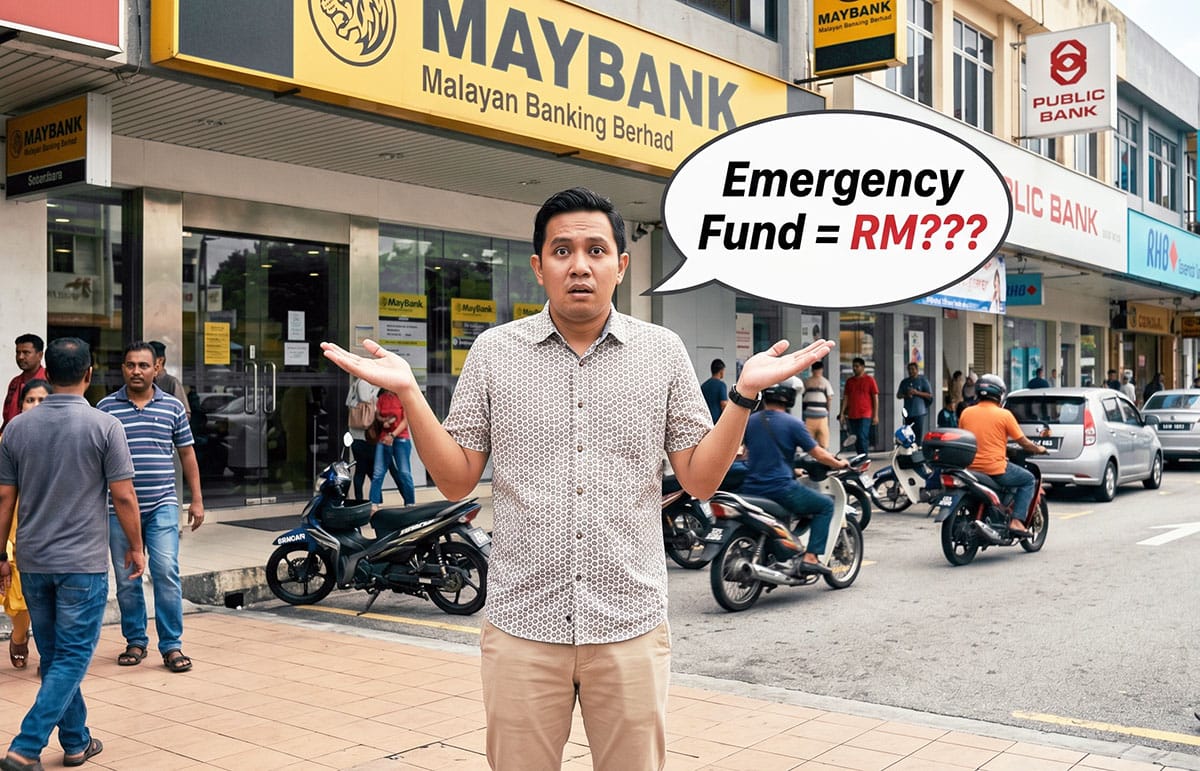
The emergency fund most Malaysians never built is the one they desperately need right now.
Let me tell you what December 2025 actually felt like.
I was retrenched. The monthly salary stopped. The bills did not.
I had a small emergency fund set aside. Most financial advisors recommend three to six months of expenses. Mine covered significantly less than that. It drained faster than I expected, because when income stops, expenses do not pause politely to let you catch up. They keep arriving. On schedule. Without sympathy.
This article is not written from a comfortable distance. It is written by someone who has lived the exact scenario it is warning you about. And who learned, the hard way, that an emergency fund is not optional. It is the difference between a difficult situation and a genuinely dangerous one.
The Malaysian Savings Reality Is Not Pretty
Before we get into what one bad month actually feels like, let us establish where most Malaysians actually stand.
55% of Malaysians have less than RM10,000 in available savings to draw on in the event of an emergency, according to PIDM's savings behaviour report. More than half the country is one significant financial shock away from serious difficulty.
Only 53% of Malaysians could raise RM1,000 for an emergency in 2021, according to Bank Negara Malaysia's Financial Capability and Inclusion Survey. That number improved slightly from 48% in 2018, but remains deeply concerning. Nearly half the country cannot access even four figures in an emergency.
27% of Malaysians save less than 5% of their income. Another 11% save nothing at all.
These are not abstract statistics. They are a portrait of a country where the majority of working adults are one job loss, one medical emergency, one unexpected major repair away from financial crisis.
Why Malaysians Do Not Build Emergency Funds
The easy answer is that people cannot afford to save. For genuinely low-income Malaysians where every ringgit of income is already allocated to survival expenses, that is entirely true and deserves to be acknowledged honestly.
But income alone does not explain everything. The savings behaviour data shows that even among middle-income Malaysians, emergency funds are chronically underfunded. And the reasons go beyond simple mathematics.
The "I'll do it next month" attitude is real and remarkably persistent. An emergency fund feels abstract and remote until the moment you desperately need it. Right now, in this month, the new phone upgrade feels more immediate. The dinner out feels more rewarding. The streaming subscription renewal is automatic and barely noticed. The emergency fund contribution requires a deliberate decision that is easy to defer because the emergency it is meant to cover has not happened yet.
Lifestyle creep compounds the problem. As income grows, spending tends to grow with it. The new car that requires a larger loan. The upgraded apartment with a higher rent. The social commitments that multiply as careers progress. Each of these feels justified individually. Together, they leave the emergency fund perpetually at the bottom of the priority list.
And then there is the honest income and obligation reality. Many Malaysians, particularly those supporting families or carrying the eldest child burden we discussed in an earlier article, genuinely have very little left after obligations are met. For these Malaysians, the gap between understanding why an emergency fund matters and being able to build one is a real structural problem, not a character failing.
What One Bad Month Actually Looks Like
Let me reconstruct March 2026 for you, because it is the clearest illustration I have of what life without an adequate emergency fund actually looks like in practice.
By March, my retrenchment was three months in. The emergency fund was gone. My own company had just been revived, with one client who paid for a four-week sprint. That payment was real income and I was grateful for it. But it was one client. One project. Not enough to cover everything, and certainly not enough to feel stable.
So I did what you do when the options narrow. I started writing for Newswav again. I took in more sponsored posts on the blog. I started selling off redundant gadgets, the tech products accumulated from years of reviews that were sitting in boxes doing nothing. I looked at every possible income stream, however small, and activated it.
But the bills were not waiting for the income streams to stabilise.
The first thing I did was prioritise utilities. Electricity and internet had to stay on. Without electricity, the family cannot function. Without internet, I cannot work. No income, no clients, no articles. The internet bill was survival infrastructure, not a luxury.
Then came the conversations with the bank. Calling your bank to tell them you cannot make the full loan payment this month is not a comfortable experience. But it is better than saying nothing and defaulting silently. Most banks have hardship arrangements. Mine allowed partial payments while I caught up. It is not a solution. It is a pressure valve that buys time.
The rental situation was where luck played a role I cannot fully credit to planning. My landlord understood. He waited. Not every Malaysian in a similar situation has a landlord with that patience. Some face eviction notices on top of everything else. I was fortunate.
The stress during that period was real and constant. Not the dramatic, visible stress of someone visibly falling apart. The quiet, grinding stress of managing a complicated financial equation every single day, where one unexpected expense could tip the balance and require yet another conversation, yet another partial arrangement, yet another creative solution.
I never gave up. But I also understand, having lived through it, exactly why some people do.
The Three to Six Month Standard, And Why It Feels Impossible
Financial advisors universally recommend maintaining three to six months of essential expenses in an accessible emergency fund. For someone with monthly essential expenses of RM3,000, that means RM9,000 to RM18,000 sitting in a liquid account doing nothing except waiting for a crisis.
For most Malaysians earning at or near the median salary of RM3,000 per month, that number feels not just ambitious but almost absurd. Three to six months of expenses when you are currently spending everything you earn just to stay afloat.
This is where the advice needs to be more honest than most financial content is willing to be.
Starting small is not a compromise. It is the only realistic path for most Malaysians. The goal of three to six months is correct. The method of getting there has to be calibrated to reality.
Where to Start, Even When the Amount Feels Embarrassing
Here is the advice I would give anyone earning RM3,000 a month who has never had an emergency fund.
Set aside something the moment your salary arrives. Not what is left after everything else. First, before anything else. Even RM50. Even RM100. The amount matters less than the habit in the beginning. Once the money is moved to a separate account before you see it in your spending balance, it tends to stay there. Once it remains in your main account waiting to be moved later, it tends not to.
Put it somewhere that earns more than a savings account but remains accessible. ASB or ASNB for eligible Malaysians gives you genuine dividends on money that can still be withdrawn when needed. Versa's money market fund offers returns of around 3.3 to 3.4% annually with full liquidity, meaning you can withdraw the next business day. Your emergency fund should not be locked away in a fixed deposit you cannot access without penalties. It needs to be reachable within 24 to 48 hours.
Automate the transfer if your bank allows it. Set up an automatic transfer to a separate account on the day your salary arrives. Even RM100 per month compounds to RM1,200 in a year. Not a full emergency fund, but a meaningful buffer that makes the next difficult month slightly more manageable than the one before.
And critically, treat the emergency fund as a separate account with a single purpose. Naming it something specific, "Emergency Only" or "Do Not Touch," matters more than it sounds. Accounts that are mentally earmarked for a specific purpose are less vulnerable to the rationalisation that an almost-emergency justifies a withdrawal.
What Changes When You Have One
Here is what I know now that I did not fully appreciate before December 2025.
A well-funded emergency fund does not just protect you from financial disaster. It changes the quality of every decision you make in a crisis. When you have a buffer, you can wait for the right client rather than taking the wrong one out of desperation. You can negotiate from a position of stability rather than panic. You can give the job search the time it needs rather than accepting the first offer because the bills cannot wait.
Without it, every decision gets made under pressure. Under pressure, people make worse decisions. They take lower-paying contracts because they need the cash immediately. They accept unfair terms because they cannot afford to walk away. The absence of an emergency fund is not just a financial problem. It is a decision-making problem that compounds through every choice made in a crisis.
The stress that comes from having no buffer is not just unpleasant. It is cognitively expensive. Research consistently shows that financial stress impairs judgment, reduces focus, and depletes the mental bandwidth needed to solve complex problems. The period I described in March was not just financially difficult. It was mentally exhausting in a way that made clear thinking harder precisely when clear thinking was most needed.
My Take
I started contributing to a Versa account as a dedicated emergency fund the moment the income from my client gave me even a small amount to redirect. Not because the amount I could set aside was impressive. Because I knew, from direct and recent experience, what the alternative felt like.
The lesson is simple but it needs to be said plainly for anyone who has been putting this off.
Your emergency fund is not saving for the future. It is buying yourself time, stability and clear thinking for the present moment when everything goes wrong at once. Because at some point, something will go wrong. For some of us it will be a retrenchment. For others a medical emergency, a family crisis, a car that stops working, a landlord who is not patient.
The question is not whether the bad month will come. It will. The question is whether you will face it with three months of breathing room or with nothing between you and a very uncomfortable series of phone calls.
Start with RM50. Start today. Start before you finish reading this article.
The month you will eventually thank yourself for it is coming. The only variable is whether you will have anything in that account when it arrives.
Kamarul Azwan (k.azwan@gmail.com) is a content creator under the Newswav Creator programme, where you get to express yourself, be a citizen journalist, and at the same time monetize your content & reach millions of users on Newswav. Log in to creator.newswav.com and become a Newswav Creator now!
The User Content (as defined on Newswav Terms of Use) above including the views expressed and media (pictures, videos, citations etc) were submitted & posted by the author. Newswav is solely an aggregation platform that hosts the User Content. If you have any questions about the content, copyright or other issues of the work, please contact creator@newswav.com.