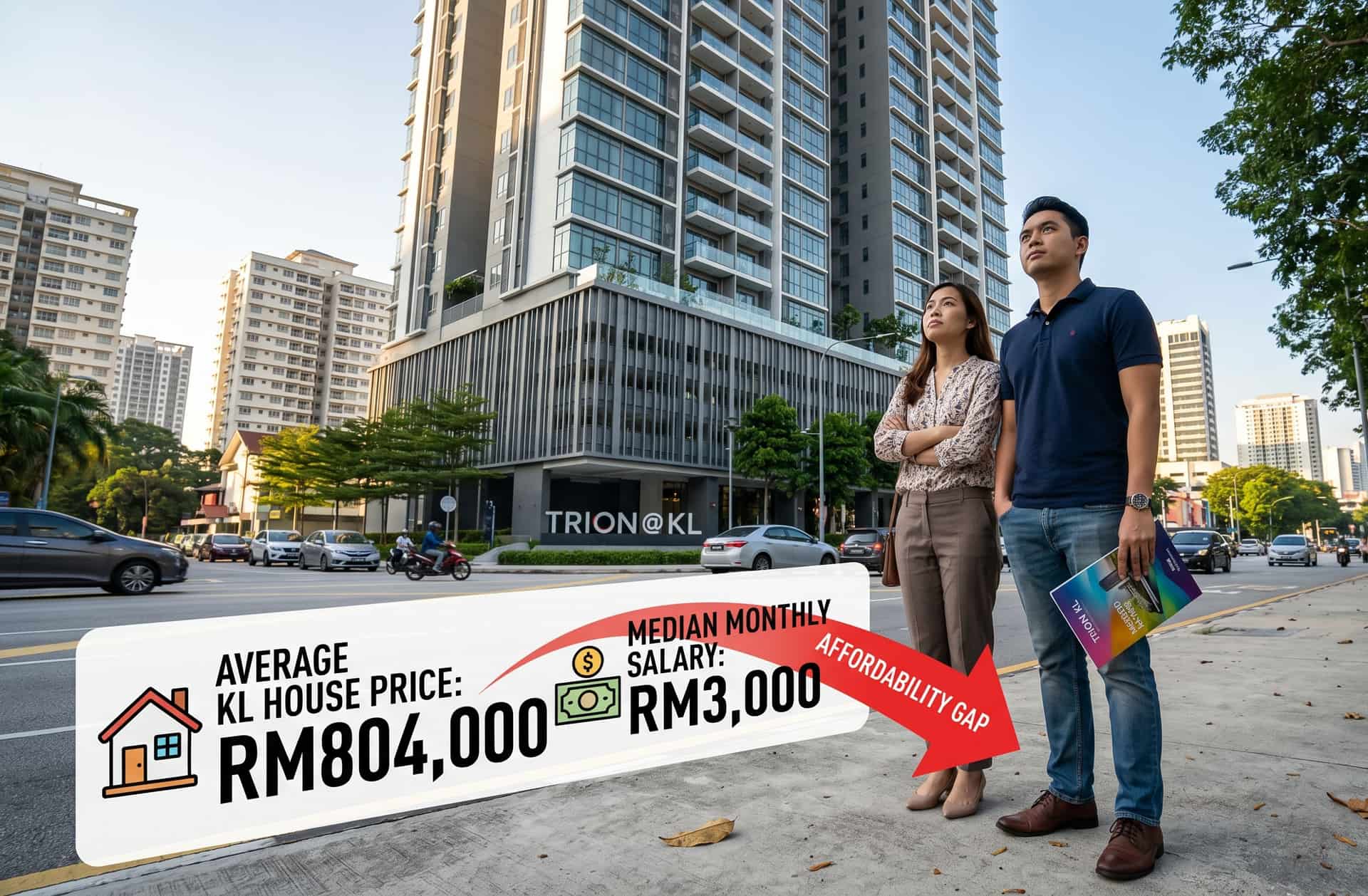
The average Malaysian salary can barely finance half a KL property. But homeownership is not impossible yet.
Owning a home is one of the oldest financial goals in the Malaysian playbook. Get a job, save for a deposit, buy a house, pay it off, pass it down. That was the plan. For millions of Malaysians today, that plan is increasingly looking like a story their parents told them from a different era.
The numbers explain why.
The Gap That Keeps Growing
The average house price in Malaysia hit RM486,070 in Q1 2025. In Kuala Lumpur specifically, the average house price sits at RM804,642, making it one of the most expensive housing markets in Southeast Asia relative to local incomes. In Selangor, the average is RM553,196.
Now look at the income side. Malaysia's median monthly salary is approximately RM3,000. That means the typical Malaysian worker earns roughly RM36,000 a year. A RM486,000 house is more than 13 times their annual income.
The internationally accepted benchmark for housing affordability is a house price-to-income ratio of 3 times annual income. Malaysia is sitting at over 13. That is not a gap. That is a chasm.
House prices in Malaysia grew at a compound annual growth rate of 26.5% between 2002 and 2014, while household incomes grew at only 11.7% over the same period. The affordability problem did not appear overnight. It has been compounding quietly for two decades, and the Malaysians who feel it most acutely today are young workers, new families, and anyone in the median income bracket trying to buy in an urban area.
What Your Salary Can Actually Get You
Let us put some real numbers on this because the abstract discussion of affordability is less useful than understanding what a specific salary can realistically finance.
Banks in Malaysia typically allow a maximum of 30% of your net monthly income toward home loan repayments. At the current interest rate of around 4%, on a 35-year loan tenure, here is a rough picture:
Someone earning RM3,000 a month can afford a loan of approximately RM270,000 to RM290,000, assuming no other debts. That rules out most properties in KL and Selangor entirely. They would need to look at Seremban, Nilai, Rawang, Semenyih, or Klang, which means a longer daily commute, a second car, and the hidden costs of distance from the city.
Someone earning RM5,000 a month can afford a loan of around RM450,000 to RM480,000. That opens up options in outer Klang Valley suburbs. Still not in KL itself.
Someone earning RM8,000 a month can qualify for loans in the RM700,000 to RM750,000 range. This is where choices in the Klang Valley begin to feel reasonable.
The maths is uncomfortable but important. For most Malaysian workers earning at or below the median income, city homeownership is not a matter of not working hard enough. The numbers simply do not add up, especially once you factor in car loans, PTPTN repayments, and the general cost of living.
The Geography Trade-off
Here is the piece of the affordability conversation that gets overlooked when people say "just buy further out."
Yes, a landed property in Semenyih or Seremban is significantly cheaper than anything in Petaling Jaya. But moving further away from the city does not make you richer. It just shifts the cost from your housing loan to your daily commute.
A car purchased to support a longer commute. Toll costs every day. Petrol. Time spent in traffic that could be spent working, resting, or with family. These costs are real and they compound every month for as long as you live in that house.
My own situation reflects this trade-off directly. I own a house that was inherited through my mother, but it is located far enough from the city that commuting from there is not practical. So I rent in Subang Jaya and pay for the convenience of proximity. The plan now is to sell the inherited property and use the proceeds to buy something closer to the city outskirts, where prices are more manageable without sacrificing the entire daily commute. No bank loan required.
That is not a path available to everyone. Most Malaysians looking to buy their first home do not have an inherited property to sell. They are working with a salary, a savings account, and whatever they can borrow.
What the Government Schemes Actually Offer
The government has not been entirely absent from this problem. Several programmes exist specifically for Malaysians who struggle to enter the property market through conventional means.
PR1MA offers homes priced between RM100,000 and RM400,000, targeted at households earning between RM2,500 and RM15,000 per month. Properties are priced approximately 20% below market value. The catch is a five-year moratorium on resale, meaning you cannot sell or rent out the property for five years after purchase. For families who need the flexibility to move or generate rental income, this restriction is a genuine limitation.
The Skim Rumah Pertamaku, also known as SRP or MyFirstHome, allows eligible first-time buyers to purchase homes with 100% financing, meaning no down payment required. This is one of the most significant barriers to homeownership for young Malaysians, the 10% deposit, and SRP removes it entirely for qualifying buyers purchasing homes priced up to RM500,000.
The MyHome scheme provides a direct subsidy of up to RM30,000 for first-time buyers purchasing from participating developers. Combined with the stamp duty exemption extended until December 2027, the total upfront cost savings can be meaningful for a first-time buyer in the right price range.
The Housing Credit Guarantee Scheme, known as SJKP, was doubled to RM20 billion under Budget 2026, covering an estimated 80,000 first-time buyers. This is specifically useful for self-employed Malaysians and gig workers who cannot show conventional payslips but have consistent income. Banks are more willing to lend when the government is guaranteeing the loan.
These schemes are genuinely useful for the income groups they target. But they come with real limitations. Government scheme houses are typically smaller, located in areas with less established infrastructure, and come with restrictions that limit flexibility. They are a roof, not a wealth-building vehicle. And for Malaysians who have slightly higher incomes that disqualify them from the schemes but still cannot afford market-rate urban housing, there is a painful middle ground with no obvious solution.
Buying Versus Renting: The Honest Calculation
The rent versus buy debate in Malaysia tends to produce strong opinions, and both sides have valid points.
The case for buying is straightforward and deeply embedded in Malaysian cultural values. Your monthly payment builds equity. You own an asset that appreciates over time. You have security and stability that renting does not provide. You can eventually pass the property to your children. Most importantly, every ringgit you pay goes toward something that is yours, not your landlord's.
The case for renting is less emotionally satisfying but financially coherent in certain situations. Renting gives you flexibility to move for better job opportunities. It frees up capital that would otherwise be tied up in a down payment and can be invested elsewhere. It transfers maintenance responsibilities to the landlord. And in a market where property prices are flat or slow-growing, renting and investing the difference can actually produce better financial outcomes than buying.
I personally prefer owning. There is something about knowing the monthly payment is building toward something I actually own that feels right to me, regardless of what any calculator says. But I also recognise that this preference is partly emotional and partly cultural. Many Malaysians I know who rent by choice are not making a mistake. They are making a different calculation, and for their specific life situation, it often makes sense.
The key is making an active, informed decision rather than defaulting into one option purely out of habit or social pressure.
What You Can Actually Do Right Now
If homeownership is your goal, here are the practical steps that move you closer to it.
Check your eligibility for government schemes before you assume you cannot qualify. The full list of 2026 government housing schemes covers a much wider income and profile range than most Malaysians realise. SJKP is particularly underused by self-employed and gig workers who assume they cannot get a loan.
Start building your credit health now. Your CCRIS report and Debt Service Ratio determine how much a bank will lend you. Pay off existing debts, avoid late payments, and reduce credit card utilisation before you apply for a home loan. Give yourself at least six months of clean financial history before approaching a bank.
Use EPF Account 2 for your down payment. Many Malaysians do not realise their EPF savings can be withdrawn for property purchase. This can significantly reduce or eliminate the down payment barrier without requiring years of additional cash savings.
Look beyond your immediate neighbourhood when pricing properties. A RM350,000 house 30 kilometres from the city centre is not necessarily a bad deal. Run the full numbers including commuting costs and factor in whether the area has realistic long-term infrastructure development. Some of Malaysia's best property value appreciation stories in the last decade came from areas that felt too far out when buyers first purchased.
And if you are not ready to buy yet, that is a legitimate position. Buying a house before you are financially ready creates more problems than it solves. Rent, save, build your financial foundation, and enter the market when the timing genuinely works for you, not when social pressure tells you that you should.
My Take
My own path to homeownership has been anything but textbook. An inherited property I do not live in. Years of renting in Subang Jaya. A plan to sell and buy something that actually fits my life.
It is not the story of getting a job, saving diligently, and buying a house at 30. But it is a real Malaysian story, full of the compromises and circumstances that actual people navigate rather than the clean linear path that financial planning articles typically describe.
What I have learned is that homeownership in Malaysia is still achievable for most people, but it requires patience, flexibility about location, honest self-assessment about what you can actually afford, and willingness to use every legitimate tool available rather than doing it purely through salary savings alone.
The dream has not died. It has just moved further out, taken longer, and required more creative navigation than the previous generation needed. That is not failure. That is just the current reality, and reality is something you can plan around once you can see it clearly.
Kamarul Azwan (k.azwan@gmail.com) is a content creator under the Newswav Creator programme, where you get to express yourself, be a citizen journalist, and at the same time monetize your content & reach millions of users on Newswav. Log in to creator.newswav.com and become a Newswav Creator now!
The User Content (as defined on Newswav Terms of Use) above including the views expressed and media (pictures, videos, citations etc) were submitted & posted by the author. Newswav is solely an aggregation platform that hosts the User Content. If you have any questions about the content, copyright or other issues of the work, please contact creator@newswav.com.