
THE Philippines is not lacking in climate ambition. What remains uncertain is whether it has the systems, financing and institutional capacity to convert that ambition into sustained action.
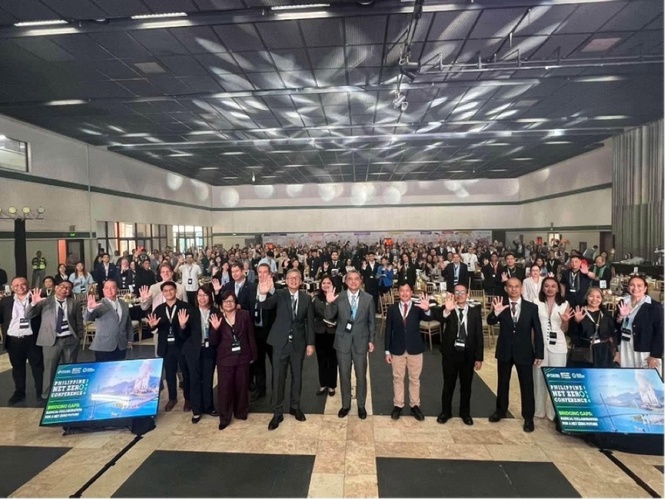
That tension shaped the Philippine Net Zero Conference 2026 and its theme “Bridging Gaps: Radical Collaboration for a Net Zero Future.” In that event, headed by Environment Secretary Juan Miguel Cuna, government, business and development partners confronted a difficult question: Is the Philippines ready to make a formal net-zero pledge?
First Gen President Francis Giles Puno’s message recognized the urgency of the transition, while underscoring the work required to connect national ambition with implementation.
Puno described the most important gap as the distance between “the future we say we want” and “the crucial choices we make today.” His observation captures climate action’s central challenge. The country may understand the need for a low-carbon future, but achieving it will require difficult decisions affecting energy, infrastructure, industries and communities amid uncertainty.
Puno emphasized that no single organization could deliver a net-zero future alone. Government, businesses, financial, and academic institutions and technology providers must combine their capabilities. Success should be measured not by announced commitments, but by “the projects we deliver” and “the progress we enable.”
Secretary Cuna presented the government’s current climate pathway. He made clear that although the Philippines has not committed to a formal net-zero target, its national direction is firmly anchored in low-carbon and climate-resilient development through the enhanced 2026 Nationally Determined Contribution (NDC).
Under the NDC, the country targets a 75-percent net emissions reduction and avoidance from 2025 to 2035, measured against projected cumulative business-as-usual emissions. However, only 7 percent of the target is unconditional. The remaining 68 percent is conditional on adequate means of implementation, including climate finance, technology transfer and capacity-building support.
This distinction reflects fiscal realities and the conditions necessary to make the target credible. It reveals why a formal net-zero pledge may be premature. A binding commitment requires dependable resources, accurate emissions data, stable policies and institutions capable of sustaining action over decades.
Cuna’s call for a shift “from commitments to implementation; from plans to projects; from policy statements to investment pathways” defines the Philippines’ climate challenge. The country must prove that its targets and emerging frameworks can generate a reliable pipeline of bankable, measurable and socially responsible projects.
Challenges and safeguards
The policy architecture is taking shape. It includes the country’s Long-Term Strategy, the NDC Implementation Plan, the Just Transition Framework, a carbon-market policy framework, stronger measurement and reporting systems, and a comprehensive financial and investment plan. These are not separate initiatives but must function as connected parts of one national pathway.
Implementation remains the crucial test. National policies must be aligned with local government action, public budgets, permitting systems and private investment decisions. Bureaucratic silos, uncertain regulations and limited technical capacity can prevent climate projects from advancing beyond the planning stage.
Financing presents another major obstacle. The NDC’s conditional portion demonstrates that the Philippines needs substantial external support. Yet climate finance must be accessible, scalable and non-debt-creating where possible. Investors need clear rules, viable revenue models, credible safeguards, transparent data and appropriate risk allocation. Without these conditions, ambition on paper will not be delivered.
The social dimension is important. Cuna stressed that a transition cannot be durable if it is technically sound but socially unjust. Workers may face displacement, communities dependent on high-carbon activities may experience economic disruption and small enterprises may struggle with financing requirements.
A credible transition must include reskilling, decent work, social protection and livelihood diversification. Coal-dependent communities, agricultural workers and other vulnerable groups must have a meaningful role in shaping the policies affecting them.
Nature-based solutions require strong safeguards. Forests, mangroves, seagrass meadows and tidal wetlands provide carbon sequestration, coastal protection, food, livelihoods and resilience. Nature-based climate action must respect community rights, secure land tenure, ensure transparent benefit-sharing and rely on credible measurement.
Carbon markets can help mobilize international finance but cannot substitute for genuine emissions reductions. The country must prevent double counting, maintain accurate national accounting, and protect Indigenous peoples and local communities. Cuna said, “We welcome investment, but we will not compromise integrity.”
The Philippines has an adopted NDC, a clear low-carbon policy direction, emerging carbon-market institutions, nature-based strategies, and an expanding network of public and private partners. But before making a formal net-zero pledge, it must demonstrate that it can implement projects, mobilize finance, protect workers, safeguard communities and maintain long-term accountability.
More than a theme, “Bridging Gaps” shows the work ahead: bridging ambition and implementation, national plans and local realities, investment and social protection, and today’s commitments with tomorrow’s results. The Philippines is building that bridge. Though not ready to cross into a binding net-zero commitment, it is laying the foundations needed to make that commitment credible when the time comes.
The author is the founder and chief strategic advisor of the Young Environmental Forum and a nonresident fellow of Stratbase Institute. He completed a climate change and development course at the University of East Anglia (UK) and an executive program on sustainability leadership at Yale University (USA). Email him at ludwig.federigan@gmail.com.

