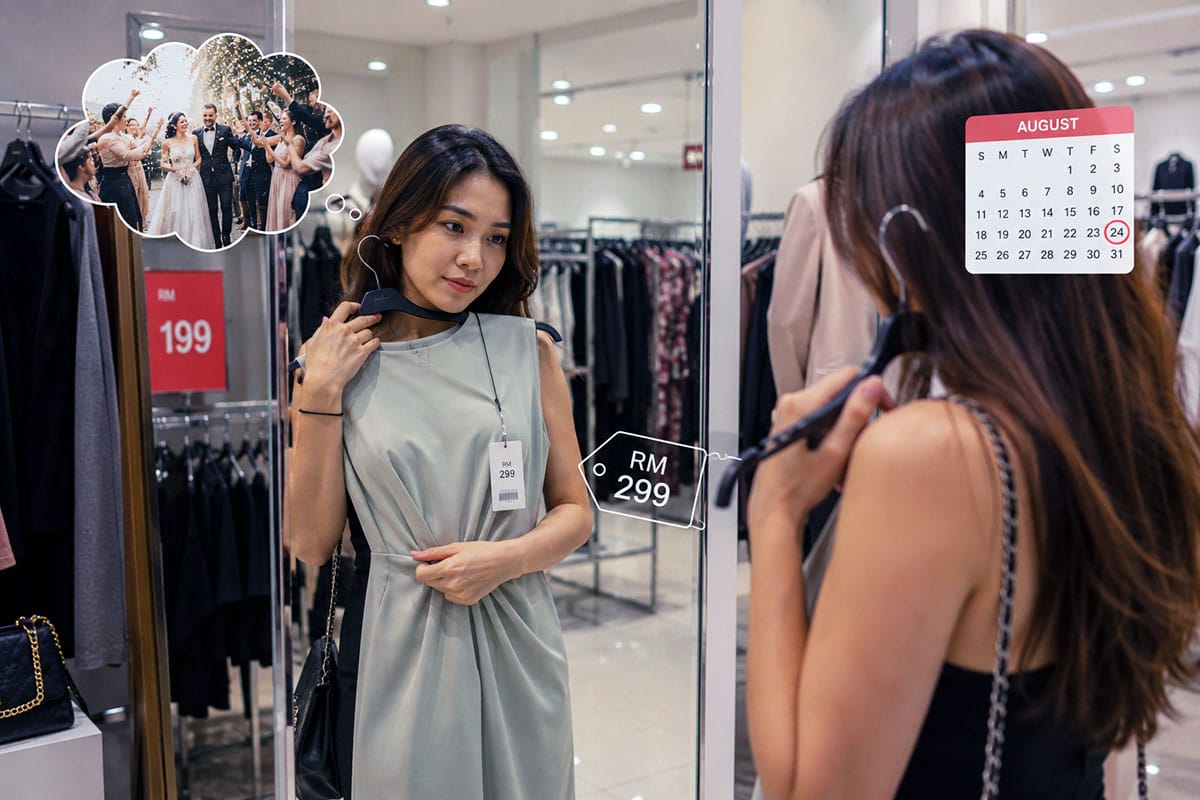
Nobody at the wedding remembers your outfit. But your instalment plan does not forget.
There is a specific kind of Malaysian gathering where you can watch this play out in real time. A wedding, a kenduri, an open house. Someone arrives in an outfit clearly bought for the occasion, tags brushed off minutes before walking through the door. Compliments follow. Photos get taken. And somewhere in the background sits a receipt, or worse, a BNPL instalment plan, quietly ticking away for an outfit that will be worn once, for people who will mostly forget what anyone wore by the following week.
Nobody forces this. Nobody sends an invitation demanding new clothes. And yet the pressure is real enough that Malaysians will adjust their entire budget around it, sometimes going into debt to meet a standard that was never actually written down anywhere.
Festive Spending Is Protected, Even When Everything Else Gets Cut
Malaysia gives us a clean, almost scientific demonstration of this pattern every year around Hari Raya. Households cut back on eating out, delay big purchases, budget more carefully across the board. But when it comes to festive spending, Aidilfitri outfits, balik kampung travel, duit raya, kuih raya, the belt-tightening stops.
Economists have a term for this: symbolic consumption. Households are not simply buying food or clothes. They are reaffirming belonging, honouring reciprocity, and protecting their place within a family and social structure. Dr Carmelo Ferlito, CEO of the Centre for Market Education, noted that even under real cost-of-living pressure, families tend to reallocate priorities rather than abandon festive spending entirely, because this spending sustains identity and relational capital in a way other purchases do not.
That is a generous way of putting it. Less generously: people will go without to keep up appearances in front of relatives they see once a year.
The same report noted that some households turn to EPF flexible withdrawals, BNPL schemes, and even Ar-Rahnu pawn services specifically to fund festive spending. That is worth sitting with for a moment. Pawning something to buy an outfit for a gathering, so the people at that gathering do not notice you are struggling. The irony writes itself.
The Wedding Economy Runs on This Exact Instinct
Weddings amplify the same dynamic, just with bigger numbers attached. A mid-range Malaysian wedding for 200 to 400 guests now runs RM55,000 to RM110,000, driven heavily by guest count and the expectation of a certain standard of hosting. Add hantaran, which alone can range from RM5,000 to RM50,000 depending on family expectations, and the total climbs fast.
Much of that spending is not really about the couple. It is about what extended family, colleagues, and acquaintances who will attend for one evening will think of the hosting. Bigger halls, more elaborate catering, better photography, all partly justified by comfort and celebration, and partly justified by not wanting to be the family that hosted something "small" or "simple" in front of people who will compare notes afterward.
Why This Feels So Hard to Resist
There is real psychology behind why this specific kind of spending is so difficult to opt out of, even when you know better.
Psychologists studying impulse spending point to a specific driver: the need to impress others. This shows up not just in buying gifts, but in trying to project a certain social status through appearance, possessions, or how well you host an event. It is not irrational exactly. Humans are wired to care about social standing. But the wiring did not account for a world with instalment plans, 50% flash sales, and a constant audience watching through phone screens.
The purchase itself often provides a brief lift, then fades fast, sometimes replaced by regret once the bill or the BNPL notification arrives. That cycle, buy for the moment, feel the temporary high, absorb the financial consequence later, plays out at scale every festive season and every wedding season in Malaysia.
The Quiet Exception: People Who Never Bought In
Here is the part that surprised me while researching this: not everyone is running on this operating system, and the ones who are not seem noticeably less stressed about money.
Some people attend every gathering, every wedding, every open house in the same handful of outfits, indefinitely. Not because they cannot afford better, but because the thought that anyone at the event is tracking their wardrobe simply never occurs to them. The social pressure that feels so real to one person is, to another, a complete non-issue, because they never signed the mental contract that says appearances need managing in front of people they barely know.
That distinction, between the pressure being real versus the pressure being self-imposed, does a lot of work in explaining why some households sail through festive seasons debt-free while others quietly take on financing to get through the exact same calendar of events.
My Take
I will be honest, I do not really feel this particular pressure. My baju melayu for Hari Raya is ten years old this year. Same one, every year, for a decade. If it still fits, I wear it. Jeans and a t-shirt work fine for most gatherings I attend. Nobody has ever mentioned it, and I suspect nobody has ever noticed, because nobody is actually paying that much attention to what anyone else wears in the first place.
Where I am not immune is watches. Shopee runs a 50% sale and some part of my brain decides this is an emergency requiring immediate action. I have bought watches on impulse I did not need, and regretted the purchase within days more than once. So I am not writing this from some position of total financial discipline. I have my own version of this weakness. Mine just happens to be private rather than performed in front of relatives at a wedding.
What I have noticed, though, is that the moment you stop believing public opinion carries any real weight, an enormous amount of financial pressure simply evaporates. Nobody at a kenduri is calculating your outfit's resale value. Nobody at a wedding remembers what you wore by the time they get home. The audience you are performing for is, in most cases, not actually watching, and even when they are, their opinion changes nothing about your actual life.
Be thankful for what you already have. It sounds like something printed on a motivational poster, but it happens to be the exact thought that keeps a person out of debt they do not need to be in, spent on people who were never really keeping score.
Kamarul Azwan (k.azwan@gmail.com) is a content creator under the Newswav Creator programme, where you get to express yourself, be a citizen journalist, and at the same time monetize your content & reach millions of users on Newswav. Log in to creator.newswav.com and become a Newswav Creator now!
The User Content (as defined on Newswav Terms of Use) above including the views expressed and media (pictures, videos, citations etc) were submitted & posted by the author. Newswav is solely an aggregation platform that hosts the User Content. If you have any questions about the content, copyright or other issues of the work, please contact creator@newswav.com.