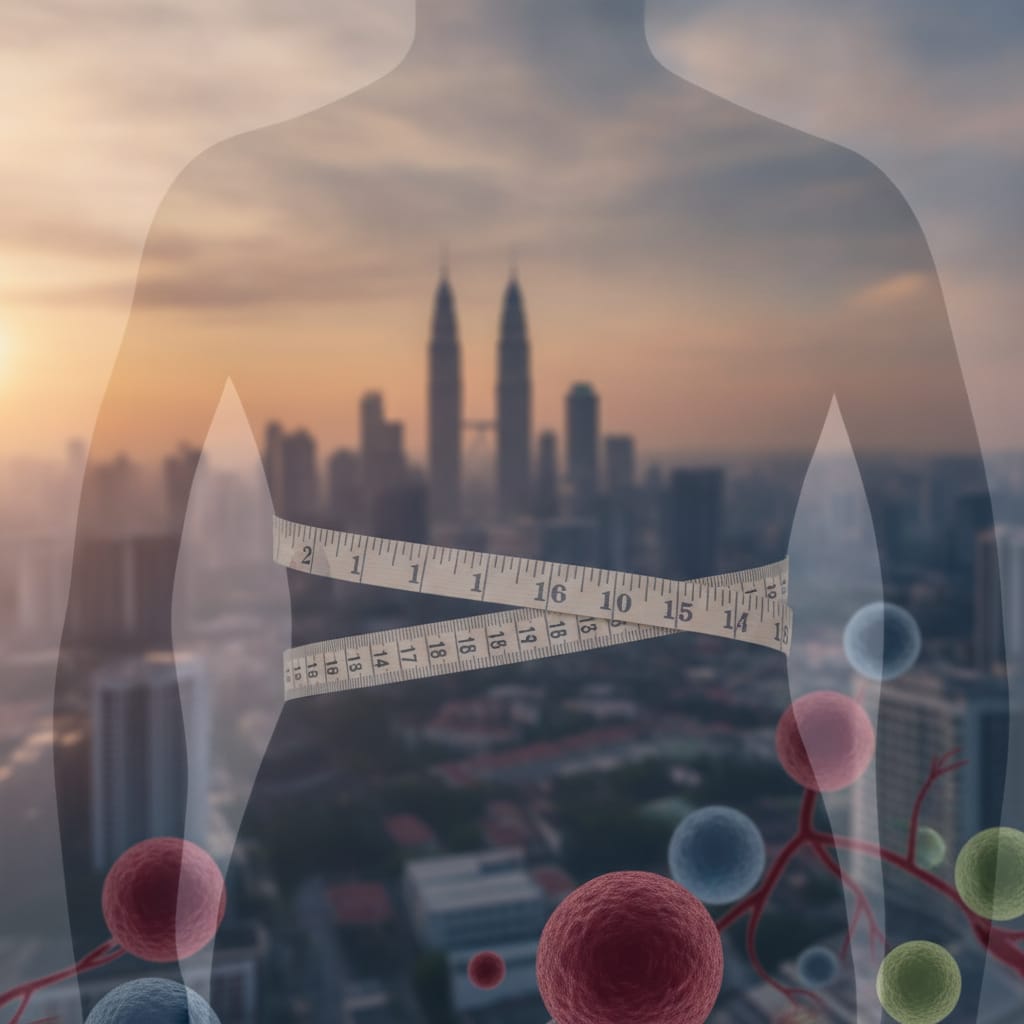
Over the past few weeks we’ve looked at high blood pressure, cholesterol and diabetes. These are three of the most common health problems affecting Malaysians, and they often occur together.
Today I’d like to talk about something that links all three.
Our waistline.
Most of us own a set of bathroom scales.
Every now and then we step on them, look at the number, smile if it’s gone down or sigh if it’s gone up.
But the truth is, the number on the scales doesn’t always tell the full story.
In fact, where we carry our weight can sometimes be more important than how much we weigh.
That surprises many people.
I’ve met people who proudly tell me they’ve only put on three or four kilograms over the years. Yet when you look a little closer, nearly all of that weight has settled around the stomach.
Others haven’t changed much on the scales at all, but their belt has gradually needed another notch.
Our waistline often tells a story that the scales cannot.
Doctors sometimes talk about “visceral fat”. It sounds technical, but the idea is actually quite simple.
Not all body fat is the same.
Some fat sits just under the skin. You can pinch it.
The more concerning type lies much deeper inside the abdomen, surrounding the liver, pancreas and other organs.
You can’t pinch it.
You often can’t even see how much is there.
But it is far more active than many people realise.
This deeper fat releases chemicals that make it harder for the body to use insulin properly. It contributes to high blood pressure, raises cholesterol and increases the risk of heart disease, stroke and type 2 diabetes.
In other words, it doesn’t just sit there.
It causes trouble.
One thing I’ve noticed over the years is that many people judge health by appearance alone.
“If he’s slim, he must be healthy.”
“If she’s overweight, she must be unhealthy.”
Life isn’t always that straightforward.
Some people who appear slim actually carry a surprising amount of fat around their internal organs. Others who are heavier remain remarkably healthy because they stay active, have normal blood pressure, healthy cholesterol and good blood sugar control.
The mirror doesn’t always tell the whole story.
Neither do the scales.
One of the simplest things you can do at home is measure your waist.
You don’t need expensive equipment.
Just a tape measure.
Place it around your stomach roughly level with your belly button, without sucking your tummy in.
For many adults, a growing waistline should be a signal to pay attention, even if the scales haven’t changed very much.
Of course, no one enjoys hearing that they’ve gained weight.
But this isn’t about chasing the perfect body.
It’s about protecting the organs inside your body.
That’s a very different goal.
Social media often promotes dramatic diets, detox drinks and “fat-burning” supplements.
If only it were that easy.
The truth is there is no magic food that melts belly fat.
No special tea.
No miracle pill.
No shortcut.
Our bodies lose fat gradually when we consistently eat a little less than we burn and become more physically active.
It isn’t exciting.
But it works.
Walking regularly is one of the best places to start.
You don’t have to join a gym.
You don’t have to buy expensive equipment.
Simply moving more than you did yesterday is a good beginning.
Eating also deserves a mention.
In Malaysia we’re blessed with wonderful food, but portion sizes have quietly increased over the years.
Many of us don’t overeat because we’re hungry.
We overeat because the food tastes good, we’re eating with friends or we’re distracted by our phones or the television.
Slowing down and recognising when we’re comfortably full can make more difference than following the latest fashionable diet.
Another encouraging fact is that you don’t need to lose huge amounts of weight to improve your health.
Even losing five to ten percent of your body weight can lower blood pressure, improve blood sugar, reduce cholesterol and ease the strain on your heart.
That’s achievable for many people.
It’s also sustainable.
The goal shouldn’t be to become the lightest person in the room.
The goal is to become a healthier version of yourself than you were six months ago.
Small changes repeated every day are far more powerful than ambitious plans that last only until next Monday.
If you’ve noticed your waistband getting tighter over the years, don’t ignore it.
Your waist may be giving you an early warning long before illness appears.
The good news is that our bodies are remarkably forgiving.
It’s never too late to become a little more active, eat a little better and take control of your health.
Your tape measure isn’t there to judge you.
It’s there to remind you that sometimes the smallest measurements tell us the biggest stories.
Until the next time, stay healthy, stay informed and, above all, take good care of yourself.
The Daily Durian (zaynp100@yahoo.com) is a content creator under the Newswav Creator programme, where you get to express yourself, be a citizen journalist, and at the same time monetize your content & reach millions of users on Newswav. Log in to creator.newswav.com and become a Newswav Creator now!
The User Content (as defined on Newswav Terms of Use) above including the views expressed and media (pictures, videos, citations etc) were submitted & posted by the author. Newswav is solely an aggregation platform that hosts the User Content. If you have any questions about the content, copyright or other issues of the work, please contact creator@newswav.com.