
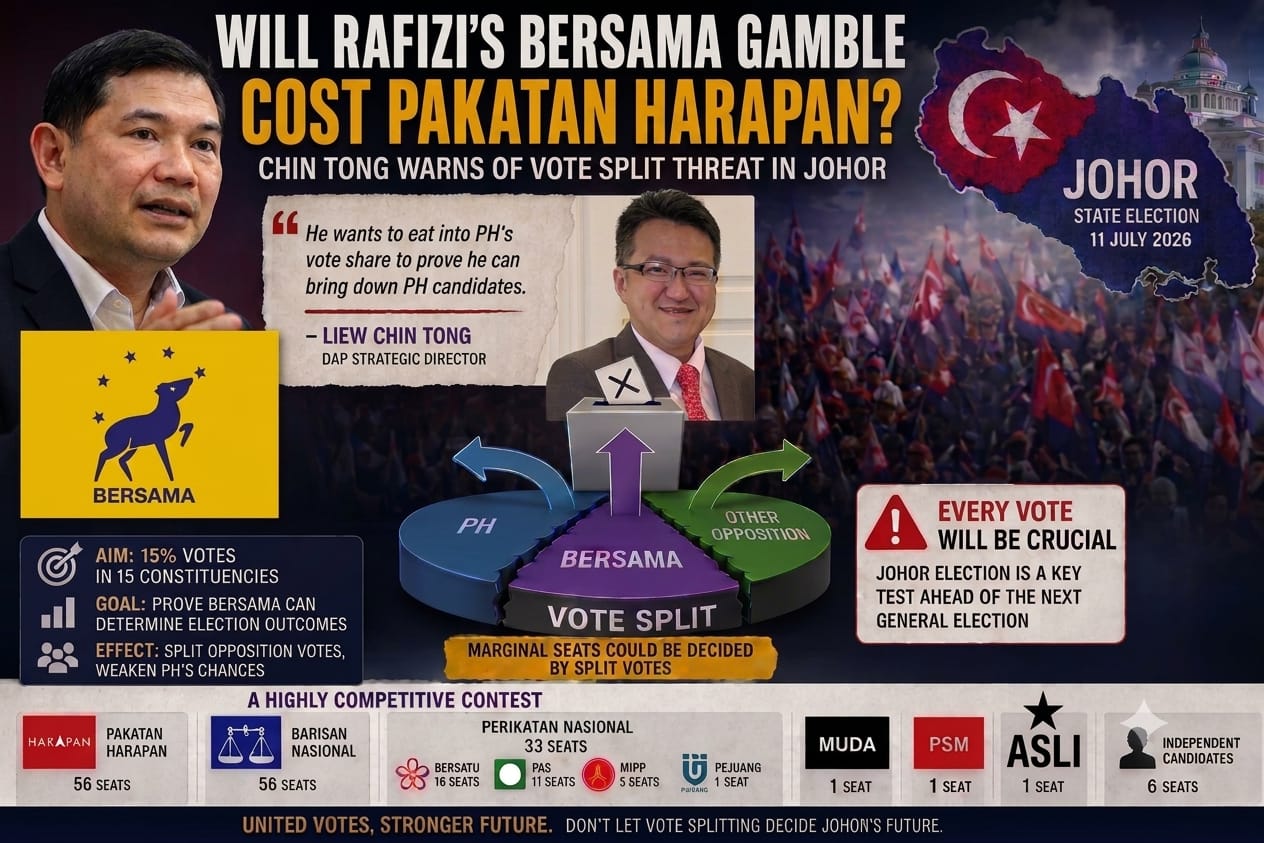
The Johor state election has taken on greater national significance after DAP strategic director Liew Chin Tong warned that the emergence of Bersama under the leadership of Dato' Seri Rafizi Ramli could unintentionally weaken Pakatan Harapan's (PH) electoral prospects through vote splitting.
According to Liew, Rafizi's strategy of contesting 15 constituencies with the aim of securing at least 15% of the votes in each seat is more than simply an attempt to introduce a new political force. He believes the strategy is designed to demonstrate that Bersama possesses enough electoral influence to determine the outcome of closely fought contests.
Liew argued that Rafizi, who has long been regarded as one of Malaysia's most data-driven political strategists, fully understands how electoral mathematics works. Even without winning seats, Bersama could attract enough opposition-leaning voters to reduce PH's vote share, potentially allowing rival candidates to emerge victorious in marginal constituencies.
"He wants to eat into PH's vote share to prove he can bring down PH candidates," Liew was quoted as saying. According to him, if Bersama succeeds in affecting election results despite being a newcomer, it would strengthen Rafizi's claim that his party has become a significant player in Malaysian politics.
The Johor state election is widely viewed as an important testing ground ahead of the next general election. Political analysts are expected to closely monitor not only which coalition forms the state government, but also how emerging parties influence traditional voting patterns and reshape future political alliances.
Rafizi, together with former federal minister Nik Nazmi Nik Ahmad, took over the leadership of Bersama in May 2026. The Johor election marks the party's first electoral contest, with Bersama fielding candidates in 15 constituencies.
The contest itself is highly competitive. Pakatan Harapan and Barisan Nasional are contesting all 56 state seats, while Perikatan Nasional is fielding candidates in 33 constituencies through Bersatu, PAS, the Malaysian Indian People's Party and Pejuang. Meanwhile, MUDA, Parti Sosialis Malaysia, Parti Orang Asli Malaysia (Asli), as well as six independent candidates, are also participating, making the electoral landscape increasingly fragmented.
Liew urged voters who favour political stability and reform to consolidate their support behind PH rather than dispersing votes among multiple opposition parties. In his view, every vote will be crucial in what is expected to be one of Johor's most closely watched state elections.
Whether Bersama ultimately emerges as a genuine new political force or merely influences the outcome by dividing votes remains one of the biggest questions facing the election.
Regardless of the final result, Rafizi's political gamble will be closely scrutinised as an indication of whether new parties can carve out meaningful space in Malaysia's increasingly competitive political landscape.
With several parties vying for support across the state, the Johor election is shaping up to be more than a battle for state administration. It may also determine whether Malaysia's opposition politics becomes more united or increasingly fragmented in the years leading to the next general election.
By: Kpost
Information Source:
Kpost (ckhorsk@gmail.com) is a content creator under the Newswav Creator programme, where you get to express yourself, be a citizen journalist, and at the same time monetize your content & reach millions of users on Newswav. Log in to creator.newswav.com and become a Newswav Creator now!
The User Content (as defined on Newswav Terms of Use) above including the views expressed and media (pictures, videos, citations etc) were submitted & posted by the author. Newswav is solely an aggregation platform that hosts the User Content. If you have any questions about the content, copyright or other issues of the work, please contact creator@newswav.com.
