
-full_normal-(1).jpg)
Malaysia's long-awaited Multi-Lane Free Flow (MLFF) toll system is moving forward again, with almost all highway concessionaires now reportedly discussing its implementation.
Works Minister Datuk Seri Alexander Nanta Linggi said discussions are ongoing between highway concessionaires and their respective business-to-business partners as the government works towards a seamless barrier-free tolling system.
Malaysia currently has 34 tolled highways operated by 28 concessionaires, so getting most of them talking about MLFF is significant.
But after years of discussion about barrier-free tolling, there's another question motorists may want answered before the boom gates disappear:
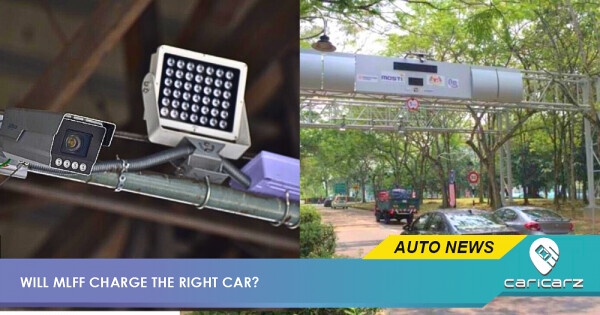
Can MLFF reliably identify your car and charge the correct vehicle?
Unlike today's toll plazas, MLFF is designed to let vehicles continue travelling through open highway lanes without stopping at a boom gate.
That means the system needs to identify vehicles while they're moving.
Malaysia's MLFF development has involved technologies including Radio Frequency Identification (RFID) and Automatic Number Plate Recognition (ANPR).
How Barrier-Free Tolling Could Work 1. DETECT The system detects a vehicle travelling through the tolling point. 2. IDENTIFY RFID and ANPR can be used to identify the vehicle and its registration number. 3. VERIFY Multiple identification technologies can provide additional information instead of relying on a number-plate camera alone. 4. CHARGE The appropriate toll can then be collected without the vehicle stopping at a barrier. But Can ANPR Read Every Malaysian Number Plate?This is where things get interesting.
Touch 'n Go has previously said that ANPR cameras on their own can achieve accuracy of up to around 95%, with factors including heavy rain and intense sunlight potentially affecting recognition.
There's also a very Malaysian complication: our number plates aren't always particularly camera-friendly.
The Works Ministry has previously acknowledged during parliamentary proceedings that Malaysia does not have a fully standardised number-plate format, presenting another challenge for ANPR-based identification.
Fancy Number Plates Could Be A ProblemStylised fonts, unusual spacing and other non-standard number-plate designs can make automated recognition more difficult. That's one reason an MLFF system cannot simply depend on a camera reading a registration number perfectly every single time.
That's also why combining technologies matters.
Rather than relying purely on ANPR, RFID provides another way of identifying a vehicle. More advanced MLFF concepts demonstrated locally have also incorporated technologies such as LiDAR and AI.
The Trial Results Are Promising.jpg)
The numbers demonstrated so far suggest the technology itself is becoming increasingly capable.
Touch 'n Go said its MLFF proof-of-concept on the LKSA highway achieved 100% vehicle detection and more than 99.98% successful reading of existing TNG RFID tags during testing.
Reality CheckThose results are encouraging, but they should not be interpreted as a guarantee that every toll transaction will always be charged to the correct vehicle. Vehicle detection and RFID tag-read accuracy are not the same thing as billing accuracy.
A nationwide MLFF system would ultimately need to perform reliably across Malaysia's wider highway network and varying traffic and weather conditions.
And this leads to another important question.
Even with a highly accurate system, motorists will want a clear way to challenge a transaction if they believe the wrong vehicle was identified or the wrong toll was charged.
So What's Still Holding MLFF Back?
.jpg)
Technology is only one piece of a much bigger puzzle.
Malaysia needs multiple highway concessionaires, commercial partners, payment systems and enforcement mechanisms to work together as one seamless network.
There's also the question of toll evasion. With no barrier stopping a vehicle that hasn't paid, authorities need a system capable of identifying non-payment and taking appropriate action afterwards.
The government has previously indicated that legislative changes are required to deal with enforcement and unpaid tolls under MLFF.
MLFF: The Big Issues Still To Solve One seamless system across multiple highway concessionaires. Reliable vehicle identification using RFID, ANPR and supporting technologies. Toll evasion and enforcement once physical barriers disappear. Commercial agreements between concessionaires and their B2B partners. Consumer confidence in payments, accuracy and dispute handling. When Will Malaysians Actually Get MLFF?That's the RM-million question, and for now there still isn't a firm nationwide implementation date.
Malaysia has discussed MLFF for years, with earlier implementation targets having already come and gone. The government's approach has since shifted towards a B2B model involving highway concessionaires and their respective partners.
The latest development shows that discussions are moving forward, but Nanta has stopped short of announcing exactly when motorists will finally be able to drive through Malaysian tolling points without barriers.
Read: M'sia Is Moving Toward Barrier-Free Tolls, But Gov Just Dropped One Non-Negotiable Rule
MLFF Malaysia: Your Questions AnsweredTap a question below for a quick answer about Malaysia's Multi-Lane Free Flow toll system.
What does MLFF mean? MLFF stands for Multi-Lane Free Flow. Instead of slowing or stopping at conventional toll booths, vehicles travel through open lanes while the tolling system identifies them electronically. Will Malaysia's MLFF use RFID? RFID has been a key part of Malaysia's MLFF development and proof-of-concept systems, alongside technologies such as Automatic Number Plate Recognition (ANPR). The final nationwide implementation model has yet to be fully detailed. What happens if a car doesn't pay the toll? This is one of the issues the government still needs to address before full implementation. Without barriers, unpaid vehicles can continue driving, meaning identification, recovery and enforcement mechanisms need to operate after the tolling point. Legislative changes have previously been discussed to support MLFF enforcement. Could MLFF charge the wrong vehicle? No automated identification technology should be assumed to be infallible. Malaysia's proposed approach uses multiple technologies, including RFID and ANPR, to improve identification accuracy. Current trial results have been highly accurate, and there is no evidence of widespread wrong-vehicle charging from Malaysian MLFF trials. Will MLFF make tolls more expensive? Works Minister Datuk Seri Alexander Nanta Linggi has previously said motorists should not be burdened with higher toll charges simply to pay for MLFF implementation. Will MLFF solve highway congestion? Not completely. Removing toll barriers could reduce bottlenecks associated with toll collection, but Parliament's Public Accounts Committee has cautioned that MLFF alone will not solve overall highway congestion. When will MLFF launch in Malaysia? There is currently no firm nationwide launch date. Almost all highway concessionaires are now discussing implementation with their respective B2B partners, but negotiations and preparations remain ongoing.