
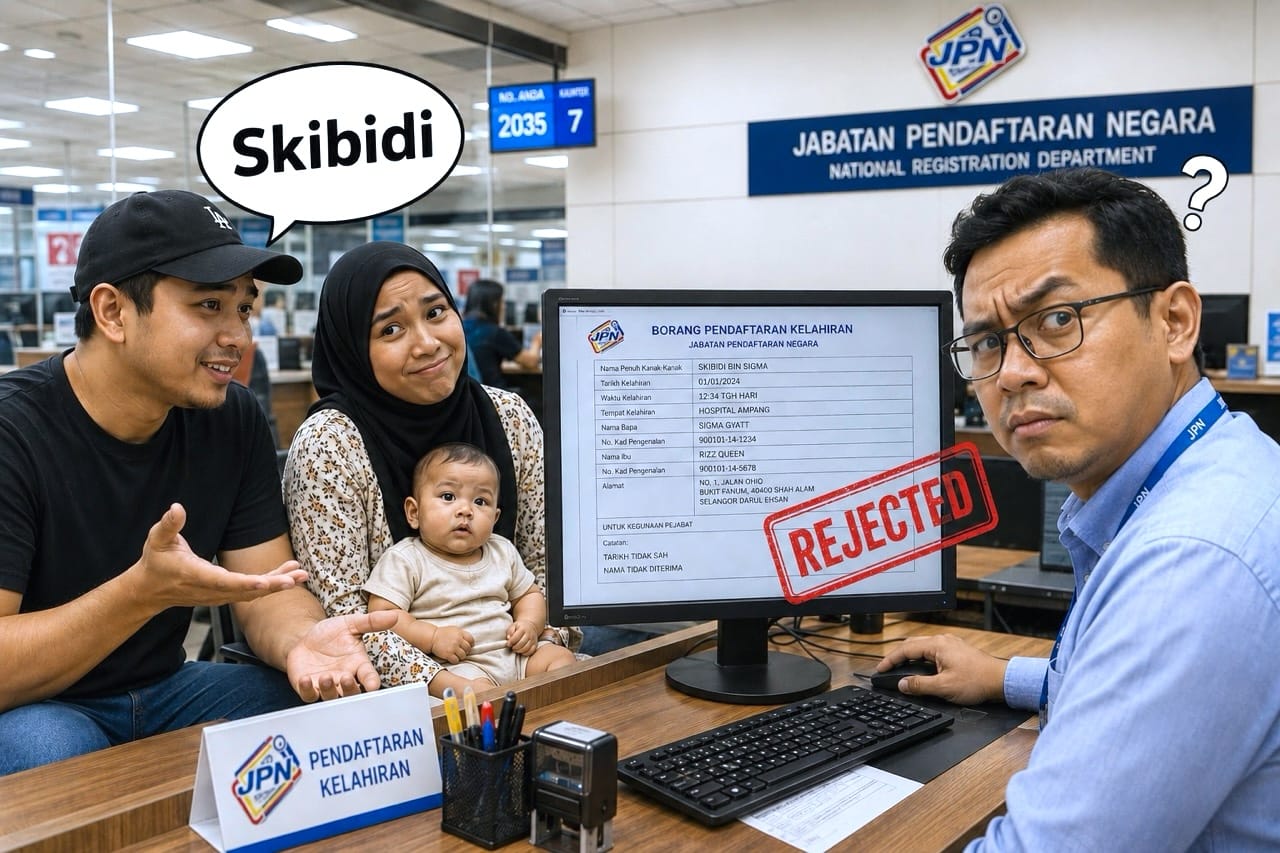
Somewhere out there, a parent tried to register their baby as "Skibidi." We don't know how that conversation at the JPN counter went, but we can guess.
The National Registration Department recently had to remind Malaysians, in writing, that "skibidi" is not an acceptable baby name. Not because of some new law, but because enough hopeful parents apparently needed the reminder. Which tells you everything about where we are as a society in 2026.
The Names JPN Actually Rejected
The list of names JPN has flagged as unacceptable reads like a fever dream of internet culture colliding head-on with a government form. "Mipan zuzu." "Nur Sayunx." "MybabyGirl," capital letters and all. "Siti Nurtizen," presumably named after a certain someone's comment section. "Sailormoon" and "Ultraman," for parents who wanted their child's birth certificate to double as a merchandise tie-in. And yes, "skibidi," a word whose meaning changes depending on which TikTok you last watched, but is never quite appropriate for an official document.
Then there's the typo tier. "Chuynx" (short for "sayang," or "darling"). "Ytjt" ("yang tau je tau," Malaysia's answer to "iykyk"). "Usyux" (a stylised "busuk," meaning smelly). JPN, reasonably, wants names people can actually read out loud without squinting.
The Real Rules Behind the Rejections
Behind the funny examples is an actual legal framework, not just JPN being fussy. Under Section 16 of the Births and Deaths Registration Act 1957, the Registrar has the power to reject a name deemed undesirable. That covers names with offensive meanings, names that are really just abbreviations strung together, names referencing professions like "Doctor" or titles like "Datuk" and "Tan Sri" that can only be officially bestowed, and names lifted straight from nature or the animal kingdom, think "Harimau," "Hujan," or "Batu."
Lineage titles like Syed, Syarifah, Megat and Wan need proof of actual ancestry before they're allowed. And there's a hard 80-character limit on the full registered name, spaces and "bin" or "binti" included, which still leaves enough room for some genuinely ambitious combinations.
Did You Know "Mohd" Has Been Quietly Banned For Decades?
Here's the twist nobody saw coming. JPN confirmed in a viral post this year that "Mohd" hasn't been an acceptable spelling for new birth registrations for decades. It has to be spelled out in full, "Mohamad," "Muhamad," or "Muhammad." Same goes for "Abd," which needs to become "Abdul." The rule isn't new, some accounts trace it back to the early 1990s, but because it only affects new registrations, millions of Malaysians already carrying "Mohd" on their IC never noticed anything changed. JPN's own social media team even joked that the shrinking population of "Mohd"-named Malaysians is basically becoming national heritage at this point.
My Two Boys Got Simple Names On Purpose
When it came to naming my own two sons, my wife and I deliberately kept things simple. Names that are easy to remember, easy to spell, easy to say out loud to a teacher or an immigration officer, but still distinct enough to feel like theirs. I've come across names on the other end of the spectrum, ones so long and layered that even the parents' close friends struggle to recall the first three words, let alone the full string. I get the instinct behind it, every parent wants their child's name to carry meaning and hope. But a name gets used thousands of times over a lifetime, and if it takes effort just to say, that's a cost the child pays every single day, not the parent.
A Name Sounding Nice Doesn't Mean It Means Something Nice
This is where it gets genuinely interesting rather than just funny. Take "Jamal," a hugely popular name across the Muslim world, generally understood to mean "beauty." The name shares its root with the Arabic word for camel, a linguistic overlap that's sparked plenty of good-natured jokes over the years about parents unknowingly naming their sons after a very beautiful desert animal. It's not technically the same word, different spelling, different vowel, but the confusion is common enough that it's worth knowing before you fall in love with a name purely for how it sounds.
And it's not just an Arabic problem. Just across the causeway, Singapore has its own famous case in Batman bin Suparman, a completely real, legally registered name that became an international news story purely because nobody stopped to think about how "Batman, son of Suparman" reads on official paperwork everywhere else in the world.
Is JPN Overstepping?
Not everyone agrees JPN even has the legal standing to reject names this freely. As far back as 2018, constitutional lawyer Nizam Bashir argued that the Births and Deaths Registration Act 1957 doesn't actually give the government the authority to determine what a child is called, only the mechanics of registering the birth. It's a fair legal question that's never been fully tested in court.
But personally, I land on the side of sensible protection here. A name isn't just a label, in plenty of belief systems it's thought to shape character and identity over a lifetime. That said, naming a child "Batman" doesn't make him leap off buildings at seventeen, so there's clearly a line between genuinely harmful names and ones that just make for a good story at a dinner party.
My Take
If there's one thing I'd tell any parent picking a name right now, check what it means in every language your child is likely to encounter, not just your own. A name that sounds beautiful to you might carry a completely different meaning somewhere else, and your child is the one who has to live with that, not you. Keep it simple, keep it meaningful, and maybe leave "Skibidi" for the family group chat instead of the birth certificate.
Kamarul Azwan (k.azwan@gmail.com) is a content creator under the Newswav Creator programme, where you get to express yourself, be a citizen journalist, and at the same time monetize your content & reach millions of users on Newswav. Log in to creator.newswav.com and become a Newswav Creator now!
The User Content (as defined on Newswav Terms of Use) above including the views expressed and media (pictures, videos, citations etc) were submitted & posted by the author. Newswav is solely an aggregation platform that hosts the User Content. If you have any questions about the content, copyright or other issues of the work, please contact creator@newswav.com.