
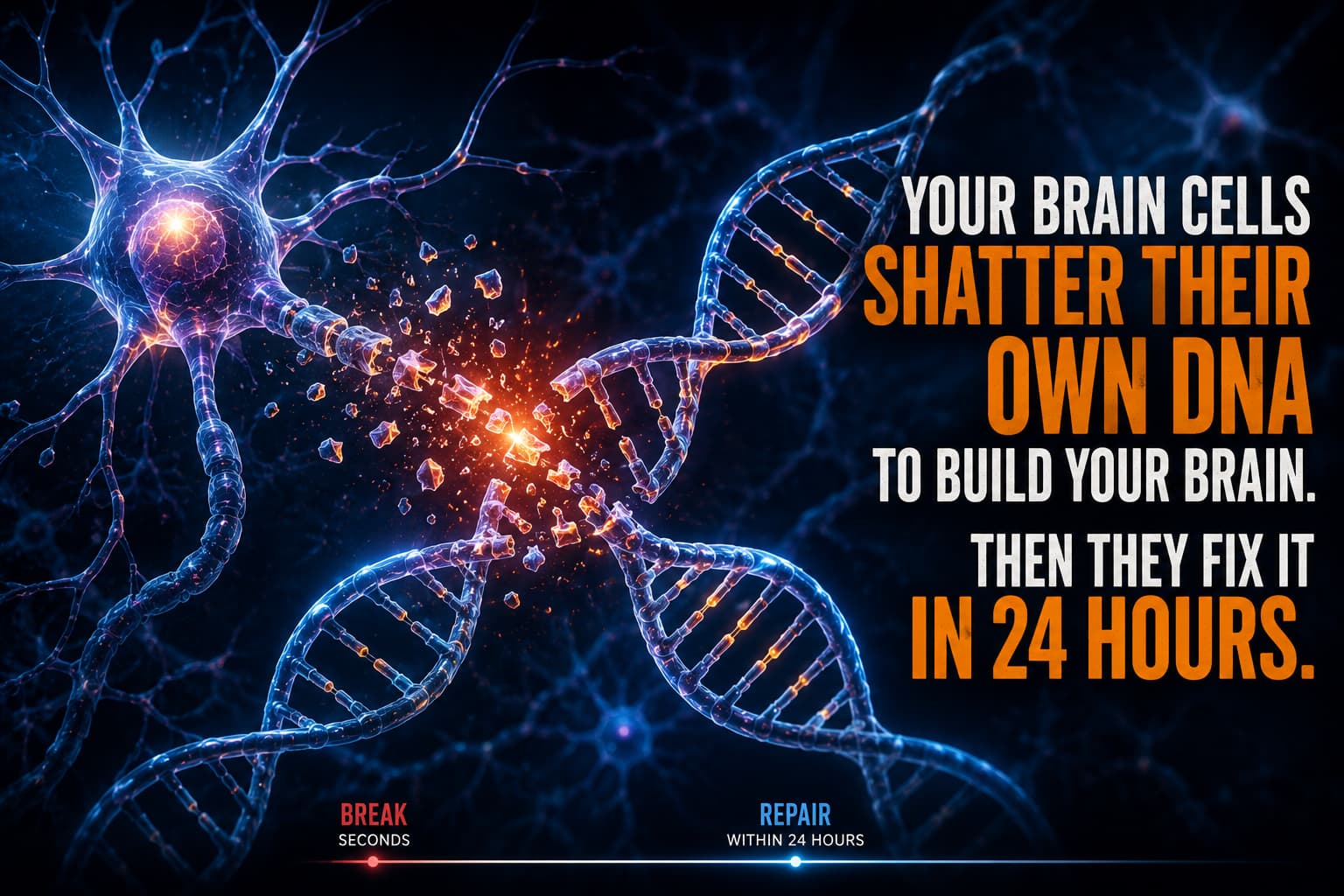
Building a healthy brain involves a step that sounds like it should be catastrophic. Young neurons routinely break their own DNA, completely severing both strands of the double helix, as they squeeze through crowded tissue during development. And then they repair the damage within a day.
A study published in Nature in June 2026 by researchers at Kyoto University revealed that this process is a normal, routine feature of brain formation. It is not a malfunction. It is not a rare event. It happens on a massive scale as the brain builds itself.
During development, newly formed neurons must physically travel through densely packed tissue to reach their final positions in the cerebral cortex. This journey forces each cell through extremely narrow gaps between fibres and neighbouring cells. The research team mimicked this journey by guiding neurons through microchannels designed to replicate those tight spaces. Using fluorescent markers, they watched DNA double-strand breaks appear as the cells passed through the channels, then gradually disappear after the cells emerged on the other side.
Most of the breaks were repaired within 24 hours, with no lasting effects on function.
The team traced the damage to an enzyme called Topoisomerase IIb, which normally makes temporary cuts in DNA to relieve twisting and mechanical strain during everyday cellular activity. Under the physical stress of migration through tight spaces, the enzyme gets trapped mid-process, leaving broken DNA ends behind. The cells then fix these breaks using a repair mechanism called non-homologous end joining, which reconnects the severed strands.
"The developing brain appears to have evolved to tolerate and repair the neuronal damage efficiently," said Professor Mineko Kengaku of Kyoto University's Institute for Integrated Cell-Material Sciences, who led the study. "But understanding the limits of that tolerance, and what happens when repair is incomplete, brings us closer to understanding a range of neurological conditions."
That last point is the real kicker. If the repair process fails or is incomplete, the accumulated DNA damage could contribute to neurodevelopmental disorders. Understanding this mechanism opens new research directions for conditions that have been difficult to explain at the molecular level.
The research was a collaboration between Kyoto University, the University of Tokyo, the University of Osaka, the National University of Singapore, and the Tokyo Metropolitan Institute of Medical Science.
What's most remarkable is the sheer scale of it. This is not a rare accident. It is millions of DNA breaks happening as a standard part of how every human brain is built.
Ronny M (ronny76netstuff@gmail.com) is a content creator under the Newswav Creator programme, where you get to express yourself, be a citizen journalist, and at the same time monetize your content & reach millions of users on Newswav. Log in to creator.newswav.com and become a Newswav Creator now!
The User Content (as defined on Newswav Terms of Use) above including the views expressed and media (pictures, videos, citations etc) were submitted & posted by the author. Newswav is solely an aggregation platform that hosts the User Content. If you have any questions about the content, copyright or other issues of the work, please contact creator@newswav.com.