
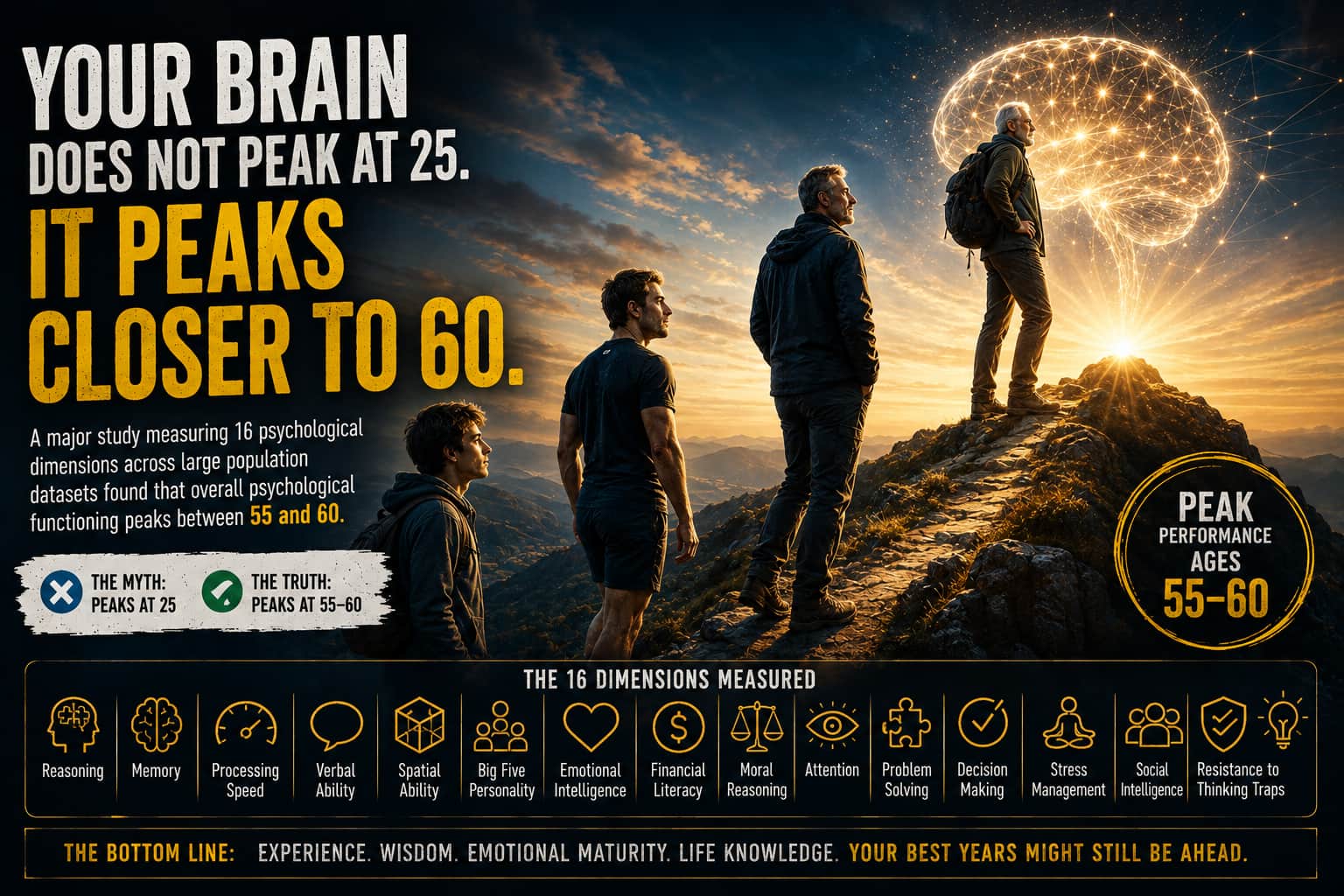
There is a widespread belief that the human brain hits its peak somewhere in the mid-twenties and then slowly declines. It is repeated in pop culture, self-help books, and even some scientific discussions. And according to a study published in the journal Intelligence, it is incomplete at best and misleading at worst.
Researchers Gilles Gignac from the University of Western Australia and Marcin Zajenkowski from the University of Warsaw measured 16 psychological dimensions across large population datasets. These included cognitive abilities like reasoning, memory, and processing speed, the Big Five personality traits, emotional intelligence, financial literacy, moral reasoning, and resistance to common thinking traps like the sunk cost bias.
When all 16 dimensions were combined into a single index, overall psychological functioning peaked between ages 55 and 60. Not 25. Not 30.
What happens is more nuanced than a simple rise and fall. Raw cognitive speed and fluid reasoning do decline from the mid-twenties onward. That part of the old narrative is accurate. But other abilities keep growing for decades. Crystallised intelligence, the accumulated knowledge and vocabulary you build over a lifetime, increases well into the 60s. Emotional intelligence peaks around the mid-40s. Conscientiousness peaks near 65. Emotional stability peaks around 75. Financial literacy and moral reasoning continue improving into late adulthood.
The decline after 60 is real, but even that comes with a fascinating detail. Under the researchers' comprehensive model, an 85-year-old scored at roughly the same overall level as an 18-year-old. The numbers came from completely different strengths, but the total functional capacity was equivalent.
The practical implications line up with what we already observe in the real world. People typically earn their highest salaries and reach peak occupational prestige between ages 50 and 55. Political leaders of major countries are most commonly elected in their mid-50s to early 60s. Charles Darwin published On the Origin of Species at 50. Beethoven premiered his Ninth Symphony at 53. Lisa Su, who led AMD through one of the most dramatic tech turnarounds in the industry, did so in her mid-50s.
This study matters because it pushes back against age discrimination in hiring and leadership. The assumption that older workers are in decline is, at best, only telling half the story. And the half it leaves out might be the more important one.
The researchers explicitly noted that individuals best suited for high-stakes leadership, judgment, or executive roles are likely to be between 55 and 60, and unlikely to be younger than 40 or older than 65. That is not a motivational poster quote. That is the data.
If you are in your 40s or 50s and wondering whether your best years are behind you, the science says no. They may literally be right in front of you.
Ronny M (ronny76netstuff@gmail.com) is a content creator under the Newswav Creator programme, where you get to express yourself, be a citizen journalist, and at the same time monetize your content & reach millions of users on Newswav. Log in to creator.newswav.com and become a Newswav Creator now!
The User Content (as defined on Newswav Terms of Use) above including the views expressed and media (pictures, videos, citations etc) were submitted & posted by the author. Newswav is solely an aggregation platform that hosts the User Content. If you have any questions about the content, copyright or other issues of the work, please contact creator@newswav.com.