Why do some dreams feel so vivid they could be memories, while others are a confusing mess of images you can barely recall? A large study out of Italy might have the answer. And it is not what most people assume.
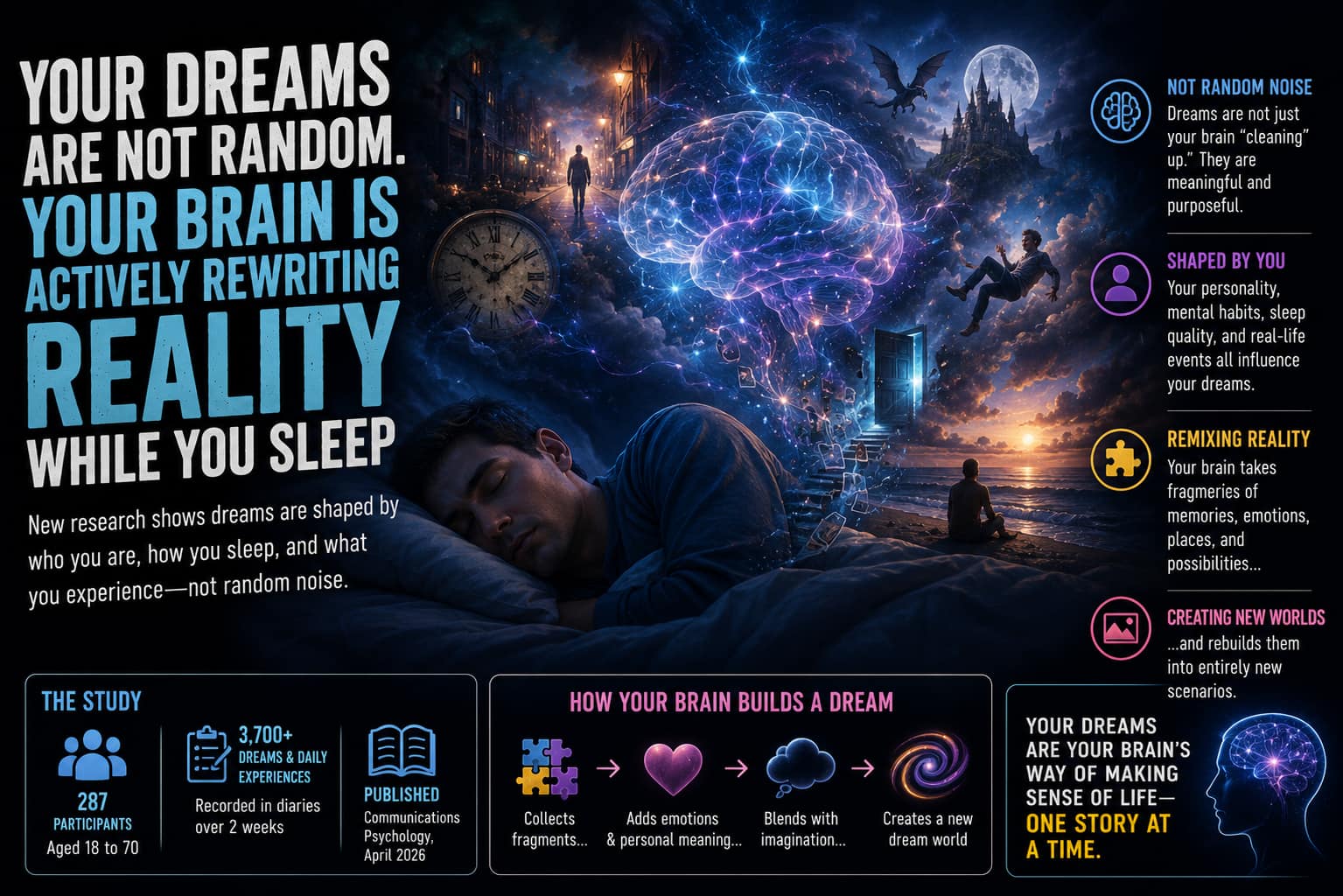
A research team at the IMT School for Advanced Studies Lucca analysed more than 3,700 descriptions of dreams and waking experiences from 287 participants, aged 18 to 70. The participants kept detailed diaries over two weeks, recording both their daily experiences and their dreams. The study was published in Communications Psychology in April 2026.
The findings challenge the common belief that dreams are just random noise from a resting brain. Instead, the researchers found that dreams are shaped by a combination of personality, sleep quality, mental habits, and major real-world events. The brain does not simply replay the events of the day. It takes fragments of memories, emotions, familiar places, and imagined possibilities, then remixes them into entirely new scenarios.
Familiar settings like offices, schools, and hospitals did appear in dreams, but they were never reproduced exactly. They were distorted, recombined, and merged with other elements. The brain actively reconstructs reality rather than passively reflecting it.
The study also found that individual traits strongly influence dream content. People who tend to let their minds wander during the day reported more fragmented and rapidly shifting dreams. People who placed greater meaning on their dreams experienced richer, more immersive ones. Poor sleep correlated with less structured dream narratives.
The researchers then compared their primary dataset with a second set collected during the COVID-19 lockdown of 2020 by Sapienza University of Rome. Dreams during that period were measurably more emotionally intense and more likely to involve themes of confinement and restriction. Global events were literally reshaping what people experienced while asleep.
The team used advanced natural language processing tools to analyse the dream reports at scale, achieving accuracy comparable to human evaluators. This allowed them to examine the meaning and structure of thousands of dreams in detail, something that was not possible in earlier, smaller studies.
My Opinion
This study is one of those rare pieces of research that makes you rethink something you experience every single day, or more accurately, every single night. Your brain is not just shutting down while you sleep. It is running a remix studio, pulling in scraps of your personality, your worries, your memories, and stitching them into something entirely new. The idea that your dreams literally changed during COVID, not because of personal stress but because of a shared global experience, is wild. It suggests that we are all, in some quiet way, dreaming together.
Ronny M (ronny76netstuff@gmail.com) is a content creator under the Newswav Creator programme, where you get to express yourself, be a citizen journalist, and at the same time monetize your content & reach millions of users on Newswav. Log in to creator.newswav.com and become a Newswav Creator now!
The User Content (as defined on Newswav Terms of Use) above including the views expressed and media (pictures, videos, citations etc) were submitted & posted by the author. Newswav is solely an aggregation platform that hosts the User Content. If you have any questions about the content, copyright or other issues of the work, please contact creator@newswav.com.