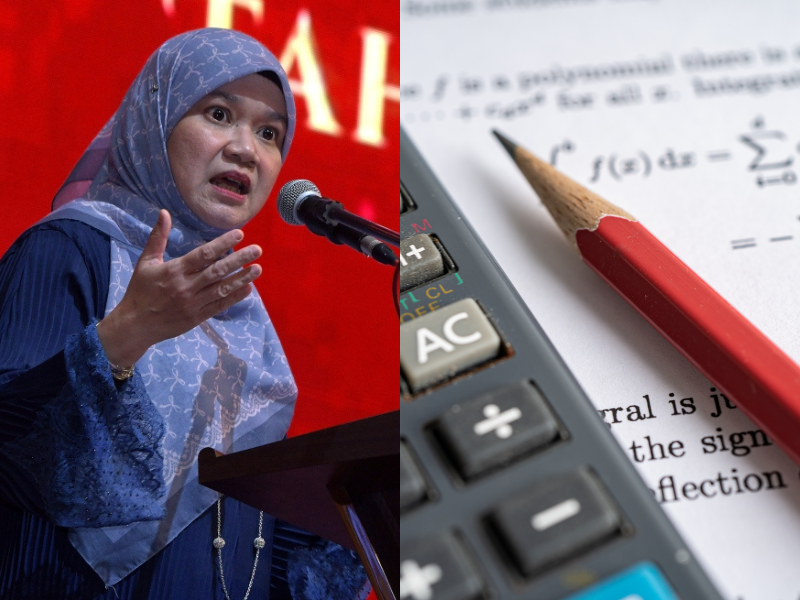
Every year during SPM results day, the sight of students showing their A+ grades all over social media has become a norm.
But between these moments of glory, there lies a stigma where people tend to perceive science stream students as more intelligent compared to their art stream counterparts.
But why does this occur?
Well to look at this issue, we have to travel back in time to the post-merdeka era. Where people were slowly understanding more and more about the cruciality of education and how a university degree oftentimes led to a higher paying position. For instance, in 2024, Malaysian graduates had a median monthly salary of RM4,521, compared with a national mean monthly wage of RM3,652.
As the colonial period of British rule had just ended, Malaysia faced a shortage of locally trained professionals. Medical education places were limited, for example, and expatriate doctors and specialists were used to fill key vacancies while the country expanded its own professional workforce. Hence, due to high demand, the job wages for these jobs were also higher compared to their alternatives. And since many people were still finding it difficult to maintain a stable lifestyle, mainly due to issues ranging from poor financial management, high rental costs, and even lack of adequate income, they opted for these jobs. Hence, the older generation tends to push their children towards becoming a doctor, engineer, etc which oftentimes require studying science subjects. I believe this is where the conception that science students are better than arts students come from.
However, times have changed, and likewise the required knowledge for success is not limited to these subjects anymore. If learnt properly, an arts student can just be as successful or if not even better than a science student.
Take for instance, the UI you're reading right now is made up of code that a computer science student made up, but that UI isn't nearly as effective without the psychological studies done behind it.
Factories that mass produce hardware, furniture, and other appliances are only profitable if they actually sell, and that requires constant monitoring, proper budgeting, and actual monetary guidance.Without the financial strategist to balance the books, the marketer to capture the audience, and the manager to lead the workforce, the grandest innovations of science would simply sit gathering dust in a warehouse.
This interdependence highlights the fatal flaw of our traditional mindset: we have spent decades treating science and arts as rivals, when they are actually two halves of the same coin.
The Saturation of the "Safe" Path
While society was busy looking down on the arts, the economic landscape silently shifted beneath our feet. The traditional, high-paying professions that parents once pushed their children into out of survival are no longer the bulletproof guarantees they used to be.
Take a look at the current landscape in Malaysia. The old promise that a science degree automatically translates into financial security is more complicated than it once appeared. A degree still carries a substantial earnings premium, but graduate outcomes vary considerably according to occupation, industry, location and skill level. Even medicine, once seen as one of the safest routes to professional security, faces its own workforce pressures. A Ministry of Health document reporting on Malaysian Medical Association data noted that resignations among contract medical officers increased from 110 in 2017 to 1,354 in 2022.
The Malaysian economy itself shows why the arts cannot simply be dismissed as an economic dead end. In 2024, the country's cultural and creative industry contributed RM130.7 billion, equivalent to 6.8% of GDP. Today, high-level corporate strategists, digital marketing directors, financial consultants, and corporate lawyers are commanding salaries that easily match, or even vastly exceed, those of standard technical roles. The modern economy does not just reward those who can build a machine; it heavily rewards those who can sell it, scale it, and legally protect it.
The Power of the Polymath
In the age of Artificial Intelligence and rapid automation, the line between "science" and "art" is blurring entirely. AI can write basic code and calculate formulas in seconds. What it cannot do is replicate human empathy, cultural nuance, strategic ethics, and creative storytelling—the very core of an arts education. When we tell an arts student they are "lesser than," we blind ourselves to the fact that they are mastering the exact soft skills—critical thinking, emotional intelligence, and persuasive communication—that global employers now value above all else.
Dismantling the SPM Day Stigma
As the next batch of SPM results rolls in, and social media inevitably fills with glittering rows of A+ grades, we need a collective shift in perspective. A student who scores straight As in Literature, History, and Economics is exercising a level of conceptual synthesis, critical argument formulation, and textual analysis that is easily as intellectually demanding as memorizing chemical bonds or solving calculus.
It is time to outgrow the post-Merdeka survival anxiety. The rigid streaming system that once siloed our youths into "smart" and "not smart" is an outdated relic of a bygone era.
We must stop measuring a student’s worth by the tools they use, whether it is a stethoscope or a paintbrush, a calculator or a keyboard. Success in the modern world belongs to those who can think critically, adapt quickly, and bring unique value to the table. Science may give us the mechanics to survive, but it is the arts that give us the reason, the culture, and the economy to thrive.
Jaden W (wmjaden3@gmail.com) is a content creator under the Newswav Creator programme, where you get to express yourself, be a citizen journalist, and at the same time monetize your content & reach millions of users on Newswav. Log in to creator.newswav.com and become a Newswav Creator now!
The User Content (as defined on Newswav Terms of Use) above including the views expressed and media (pictures, videos, citations etc) were submitted & posted by the author. Newswav is solely an aggregation platform that hosts the User Content. If you have any questions about the content, copyright or other issues of the work, please contact creator@newswav.com.