
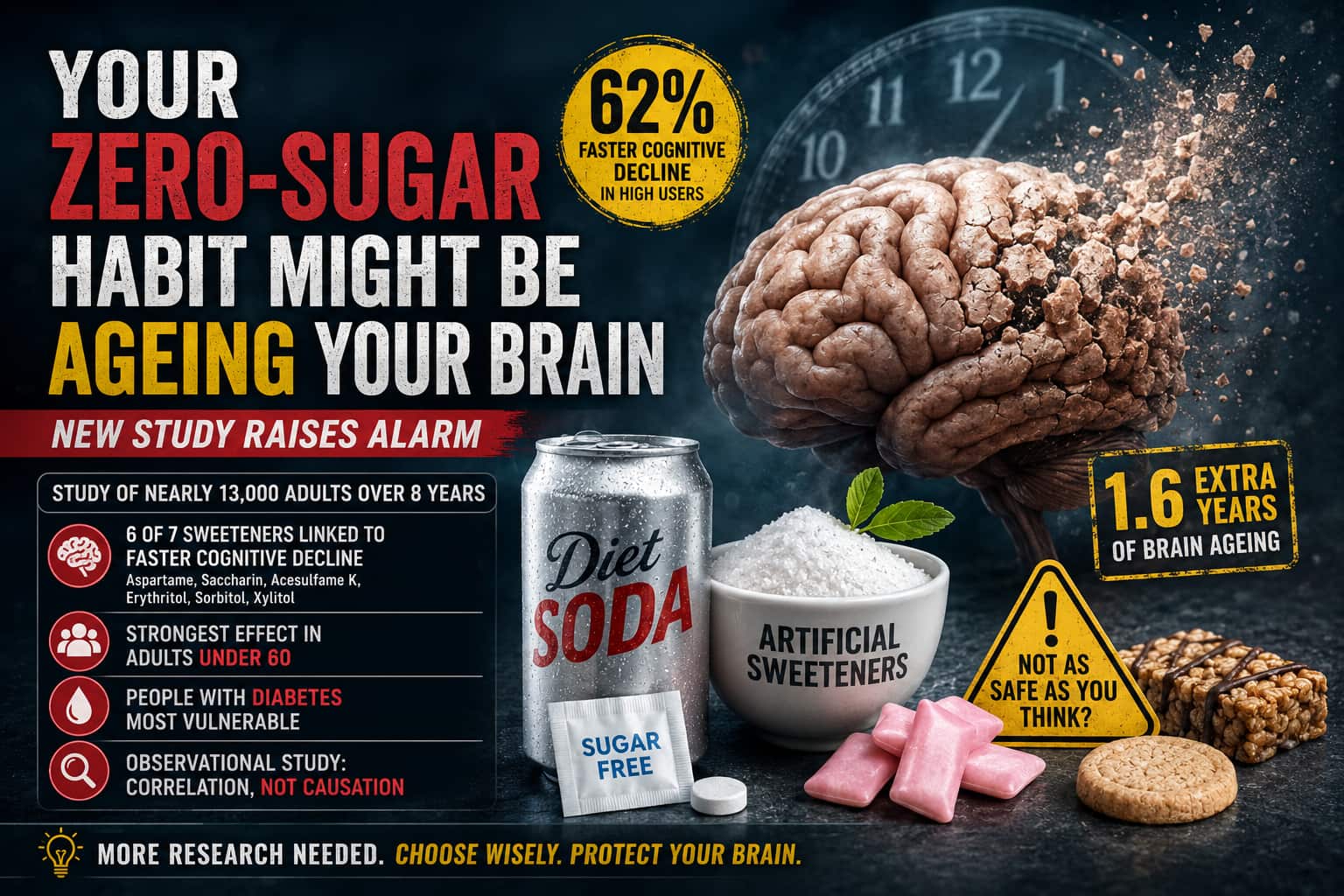
The pitch sounds reasonable. Swap sugar for artificial sweeteners, cut calories, dodge diabetes. Millions of people make that trade every day, choosing diet sodas, sugar-free snacks, and zero-calorie drink mixes without a second thought. But a large study tracking nearly 13,000 adults over eight years suggests those substitutes might come at a cost nobody expected.
Published in Neurology, the journal of the American Academy of Neurology, the research followed participants from the Brazilian Longitudinal Study of Adult Health (ELSA-Brasil). The team measured cognitive function at three points over the study period and tracked how much artificial sweetener each person consumed.
The results were striking. Adults who consumed the most artificial sweeteners, averaging 191 milligrams per day, showed a 62% faster decline in overall thinking and memory skills compared to those who consumed the least, around 20 milligrams per day. In practical terms, the researchers estimated that high intake was associated with roughly 1.6 extra years of brain ageing.
Six of the seven sweeteners tested showed a direct link to faster cognitive decline: aspartame, saccharin, acesulfame potassium, erythritol, sorbitol, and xylitol. Tagatose was the only sweetener that did not correlate with cognitive decline.
The effect was not uniform across all age groups. The association between sweeteners and brain decline was strongest in adults under 60. In people over 60, the link disappeared. People with diabetes showed a particularly high vulnerability, which is concerning because diabetics are among the most frequent users of sugar substitutes.
The researchers were clear that the study does not prove artificial sweeteners directly cause cognitive decline. This is an observational study. It shows a correlation, not a mechanism. There could be other factors at play, including the possibility that people who consume more sweeteners also eat more ultra-processed food, which has its own documented links to poorer health outcomes.
That said, the size of the study and the length of the follow-up period make it hard to dismiss. Nearly 13,000 people across eight years is a serious dataset. And the 62% figure is large enough to raise genuine concern.
What makes this particularly tricky is that artificial sweeteners have been marketed as the healthy alternative for decades. Governments have approved them. Food companies have reformulated entire product lines around them. Telling consumers that these substitutes might carry risks of their own undermines a message that has been repeated so often it feels like settled fact.
The researchers suggested that more work is needed to confirm these findings and to investigate whether natural alternatives like honey, maple syrup, or coconut sugar might be safer options.
Have you been reaching for zero-sugar options thinking they are the healthier choice?
Ronny M (ronny76netstuff@gmail.com) is a content creator under the Newswav Creator programme, where you get to express yourself, be a citizen journalist, and at the same time monetize your content & reach millions of users on Newswav. Log in to creator.newswav.com and become a Newswav Creator now!
The User Content (as defined on Newswav Terms of Use) above including the views expressed and media (pictures, videos, citations etc) were submitted & posted by the author. Newswav is solely an aggregation platform that hosts the User Content. If you have any questions about the content, copyright or other issues of the work, please contact creator@newswav.com.