.png)
A RM6 billion gap between the Rural and Regional Development Ministry’s (KKDW) development funding request and its indicative allocation for 2027 is forcing the ministry to reassess its spending priorities amid tighter federal fiscal space.
Deputy Prime Minister and Rural and Regional Development Minister Datuk Seri Dr Ahmad Zahid Hamidi said KKDW had sought RM14.39 billion under the Second Rolling Plan of 2027 but was given an indicative development allocation ceiling of about RM8.3 billion by the Ministry of Finance (MOF).
The shortfall highlights the financial constraints facing the Federal Government as ministries compete for limited development funds, he said.
“Recently, we held a coordination session with the Ministry of Finance (MOF), the Treasury Secretary-General, and the Budget Director to present our priorities and submit proposals for consideration,” Zahid said.
“The indicative development allocation ceiling given by MOF is roughly RM8.3 billion against our application of RM14.39 billion, which leaves us with a RM6 billion gap.”
Zahid said the tighter fiscal environment meant KKDW could no longer approach budgeting simply as a matter of spending more or less.
Instead, departments and agencies under the ministry must ensure limited allocations produce the greatest possible benefits for rural communities.
He called for existing programmes to be reviewed to identify projects that are outdated, duplicated or no longer address current needs.
Funding should also be redirected from lower-value initiatives towards projects capable of delivering measurable improvements to rural communities, he said.
“Budgeting is a process of converting limited resources into the greatest possible public value,” Zahid said.
“In an environment of constrained resources, efficiency does not simply mean spending less; it means spending more precisely.”
The ministry’s approach will place greater emphasis on eliminating duplication, prioritising high-impact projects and assessing the opportunity cost of every development allocation as it prepares its proposals for the 2027 rolling plan.
Zahid also has expressed anger over delays in payments to contractors carrying out development projects under the Rural and Regional Development Ministry (KKDW), warning that the problem is threatening the survival of businesses across the supply chain.
Zahid said some contractors had completed work and achieved the progress required under their contracts, including Rural Roads (JALB) projects, but were still waiting for payment.
He said the delays had created serious cash-flow problems, with some contractors forced to shut down while others faced lawsuits from material suppliers and subcontractors.
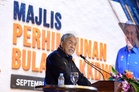
"How many contractors have already closed down? How many of them have been sued by material suppliers? How many subcontractors have sued the contractors?" he said during the KKDW monthly assembly Putrajaya today.
Zahid said the ministry was being blamed for the delays even though some of the underlying causes lay elsewhere.
"KKDW is being blamed, but the cause lies elsewhere," he said.
He warned that delayed payments did not affect contractors alone, but also suppliers, smaller contractors, workers and service providers throughout local economic chains.
According to Zahid, a single delayed payment can trigger a much wider economic impact than the value of the payment itself.
"I understand the fiscal constraints we are managing, but this matter needs to be handled more sensitively. I would like to request that the relevant parties give serious attention to this issue," he said.
Zahid also criticised the implementation of allocations, saying spending did not always correspond with approved budgets.
"Budget allocations that have been announced must be channelled! Do not implement projects that have no allocation in the budget.
"Those who should be paid are not being paid, while those who do not need to be paid are being paid. Things that are 'not budgeted for' are being carried out, while those that are 'budgeted for' are not being implemented. That is the problem before us. I am not angry, I am just 'hot'," he said.
He said sound fiscal management was not simply about controlling expenditure, but also ensuring that existing government commitments were handled responsibly.
With only four months remaining in the year, Zahid instructed KKDW to minimise new commitments and concentrate on completing projects and obligations that had already been started.
He also ordered all divisions, departments and agencies under KKDW to launch a 'Zero Pending Operation' to resolve outstanding issues and projects before the end of the year.
The operation will cover delayed projects, payments, land and utility matters, contracts, assets and pending decisions.
Zahid said every outstanding issue must have a clearly identified person responsible for resolving it, a deadline and a clear decision.
"Problems must no longer be carried from one meeting to another without anyone being truly responsible for resolving them," he said.
The directive underscores the government’s focus on ensuring approved development allocations translate into actual project delivery and timely payments, particularly as fiscal constraints continue to put pressure on public spending. - September 1, 2026