

Jack Huang still enters local show jumping competitions in Taiwan. In December, the vice president of the Fédération Equestre Internationale (FEI) will face a contest of a different kind: he is one of three candidates running to lead the sport's world governing body.
The FEI's member national federations will choose a new president on December 5 at the organization's General Assembly in Jiangyin, China. If Huang wins, he will become the first FEI president from East Asia since the federation was founded in 1921.
When 1% Style met him one afternoon, Huang mentioned that he had another competition that same week. It was only a small domestic event, he said with a smile. "But whenever I have the chance, I still want to go and compete." He knew early on, he added, that he was unlikely ever to be a top rider. He loved riding anyway, and that is why he has always wanted to do more for the sport.
The FEI is the global governing body for equestrian sport recognized by the International Olympic Committee, overseeing international competition in show jumping, dressage, eventing, and other disciplines. Its president chairs the General Assembly and the board, sets board agendas, and represents the federation in dealings with bodies such as the IOC. The General Assembly holds final decision-making power, so when member federations disagree over a rule, the president plays a central role in opening dialogue and building consensus.
Huang also chairs FEI Group VIII, the federation's regional group for Asia and Oceania. In his early years with Taiwan's equestrian association, his goal was simple: give Taiwanese riders more chances to compete abroad. Once he took responsibility for the wider region, he began hearing other federations describe the same ambition and realized that the hardest step looked different in every country. He has spent much of the past several years on airplanes, flying almost every month. Asked how he has kept going so long, he credited passion, and that passion began somewhere very personal.
His Father's Recovery Led Him Into The Saddle
Huang once spent 100 days at his father's hospital bedside. Doctors issued a critical-condition notice, and he watched his father lying there without knowing how much time he had left. Later, returning to Taiwan from abroad, he found that his father, who had needed crutches and a wheelchair, was now riding a horse, enjoying it, and getting his confidence back.
"I was more moved than shocked," Huang said of that moment. His father had played baseball as a young man and had brought his golf handicap down to single digits. Seeing him doing something he loved again changed things. "It gave me a different feeling about riding."
When the summer holidays came, his father encouraged him to try it, and he tagged along to the stables. What kept him coming back was discovering that riding was far harder than he had expected, "especially working together with a horse." At his first show jumping competition, he only hoped to finish the course. He went clear without knocking down a single rail and won. Years later, he still credits the horse. "I was still learning, but it seemed to know it was in a competition, and it carried itself all the way to the finish."
Another horse he cannot forget is SoWhat. At one rainy competition, with water pooling on the arena, the horse, which rarely refused a fence, suddenly stopped in front of one. Huang stayed on, circled, and rode at the same fence again. This time, while they were still some distance away, he felt SoWhat surge forward and clear it. "To me, that jump was like its answer to the unexpected stop."
His current horse, Victor, has taught him something too. Huang used to ride with spurs. After months of adjusting their training with his coach, he can now jump Victor without them. "A horse can't speak. You have to watch how it responds to know whether you need to change what you're doing." He sees the same lesson in his business career. "A lot of conditions are out of your hands. You first have to see clearly what is happening in front of you before you know what to do next."
Show Jumping Decisions Come Down To A Few Strides
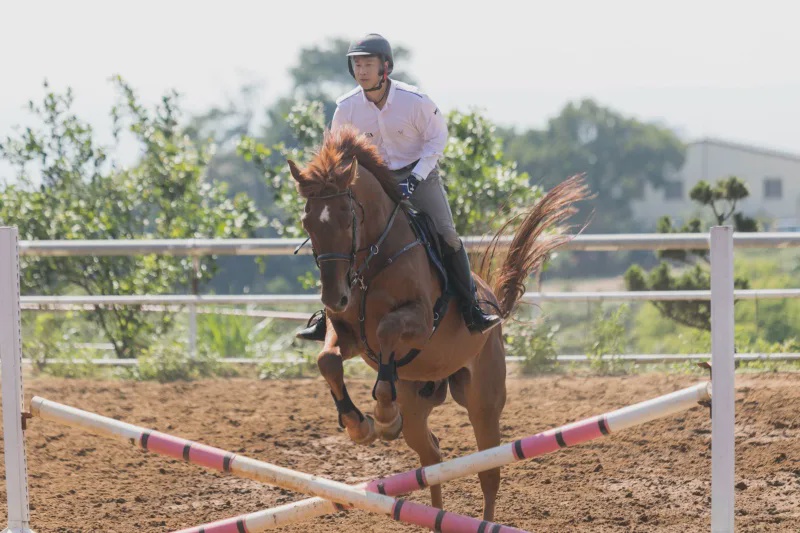
During the interview, the conversation turned to show jumping as a sport of intelligence. "Very much so," Huang said. A rider can plan the route in advance, but at the fence the horse's stride, speed, and reaction may force a change of plan. When SoWhat stopped in the rain and Huang circled back, the fence was the same, but horse and rider had to find a new rhythm for takeoff.
Compare it with sprinting. A sprinter also needs rhythm and must react quickly under pressure, but from the start to the finish line, the athlete controls only their own body. In show jumping, rider and horse produce the result together. Beyond reading the course and timing the takeoff, the rider has to sense how the partner is feeling in that moment. With only a few strides left, should they hold the pace or shorten the stride? The decision takes a split second, but the understanding between horse and rider is built slowly, day by day.
That is where Huang sees promise in Taiwanese riders. He values coordination, a feel for the horse, and the ability to adapt when conditions change. A good horse gives a rider more room, he said, but in the arena it still comes down to how the two work together. What concerns him more is whether Taiwan can connect the stages of training, from a first riding lesson to finding the right horse, having a coach, and getting enough competitions to build experience. Missing any one of those steps can make someone who wanted to keep riding give up. "But Taiwan does have real advantages for development."
Translated Guidelines Could Reach Coaches In Smaller Federations
Huang's FEI role fills his calendar with regular meetings, competitions, seminars, and federation events in many countries. He took it on simply to do something for a sport he loved. Over time, he made friends around the world and saw places he might never have visited, and he learned that people who love the same sport may start riding under very different conditions.
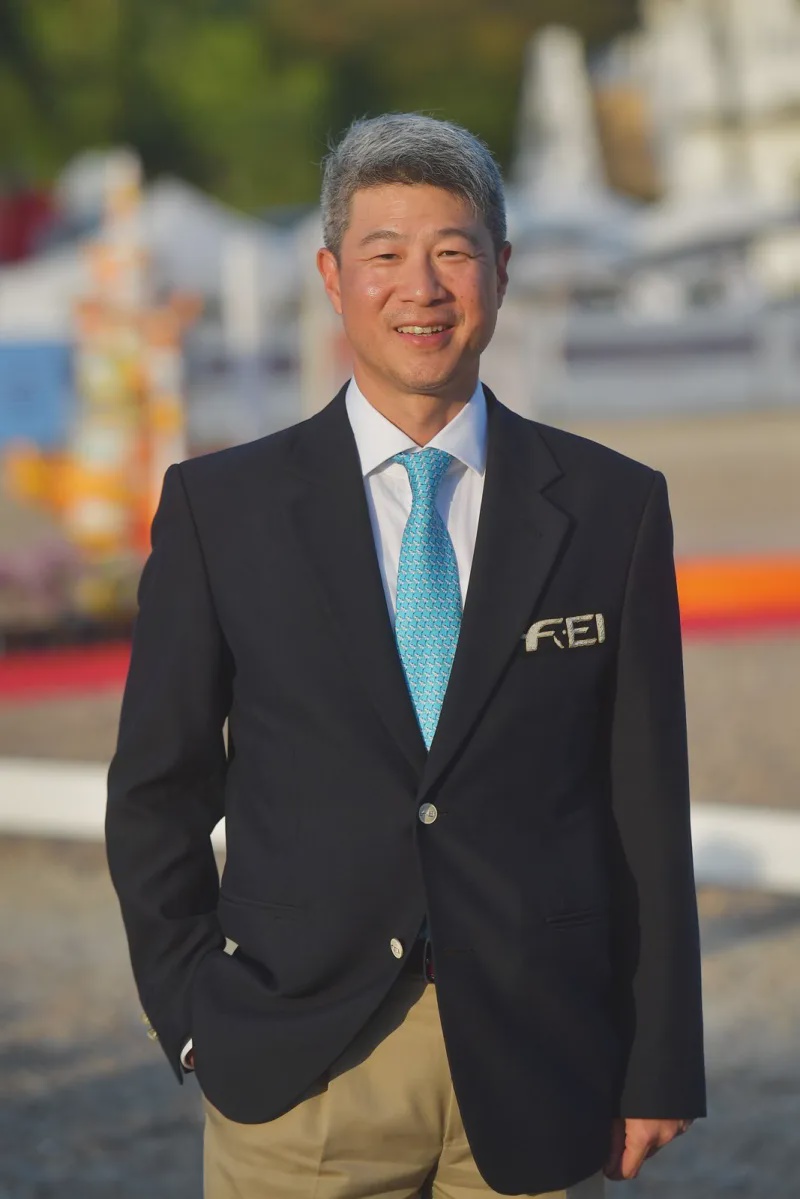
Huang grew up between Eastern and Western cultures. When he disagrees with someone, his habit is first to understand why they see things the way they do, and then to explain his own view in terms they are familiar with. He values the connections sport creates: people from different places finally have something to sit down and talk about, and in doing so they discover that what each side takes for granted may not be shared.
A single English-language training guideline shows how wide that gap can be. When FEI headquarters sends out a document, a federation with translators can pass it on to coaches. At a federation with few staff, the information may stop there. Coaches and riders can miss new knowledge about horse care, or training resources they could have applied for. Huang, who comes from the technology industry, wants to use AI to help translate such material so coaches can read it in a language they know. Headquarters also needs to hear back from members, he said, to learn which recommendations can be used right away and which require more staff, equipment, or training.
Cross-border horse transport and quarantine is the other issue he wants to keep pushing. Working on it across the region, he found that whether a rider can compete is sometimes decided before the horse ever reaches the venue. Riders care about the horse arriving on time, while quarantine authorities must weigh the disease risks that moving animals can bring. Which requirements must stay and which procedures have room for coordination has to be worked out between federations and regulators in each place. He also hopes to use his connections in the tech industry to find partners and secure resources for federations that are still developing.
Horse Welfare Hinges On The Other 23 Hours
Whether equestrian sport keeps its place at the Olympics a decade from now will take sustained effort from the people who love it, Huang said. He wants more spectators to understand the partnership they see in the arena. But he was frank that the sport's future depends on public acceptance and on continued work on horse welfare. "This is a perspective we have to pay attention to." He puts welfare at the center because public trust depends on whether people know how horses are treated when they are not competing.
Competitions have judges, veterinarians, and event management. What Huang cares about more are "the 23 hours outside competition." On ordinary days, how does a horse spend its time in the stable? How is it trained? Where can the people who look after it learn better methods? He wants the FEI to bring knowledge about care and training to the local level, and to give the public a chance to see this work, which usually goes unnoticed.
He drew on his daughter's experience at the stables. When it is feeding time, someone has to feed the horses. In the saddle, a child has to work out how to complete each movement together with the horse. "After a competition that didn't go as you hoped, you also have to decide for yourself whether you'll come back and train again next time. All of that is part of what equestrian sport teaches you." These are the things he wants more parents to see, the ones that never appear on a results sheet.
Huang Wants Every Federation To Shape The Sport
Huang said he is running with confidence in the sport, and part of that confidence comes from the changes he has seen in Asia and Oceania. Over the years, he has worked on programs to support local federations and has watched the standard of riders at Asian competitions steadily rise. To him, that progress shows that with more training and more chances to compete, riders can go further than anyone first imagined.
When he first started working for Taiwan's association, he wanted Taiwanese riders to get out into the world, and he wanted to learn how other countries had built the sport into something substantial. After years of travel, he has seen that every place has its own way of developing riders and caring for horses, and each has something others can learn from.
If elected, he hopes federations with fewer resources will get the chance to develop their own riders, and that long-established federations will look at their familiar sport afresh through others' approaches. "The next step for world equestrian sport will be taken together by people from many more places," he said. "That is what I look forward to most."
You've read it. Now join the conversation — follow us on X, Facebook and IG. Editor: Penny Wang