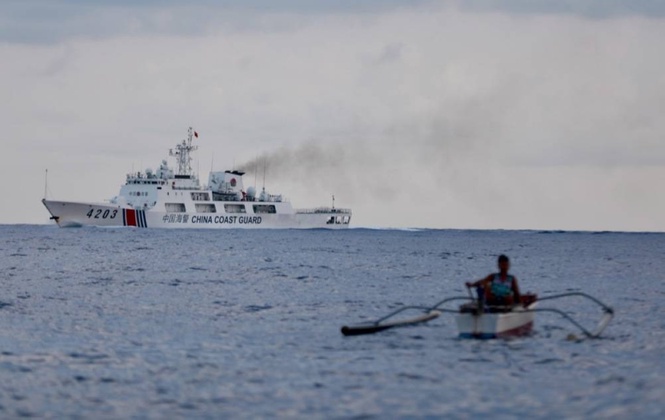
A 21-DAY stay by a Chinese marine research vessel inside Bajo de Masinloc (Scarborough Shoal) should prompt the Philippines to examine not only what China was studying but also how the information gathered could be used in the future, a national security expert said.
Jose Antonio Goitia said the length of Chinese marine geological survey ship Haiyang Dizhi Shi Hao's presence inside Bajo de Masinloc warranted scrutiny regardless of its stated research purpose.
“The temporary presence today can become the accepted reality of tomorrow if it is allowed to continue unchecked,” Goitia said.
The Haiyang Dizhi Shi Hao, operated by China's Guangzhou Marine Geological Survey, was inside the shoal from Aug. 11 to Sept. 1.
The vessel is designed for marine geological surveys and is capable of examining the seabed and shallow subsurface. It is equipped with a stern-mounted A-frame used to deploy and retrieve survey and scientific equipment.
Goitia said marine geological surveys can generate detailed information about seabed conditions and the shallow subsurface. Such data have legitimate scientific applications but can also be relevant to marine engineering and the planning of future activities at sea.
For the Philippines, Goitia said the concern is therefore not simply whether China is conducting research, but what information is being gathered and what it could eventually support.
The incident also comes amid other unusual Chinese activities around Bajo de Masinloc this year.
In May, a floating platform or raft was spotted inside the shoal and was reportedly linked to Chinese research vessels. The presence of a drilling-capable survey vessel for nearly three weeks adds another development that warrants close monitoring, Goitia said.
“Any single incident might have an explanation. A pattern is harder to wave away,” he said.
Goitia pointed to Panganiban (Mischief) Reef as a reminder of how seemingly limited Chinese activities in the West Philippine Sea can evolve over time.
China established its first structures at Panganiban Reef in 1995, initially describing them as shelters for fishermen. The outpost eventually developed into a major artificial island with an airfield and military facilities.
Goitia said the Philippines should not dismiss incremental activities simply because they are initially presented as temporary or civilian in nature.
“Sovereignty is rarely lost all at once,” he said. “It is gradually eroded when challenges to it are repeatedly allowed to pass unanswered.”
The Philippines maintains sovereignty over Bajo de Masinloc and its maritime rights in the area. Goitia said activities that could potentially alter the status quo should be examined while they are taking place rather than only after their consequences become apparent.
“Our sovereignty cannot be traded, surrendered, or made a subject of negotiation,” he said.