
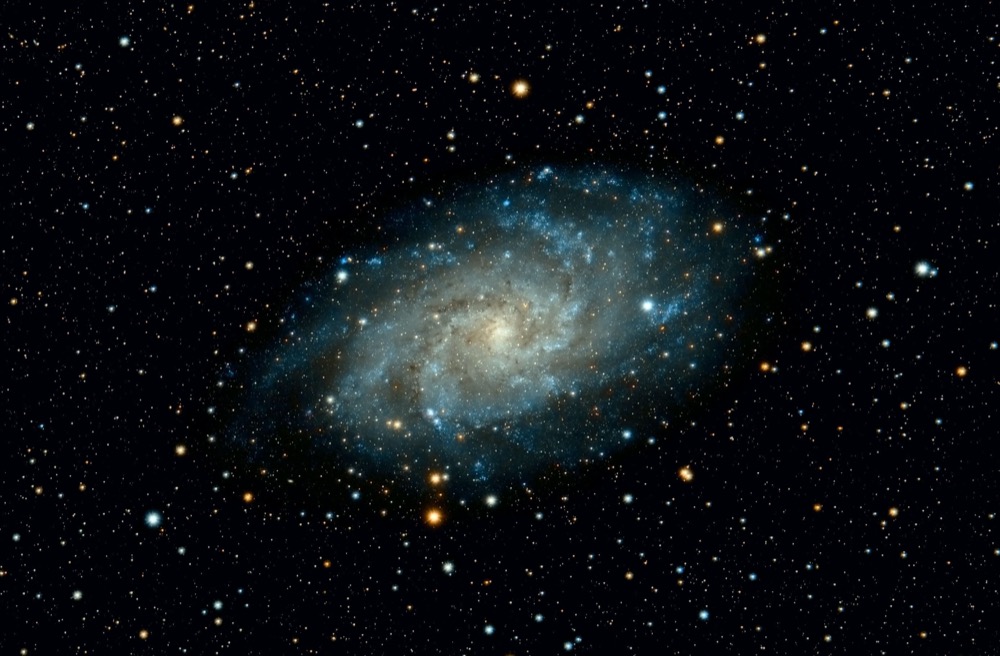
Astronomers have achieved one of the most precise measurements ever made of the Milky Way’s distant spiral arms, revealing that parts of our galaxy lie farther from Earth than long-established maps predicted. The breakthrough, published in Astronomy & Astrophysics, relies on an innovative method that uses the delayed echoes of powerful cosmic explosions instead of traditional models of galactic motion, offering a clearer picture of the Milky Way’s true structure.
A New Way To Measure the Milky Way
Mapping the Milky Way has always been one of astronomy’s greatest challenges. Unlike distant galaxies that can be photographed in their entirety, Earth sits inside the Milky Way’s disk, surrounded by billions of stars and vast clouds of dust that obscure much of the view. For decades, astronomers estimated the distances to the galaxy’s outer spiral arms by measuring how gas clouds move and comparing those motions with models describing the Milky Way’s rotation.
Those models become increasingly uncertain in the galaxy’s outskirts, where dark matter dominates the gravitational environment and observational landmarks become scarce. Researchers have now demonstrated a completely different approach that avoids these uncertainties. Instead of relying on assumptions about galactic rotation, they measured distances directly through geometry by observing X-ray light scattered by interstellar dust.
“This is a very direct way, relying only on geometry, to precisely measure distances to the Milky Way’s spiral arms,” said Dr. Vaia.
The technique provides an independent measurement that remains reliable even in the most distant regions of the galaxy.
Cosmic Explosions Became Precision Measuring Tools
The research takes advantage of gamma-ray bursts, the most energetic explosions known in the universe. These events release extraordinary amounts of energy in just seconds, producing intense X-rays that travel across the cosmos. As those X-rays pass through the Milky Way, some collide with microscopic dust grains embedded within spiral arms. The scattered light follows a slightly longer path before reaching Earth, arriving later than the direct signal. This delay creates expanding rings of X-ray light around the original burst when viewed by space telescopes.
Because the expansion rate depends solely on geometry, astronomers can calculate the precise distance to the dust responsible for each ring. The team analyzed archived observations collected by the European Space Agency’s XMM-Newton observatory and NASA’s Chandra X-ray Observatory, including data from the extraordinarily bright gamma-ray burst detected in 2022. That event generated multiple expanding rings, allowing scientists to probe dust clouds located tens of thousands of light-years from Earth with remarkable precision.
The Galaxy’s Outer Spiral Arms Are Farther Away Than Expected
The new measurements produced one of the clearest maps yet of the Milky Way’s outer structure. Researchers determined that the Outer Scutum-Centaurus Arm lies roughly 62,000 light-years from Earth with an uncertainty of only about one percent, representing one of the most accurate distance measurements ever obtained for such a remote region. While previous direct estimates carried uncertainties nearly ten times larger, the new approach dramatically improves confidence in the result.
The study also confirmed the accepted distance to the Perseus Arm, providing strong validation of the method. More importantly, two of the galaxy’s most distant spiral arms were found to be located noticeably farther away than predicted by traditional rotation-based maps, with differences reaching nearly ten percent. These findings indicate that long-standing models have systematically underestimated the true distances to some of the Milky Way’s outermost structures.
Findings Could Improve Future Maps of the Galaxy
The findings, published in Astronomy & Astrophysics, extend beyond simply correcting the position of a few spiral arms. If astronomers have underestimated distances in the outer Milky Way, they may also need to refine models describing the galaxy’s rotation, mass distribution, and the influence of dark matter. A more accurate galactic map could improve studies of star formation, the structure of the galactic disk, and the evolution of our cosmic neighborhood.
The research also demonstrates the tremendous scientific value of gamma-ray burst light echoes as precision measuring tools. Although exceptionally bright bursts like the 2022 event are rare, future X-ray observatories with greater sensitivity are expected to detect similar echoes from many more directions across the sky. That capability could allow astronomers to expand this geometric mapping technique throughout the Milky Way, gradually replacing uncertain estimates with direct measurements and delivering the most detailed three-dimensional portrait of our home galaxy ever assembled.