.jpg)
By Mihar Dias (C) September 2024
National Day celebrations hold deep significance for any nation, a time to reflect on the country's journey, honour its leaders, and renew the spirit of unity. In the United States, former presidents are invited to official events as a symbol of continuity, respect, and national unity. Yet, in Malaysia, the absence of our former Prime Ministers at the National Day celebration in Putrajaya raises unsettling questions.
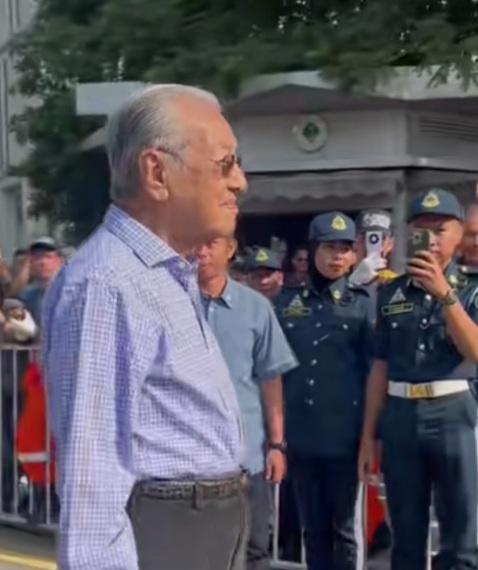
This year, at 99 years old, former Prime Minister Tun Dr Mahathir Mohamad made headlines for his appearance at the National Day festivities—not as an invited guest on stage, but as a mere spectator among the crowd. Clad in a simple blue chequered shirt, he arrived in a Proton X70, mingling with the public for a brief 20 minutes.
The reception was overwhelmingly positive, with onlookers cheering for "Tun" and celebrating his presence. Yet, the image of a former Prime Minister, who served the nation for over two decades, standing among ordinary citizens rather than being honoured as a special guest, speaks volumes about the current state of our politics.
Zaid Ibrahim, a former Law Minister, aptly questioned why Tun Mahathir wasn’t invited to the National Day celebration. His question is not just about Mahathir but about the broader issue of how Malaysia treats its former leaders. Why weren’t other former Prime Ministers like Muhyiddin Yassin and Ismail Sabri invited? If Abdullah Badawi (Pak Lah) is unwell, why not have his wife represent him? Even Najib Razak, currently embroiled in legal battles, could have been given a moment of joy had his wife Rosmah been invited. (Zaid Ibrahim on X)
And what of our Father of Independence, Tunku Abdul Rahman? Would it not have been fitting to invite his descendants to remind us of the sacrifices made to achieve our nation's freedom? Why not extend the same courtesy to the families of other pivotal figures in our history, such as Tun Cheng Lock, Tun Sambanthan, and others who played crucial roles in shaping Malaysia? Their absence reflects a troubling trend in our national psyche—one where the contributions of the past are overshadowed by the ambitions of the present.
In Singapore, the story is different. Former leaders, such as Lee Kuan Yew, Othman Wok, and Ong Pang Boon, were always honoured during national celebrations, long after their retirements. When Lee Kuan Yew passed away, his chair was poignantly left empty as a mark of respect. This act of remembrance isn’t just ceremonial; it is a recognition of the continuity of leadership and the gratitude a nation owes to those who paved the way.
In Malaysia, however, our political landscape is often tainted by bitterness and egocentrism. Current leaders, it seems, are more interested in self-promotion than in acknowledging the legacies of their predecessors. The absence of former Prime Ministers from the stage at National Day isn’t just an oversight—it’s a deliberate act that reveals the deep fractures in our political culture. It reflects a mindset that is more concerned with rewriting history than learning from it.
This disregard for former leaders has implications far beyond the optics of a National Day celebration. It suggests a lack of national cohesion and a reluctance to acknowledge the complexities of our history. It also raises doubts about the ability of our leaders to be magnanimous. After all, if they cannot find it in their hearts to honour those who came before them, what hope do we have for a unified Malaysia?
Prime Minister Anwar Ibrahim, who prides himself on his reformist image, had an opportunity to set a new tone by inviting his predecessors to the National Day celebration. It would have been a powerful statement of unity, a recognition that despite political differences, Malaysia’s progress is the result of the collective efforts of all its leaders. But that opportunity was missed, and the message sent instead was one of division.
As we move forward, we must ask ourselves what kind of nation we want to be. Do we want to be a country that celebrates only the present, or one that honours its past and learns from it? The absence of our former Prime Ministers at National Day celebrations is more than just a matter of protocol—it’s a reflection of our national soul. If we cannot remember and respect those who led us, how can we expect to move forward as a united nation?
In the spirit of Merdeka, let us hope that future National Day celebrations will not only be about parades and speeches but about coming together as one nation, recognising that our strength lies in our diversity—of leaders, of ideas, and of histories. Only then can we truly claim to be a united Malaysia.

Mihar Dias is a content creator under the Newswav Creator programme, where you get to express yourself, be a citizen journalist, and at the same time monetize your content & reach millions of users on Newswav. Log in to creator.newswav.com and become a Newswav Creator now!
The User Content (as defined on Newswav Terms of Use) above including the views expressed and media (pictures, videos, citations etc) were submitted & posted by the author. Newswav is solely an aggregation platform that hosts the User Content. If you have any questions about the content, copyright or other issues of the work, please contact Newswav.

