The world's largest annual semiconductor trade show opens this week in Taipei, with industry body SEMI projecting that global chip revenue will surpass $1.5 trillion in 2026 — the same year Taiwan's domestic materials market is forecast to command roughly 30% of the global total.
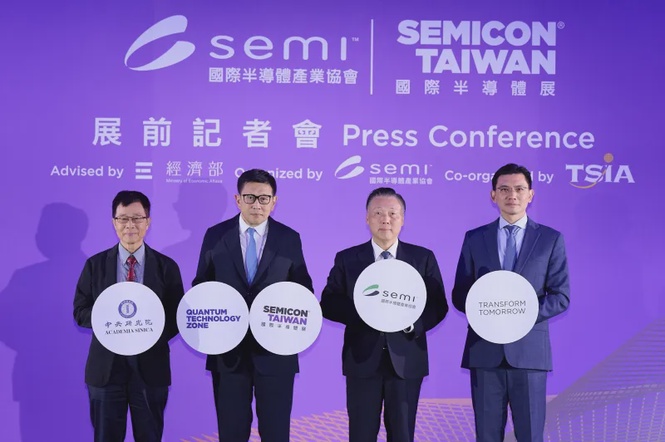
SEMI held a pre-show press conference on August 31, revealing that SEMICON Taiwan 2026 will span both halls of the Taipei Nangang Exhibition Center, drawing more than 1,300 exhibitors from 65 countries to fill 4,300 booths. Eighteen national pavilions have been established, and organizers expect more than 100,000 professionals to attend over the course of the event.
AI Decouples Chip Demand From Broader Economic Headwinds
Despite a global macroeconomic environment in which GDP and investment growth hover near just 2.1%–2.2%, semiconductor demand is expanding at a pace that has no parallel in the consumer electronics era, according to SEMI Senior Director of Industry Research Clark Tseng.
"This growth is not a broad-based recovery — it is highly concentrated in high-end computing, high-bandwidth memory, and advanced logic process nodes," Tseng said. The structural driver, he explained, is the surging buildout of AI infrastructure: data centers, high-performance computing systems, and high-bandwidth memory (HBM) chips now constitute a demand engine entirely unlike the smartphones and personal computers that once defined the industry's cycles.
SEMI has lifted its equipment spending outlook to match. Wafer front-end equipment (WFE) spending is forecast to climb from $117 billion last year to $220 billion by 2028, while test equipment and packaging equipment markets are expected to reach $23.5 billion and $10 billion, respectively, over the same period. Global semiconductor revenue, Tseng added, is on course to cross $2 trillion by 2030.
Taiwan's $28 Billion Materials Ecosystem Proves Hard to Replicate
The surge in AI-driven chip demand is reshaping the materials market as well. SEMI estimates global semiconductor materials revenue will hit $83 billion in 2026, rising to $92 billion in 2027 — two consecutive years of double-digit percentage growth, a streak rare in the industry's history.
Taiwan sits at the heart of that expansion. In 2027, Taiwan's materials market alone is projected to reach $28 billion, accounting for roughly 30% of the worldwide total — the highest share of any single market — spanning both front-end wafer fabrication materials and back-end packaging materials.
Tseng attributed that dominance to something harder to replicate than any individual factory: the depth of Taiwan's integrated supply chain. "Taiwan's advantage is not built on any one process node or any one company," he said. "It spans wafer manufacturing, advanced packaging, test interfaces, wet-process equipment, and subsystem components — a level of vertical integration that makes Taiwan's role both resilient and irreplaceable."
Advanced process nodes demand ever-greater chemical purity and physical stability, while heterogeneous integration is creating insatiable appetite for high-grade substrates and specialty packaging materials — trends that Tseng said are giving Taiwan's domestic supply chain "an unprecedented opportunity to upgrade."
Microsoft, Google, and NVIDIA to Share the Stage With TSMC
The exhibition program reflects the ecosystem's breadth. SEMI Global CMO and Taiwan President Terry Tsao said this year's event brings together the full end-to-end AI supply chain under one roof: cloud service providers including Microsoft, Meta, and — speaking in Asia for the first time — Google's head of AI infrastructure, alongside chip designers NVIDIA, AMD, Broadcom, and Marvell; manufacturers TSMC, UMC, Samsung, SK hynix, and Micron; packaging leader ASE; and system integrators Foxconn, Quanta, Wiwynn, Cisco, and Delta.
Off the exhibition floor, the show is leaning into what SEMI calls "tech diplomacy." A Chip Summit, co-organized with Taiwan's Ministry of Economic Affairs (MOEA) and the Industrial Technology Research Institute (ITRI), will use Taiwan's semiconductor relationships as a platform for international engagement. A parallel session co-hosted with Academia Sinica — Taiwan's top public research institution — will explore trusted supply-chain architecture and deepen cooperation with the European Union.
SEMI has also formalized a permanent "Silicon Startup" innovation zone at this year's event and signed a memorandum of understanding with Silicon Catalyst, a prominent U.S. semiconductor incubator, to channel venture capital and advanced technology into Taiwan's innovation pipeline.
Academia Sinica Bets on Quantum-Classical Fusion as the Next Frontier
Looking beyond the current race for AI compute, Academia Sinica is using SEMICON Taiwan 2026 to outline what it sees as the next inflection point in computing. Chen Chi-dong, Distinguished Research Fellow at Academia Sinica's Critical Issues Research Center and executive director of its Quantum Computer Research Center, said the defining architecture of the coming generation will be "quantum-classical fusion" — the tight integration of quantum processors with existing CPU and GPU high-performance computing systems.
Chen identified superconducting and semiconductor-based quantum computers as the natural entry points for Taiwan, because both platforms rely heavily on silicon chips, high-frequency coaxial cables, microwave amplifiers, and high-speed FPGA control circuits — hardware that Taiwan's semiconductor and ICT industries already produce at scale.
Academia Sinica's southern campus has already built a dedicated 8-inch "QCFab" fabrication line, incorporating flip-chip bonding and through-silicon via (TSV) technology, along with a dilution refrigerator testing platform open to co-development with industry and academic partners.
"Taiwan may be a late entrant in the quantum space," Chen said, "but that means we can absorb the lessons learned by those who came first. Taiwan's strengths in precision manufacturing, chip packaging, and hardware integration put us in a strong position to supply critical peripheral components and integration solutions for large-scale quantum systems worldwide — and to secure a foothold in the next generation of computing competition."
Social Media Links & Editor Tag - Penny