.jpg)
By Mihar Dias April 2025
On Aidilfitri morning, we arrived at the mosque with hearts full of gratitude, ready to join fellow Muslims in celebrating the completion of Ramadan.
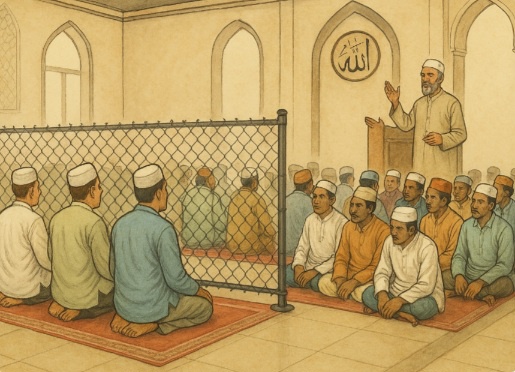
But what we witnessed left us troubled. A chain-link barrier stood across the prayer hall, subtly yet unmistakably dividing the congregation.
The first seven rows were reserved for local residents, while the remaining space was allocated to guest workers from the Indian subcontinent.
It was a clear separation—an unspoken but undeniable distinction between Muslims who shared the same faith, the same prayers, and the same devotion.
Yet, those who had arrived early—many of them foreign workers—were not allowed beyond the elegant railings. Instead, they were directed to the back rows, while locals who arrived much later were ushered to the front by the Noja (mosque caretaker).
The irony was inescapable. The khutbah (sermon) that morning spoke of unity, of the brotherhood of ummah, of Islam’s fundamental teaching that no Muslim is superior to another except in taqwa (piety).
And yet, right before us, a different message was being practised: a hierarchy had been imposed, one that seemed to contradict the very spirit of the holy day.
Some local residents were just as shocked. “This has never happened in the 40 years we’ve lived here,” one remarked.
The mosque had always been a place where all were welcome, regardless of nationality or social status. So why had this unwritten rule suddenly emerged?
The conversation continued over the mosque’s generous Aidilfitri meal. Protest murmured among the congregation—some voiced discomfort, others asked outright: “Why the separation?”
But no one could provide a clear answer. Was it about space? Tradition? Or something else entirely?
By chance, we encountered the Noja later that morning. He was preoccupied, tending to the needs of the mosque’s inner circle.
When we raised the issue, his response was pragmatic, if not unsettling. “If I didn’t take the initiative, locals would have no place in the mosque. Last year, we were overwhelmed by foreign workers.”
But is this a justifiable reason? Is the answer to overcrowding segregation? Why couldn't we be more accommodating—perhaps with extra prayer space or simply a first-come, first-served policy as is the practice in Islam?
The Prophet Muhammad (SAW) himself prayed alongside his companions, regardless of their origins.
The Kaaba, the holiest site in Islam, does not distinguish between races or nationalities—all stand shoulder to shoulder, equal before Allah.
And yet, here we were, in an affluent neighbourhood mosque, reinforcing divisions that Islam itself seeks to erase.
Aidilfitri is a time for reflection, gratitude, and renewal. But perhaps it should also be a moment for us to reassess how we practise the values we so readily preach.
If we truly believe in the unity of ummah, then shouldn’t our actions reflect that belief—not just in words, but in deed?

Share your #RAYA2025 stories and stand a chance to win prizes worth up to RM6,200!
Find out how to join here. Don’t miss out! T&Cs apply.
Mihar Dias is a content creator under the Newswav Creator programme, where you get to express yourself, be a citizen journalist, and at the same time monetize your content & reach millions of users on Newswav. Log in to creator.newswav.com and become a Newswav Creator now!
The User Content (as defined on Newswav Terms of Use) above including the views expressed and media (pictures, videos, citations etc) were submitted & posted by the author. Newswav is solely an aggregation platform that hosts the User Content. If you have any questions about the content, copyright or other issues of the work, please contact Newswav.


