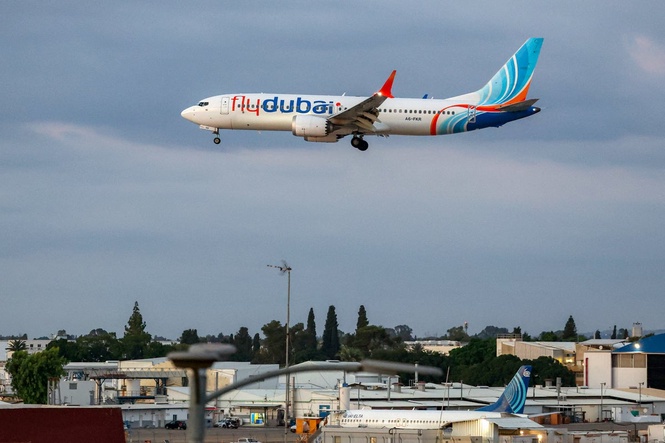
The alleged hijacking of an Israel-bound flight has raised questions over how secure the vetting process is for one of aviation’s most skilled jobs.
Flydubai FZ1073 from Dubai to Tel Aviv rapidly descended during a terrifying ordeal as the co-pilot allegedly tried to take control of the plane after attacking his fellow pilot with an axe, or possibly stabbing him.
It is still unclear why the co-pilot to acted in this way. Yet the question remains: how was this person able to bypass rigorous background checks and be given the responsibility of flying planes?
“It’s very easy after every incident to say, what more can we do?” Phillip Baum, visiting professor of aviation security at Coventry University, said. “Often, airline pilots are recruited from other states, so the degree of background checks is somewhat limited. They’ll certainly have their pilot training and licenses, but in terms of background checks from other states, it’s always a problem.”
Mr Baum, who has 35 years’ experience in aviation security, explained that varying pilot-vetting models across countries have long created issues for the aviation industry.
“You would hope, particularly with pilots, that there’s a medical assessment, a psychological assessment, then they are accepted for training, and then even during the training, there’s ongoing assessment during the course for any indications that somebody may have mental health issues.
“For ideological issues, it would be much harder to identify”.
Israeli Prime Minister Benjamin Netanyahu has claimed that the co-pilot tried to deliberately crash the aircraft after stabbing Cpt Machchhar, but that passengers held him down while other pilots landed the plane.
“The most important thing that anybody can do is analyse the behaviours of individuals around them, both as a social responsibility to identify potentially people who are experiencing poor mental health, and to be able to offer them the support that they need, but also to identify people who could have more nefarious intent,” Mr Baum said. “Employees are encouraged to report those concerns.
“The United Arab Emirates usually has a very good reputation for the care that they provide in this regard, but there are no guarantees.”
The Flydubai flight, which took off from Dubai airport with 174 people on board, was headed for Tel Aviv and suddenly plummeted 14,000ft in less than 30 seconds midway through the flight.
Witnesses on board say that Cpt Machchhar was stabbed by his co-pilot, before passengers near the front of the plane helped force the attacker out of the cockpit and subdued him.
The Israeli prime minister, who is fronting the information distribution following the incident, said that an axe may have been used in the attack, or that Cpt Machchhar was stabbed.
Mr Baum said that considering how a weapon appeared in the cockpit is not a priority. He said: “I’m actually not that worried if somebody carried a penknife into the cockpit ... Because a pilot, if they were to lock their fellow pilot outside the flight deck, wouldn’t need a weapon at all. There is a crash axe that they could use that would be far more dangerous.”
He said that screening pilots for small items is “pretty pointless”.
“All we’re trying to do then is identify prohibited and restricted articles rather than looking at intent. And my total approach to aviation security is that what we need to be doing is looking at the intent. Obviously, if we can find weapons, then we need to do that.
“The reality is, if you really wanted to identify every penknife, you would bring the airport aviation system to an utter standstill.”
Cpt Machchhar said on Friday, 2 October, that he had gone “for one last push” to open the cockpit door to allow others to come in after he was attacked.
Mr Baum said that the people on the flight were “incredibly lucky” that the door was opened to stop the co-pilot from a potential hijacking.
“You'd actually have to flick a switch or turn a knob to disarm the doors,” he explained.
Locking the cockpit door from the inside was a measure introduced after 9/11 to prevent someone in the cabin taking control of the plane.
“From my perspective, that was always wrong,” Mr Baum said. “Lock the door, but there needs to be some override system so that when people knew there was something wrong, then somebody could get into the flight deck.
“It would need some kind of delay mechanism, so that if a cabin crew member were taken hostage by a hijacker, then at least you would have time to warn the flight deck of a potential imminent attack on the flight deck, so that the pilots could sound the alarms.”
If the investigation concludes that the incident was a foiled attempt to take control of the plane, this flight would be added to a list of other rare pilot-led hijackings.
Most recently, a former Alaska Airlines pilot tried to cut the engines of a passenger flight in 2023 while riding off-duty in the cockpit, but was subdued, and the plane landed safely.
Other incidents have been deadly. In 2015, prosecutors believe that a co-pilot deliberately crashed a Germanwings flight into a mountain, killing all 150 people on board.
Read MoreEmirates flight to London diverted after passenger emergency
First passenger train between Dubai and Abu Dhabi launches
Is it safe to travel to Dubai and Abu Dhabi? Latest advice amid regional conflict
Popular safari destination introduces £33 mandatory travel insurance for tourists
Airlines to be banned from charging families ‘rip-off’ flight fees
Expert explains how to beat flying anxieties after Flydubai hijacking