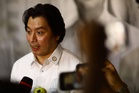
ALL fingers point to Col. Raymund Dante Lachica. The natural reaction is to demand that the House prosecution panel call him as a hostile witness in Vice President Sara Duterte’s impeachment trial. But an important witness is not automatically a necessary prosecution witness. Sometimes, the sounder strategy would be to leave the person who can supposedly explain incriminating evidence to the defense.
Gina Acosta, the former special disbursing officer of the Office of the Vice President (OVP), testified that she handed Lachica P500 million in confidential funds in four tranches of P125 million. She said she did so upon Duterte’s direct instructions. Lemuel Ortonio, an OVP assistant secretary, confirmed that Lachica was not an OVP employee and that Duterte knew of, approved and ultimately supervised the handling of the funds.
These were not friendly prosecution witnesses eager to strengthen the case. Both Acosta and Ortonio were declared hostile. Their admissions carry weight. They came from officials associated with the office being investigated, extracted under oath and against the institutional position they would be expected to protect.
Their testimony established facts that do not depend on Lachica’s version. Confidential funds were placed in the hands of someone who was neither the designated bonded special disbursing officer nor an OVP employee. Joint Circular No. 2015-01 requires cash advances to be handled by the bonded SDO or agency head. It also prohibits transferring a cash advance from one accountable officer to another.
The alleged irregularity is not confined to what Lachica ultimately did with the money. The act of turning the funds over to him is independently material. Acosta had personal knowledge of that turnover, while Ortonio confirmed Lachica’s status and described the approval structure leading upward to Duterte. Lachica cannot erase those facts by offering a belated explanation of what happened after he received the cash.
Other testimony and records raised additional problems. These include reward money supposedly given to informants but used to purchase medicine; expenditures for computers, tables and chairs; and reimbursements for expenses incurred before the funds were released. Ortonio admitted that explanations submitted to the Commission on Audit were based on Lachica’s verbal reports, without his observing the operations or visually checking the acknowledgment receipts.
Most damaging is the admission that, among the OVP’s senior officials, only Duterte and Lachica knew how the funds were implemented. Acosta said she merely released the money. Ortonio said he prepared explanations without firsthand knowledge. This is not a functioning chain of accountability. It is a closed loop involving the agency head and an outsider entrusted with half a billion pesos in public funds.
Article I charges Duterte with illegal misuse of confidential funds. To sustain it, the prosecution must establish her responsibility for the questioned system and transactions. It need not prove every peso’s final destination through Lachica if independent testimony, official records and reasonable inferences already establish unauthorized handling, deficient controls and expenditures inconsistent with the circular.
No legal rule requires prosecutors to call every person mentioned in the evidence. Nor does the best evidence rule mean that a party must present the “best witness.” That rule concerns original documents when their contents are at issue. A witness may be central to the story yet unnecessary to prove the particular proposition charged.
Calling Lachica as a hostile prosecution witness would carry substantial risk. It would give him the first opportunity to present a rehearsed, self-serving narrative while suggesting the prosecution considered him indispensable. He could deny, minimize, invoke confidentiality, claim operational necessity or blame subordinates and unnamed informants. Even if prosecutors could ask leading questions, they would be giving him a platform for the defense to reinforce his account.
Better to let the defense decide whether it wants that risk. If Lachica can truthfully explain why an unbonded non-OVP employee received P500 million, why accountability safeguards were bypassed, how the expenditures complied with the circular, and why senior officials knew virtually nothing about implementation, Duterte’s lawyers should call him. They have the greatest interest in presenting such an explanation.
This does not improperly shift the legal burden. The prosecution retains the duty to establish the charge by the standard the Senate applies. But once it presents evidence of violations and Duterte’s authorization and approval, the practical burden of answering that evidence falls on the defense. A party possessing an exculpatory witness cannot reasonably fault its opponent for declining to present him.
If the defense calls Lachica, the prosecution will occupy the stronger position. It can cross-examine him with leading questions, confront him with Acosta’s and Ortonio’s testimonies, test his claimed authority, demand the basis of each transaction, and expose inconsistencies between his answers and the liquidation records. The defense assumes the risk of his testimony, while prosecutors can attack its weaknesses without vouching for his credibility.
If neither side calls him, the Senate is not helpless. An impeachment court is not a passive jury confined to whatever the parties present. Under its Rules of Procedure on Impeachment Trials, the Senate may compel witnesses and issue lawful orders it considers essential or conducive to justice. Senator-judges may also question witnesses directly.
The Senate can summon Lachica on its own authority if it concludes that his testimony is indispensable to deciding Article I. That would place responsibility on the constitutional body with the sole power to try and decide impeachment cases. It would prevent either side from controlling him while allowing senator-judges to pursue unanswered questions.
The prosecution should be disciplined, not theatrical. Its task is not to parade every name implicated by the evidence, but to prove Duterte’s impeachable responsibility with the clearest and safest case available. It has already followed the money to Lachica and the authority back to Duterte.
All fingers may point to Lachica. That is precisely why the prosecution should not rescue the defense by calling him. Let Duterte’s lawyers present him if they believe he can explain the unexplained. If they will not, let the Senate summon the man entrusted with P500 million and require him to answer publicly to the Filipino people.
The author is a professor at the University of the Philippines Los Baños and vice chairman of the board of People’s Television Network Inc. (PTVNI).