
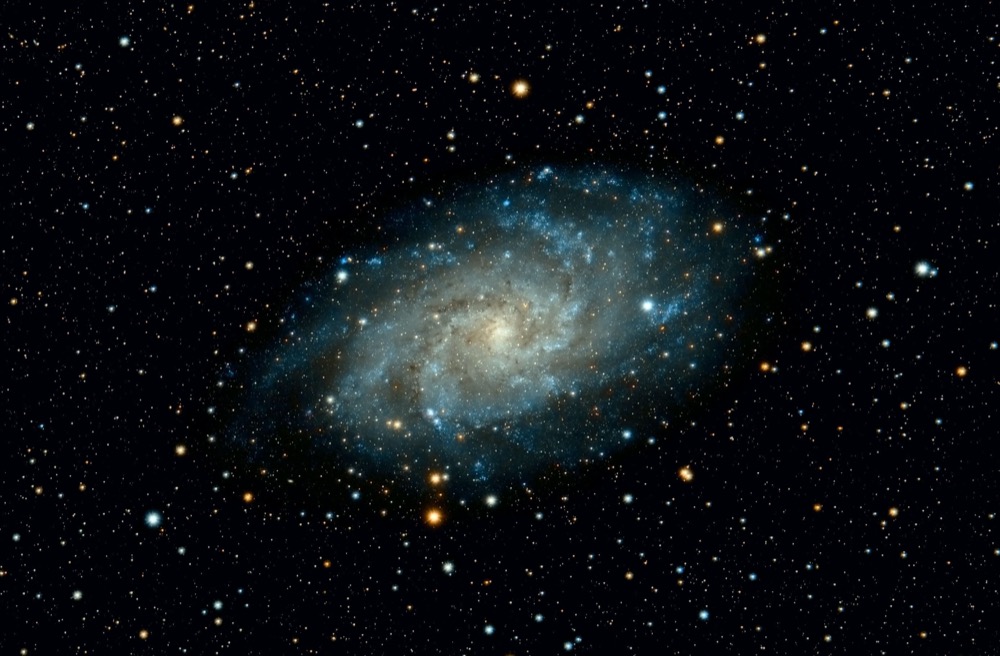
Using the powerful Atacama Large Millimeter/submillimeter Array (ALMA), researchers identified a faint oxygen signal from galaxies seen just 700 to 800 million years after the Big Bang, offering an unprecedented look at the raw material that powered the formation of the earliest generations of stars.
A Long-Standing Mystery About Early Galaxy Growth
For decades, astronomers have been able to observe stars and hot ionized gas in distant galaxies, allowing them to reconstruct many chapters of cosmic history. Yet one of the most important ingredients of galaxy evolution remained largely hidden: the neutral gas that serves as the direct fuel for star formation. This gas is the reservoir from which new stars are born, making it central to understanding how the first galaxies assembled and evolved. While observatories such as the James Webb Space Telescope (JWST) and theHubble Space Telescope (HST) have transformed our view of the early universe, they cannot directly detect this neutral component. As a result, scientists have often relied on indirect tracers that can originate from multiple environments, creating uncertainties about the true conditions inside ancient galaxies. The challenge has been particularly severe at extreme distances, where faint signals become increasingly difficult to isolate. The new observations overcome that limitation and provide one of the clearest views yet of the gas reservoirs that shaped the universe during its formative years.
ALMA Detects A Rare Oxygen Signature From Cosmic Dawn
The international research team focused on four representative star-forming galaxies dating back to an era when the universe was less than a billion years old. Using ALMA, the scientists successfully detected the [O I] 145 µm emission line in all four galaxies. This signal originates from neutral oxygen atoms and is regarded as one of the most direct tracers of neutral gas available to astronomers. Unlike the commonly used [C II] emission line, which can arise from both neutral and ionized regions, the oxygen signal provides a cleaner view of the material actively participating in star formation. To strengthen their conclusions, the researchers also analyzed the [N II] 205 µm emission line, which traces only ionized gas. The weak presence of this signal indicated that most of the detected emission was indeed coming from neutral gas. The result allowed the team to isolate and study the elusive fuel reservoirs within these distant galaxies with a level of confidence that had previously been unattainable.
Combining ALMA And JWST Revealed Conditions Inside Ancient Galaxies
The study, published in the Astrophysical Journal, combined ALMA observations with data from JWST, enabling researchers to investigate the physical and chemical properties of the gas in remarkable detail. The analysis revealed that the neutral gas inside these galaxies was extremely dense, reaching levels comparable to those found in modern starburst galaxies, which are among the most prolific stellar factories in the universe. Yet the surrounding radiation fields appeared somewhat less intense than those typically associated with starbursts. This combination paints a picture of early galaxies as compact, gas-rich systems capable of sustaining vigorous star formation under conditions distinct from many present-day counterparts. By comparing the oxygen and carbon signals, scientists were also able to refine their interpretation of previously collected *[C II]* observations, helping to place years of observational data into a clearer physical context. The findings suggest that many early galaxies contained substantial reservoirs of dense neutral gas, creating ideal environments for rapid stellar growth during one of the most transformative periods in cosmic history.
The Most Distant Direct Detection Of Neutral Gas Ever Achieved
The significance of the discovery extends far beyond the four galaxies examined in the study. By establishing a direct method for tracing neutral gas at extraordinary distances, the research opens new opportunities to investigate how galaxies formed during the universe’s earliest epochs. Assistant Professor Yoshinobu Fudamoto emphasized the importance of the achievement, stating:
“Our results represent the most distant direct detection of neutral gas in typical star-forming galaxies to date. This analysis unlocks the wealth of existing [C II] observations as a probe of neutral gas in the early universe.”
The statement highlights how the new detection method not only provides fresh observations but also increases the scientific value of large archives of previously collected data. Scientists can now revisit earlier measurements with improved confidence, extracting insights that were previously obscured by uncertainties about the origin of observed signals. This breakthrough effectively transforms a widely used observational tool into a more powerful probe of galaxy evolution during cosmic dawn.
Opening A New Window Into The Fuel Behind Star Formation
The implications of the study could shape future investigations of the early universe for years to come. By demonstrating the effectiveness of the [O I] 145 µm emission line, researchers have established a new pathway for studying one of the most elusive components of young galaxies. Dr. Akio K. Inoue underscored the importance of the result, saying: “Our work establishes the [O I] emission line as an effective tool for studying an elusive gas component in the early universe, opening a new window onto the ‘fuel’ behind star formation.” Future surveys are expected to expand the sample far beyond the four galaxies analyzed in this work. By combining observations from ALMA, JWST, and next-generation facilities, astronomers hope to build a comprehensive timeline of how galaxies accumulated gas, formed stars, and evolved into the vast structures seen across the cosmos today. Each new detection brings scientists closer to answering one of astronomy’s most fundamental questions: how the first galaxies emerged from the aftermath of the Big Bang and ultimately gave rise to systems like our own Milky Way.