
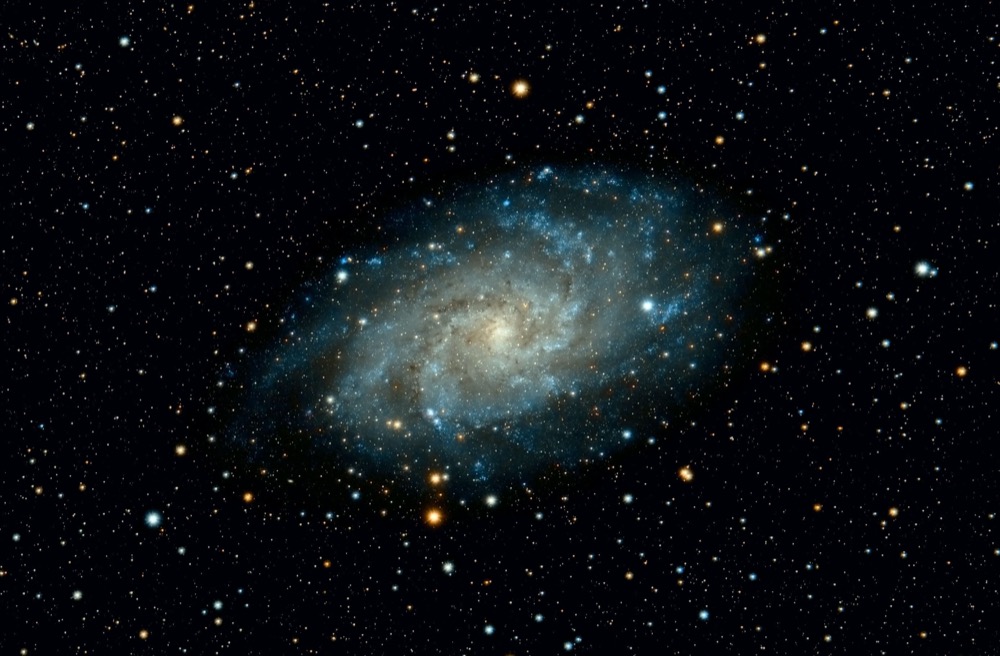
The Hubble Space Telescope has unveiled the faint glow of ESO 490-017, a dwarf irregular galaxy over 23 million light-years away, offering astronomers a rare glimpse into the motion of galaxies across the universe.
This discovery, captured in a stunning Hubble image, not only highlights the galaxy’s delicate starry structure but also sheds light on the invisible gravitational forces shaping cosmic movement. NASA reported this observation, emphasizing its significance in understanding local galaxy populations and the broader dynamics of the cosmos.
The Subtle Beauty Of ESO 490-017
ESO 490-017 is a low-surface-brightness galaxy, making it almost invisible against the backdrop of the night sky. Measuring roughly 12,000 light-years across, it lies in the constellation Canis Major, quietly floating among brighter foreground stars that dominate the field of view.
Hubble’s keen vision allows astronomers to distinguish this faint swarm of stars from the luminous interference of nearby stellar objects. The image reveals not only the galaxy itself but also a scattering of distant galaxies in red, orange, and beige hues, many exhibiting faint spiral structures, providing a rich tapestry of the cosmic neighborhood.
Such observations are rare, as dwarf irregular galaxies often escape detection due to their faintness and dispersed stellar populations.
Mapping The Cosmic Flow
This observation is part of a Hubble program designed to study the movement of galaxies and galaxy clusters through space. In the universe, matter is distributed unevenly, and these irregularities generate gravitational flows that drive the large-scale motion of galaxies, known as the cosmic flow.
By analyzing galaxies like ESO 490-017, astronomers can trace these invisible currents, revealing the gravitational influence of both visible and dark matter across millions of light-years. Such data are crucial for refining models of cosmic structure formation and understanding how galaxies interact over billions of years.
Standard Candles And Distance Measurement
Hubble’s ability to measure distances to nearby galaxies relies on the technique of using low-mass red giant stars as standard candles. By observing the brightness of these stars, astronomers can calculate the precise distance to galaxies like ESO 490-017, building a reliable map of the local universe. This method is particularly effective for dwarf galaxies, whose faint stars are otherwise difficult to study.
These distance measurements not only anchor our understanding of galaxy positions but also allow researchers to compare the motion and distribution of galaxies on a larger scale, providing insights into both the history and future evolution of the cosmos.
Building A Legacy Of Stellar Data
Beyond distance measurements, this Hubble observation contributes to a legacy archive of stellar populations in nearby galaxies. By cataloging the types of stars in ESO 490-017, astronomers gain a detailed understanding of star formation and evolution in low-mass galaxies. These archives are invaluable, serving as reference points for future observations and helping scientists identify patterns across different galactic environments.
NASA’s Hubble mission continues to expand this database, offering both professional astronomers and the public a deeper appreciation of the complexity and diversity of the universe’s smallest galactic inhabitants.