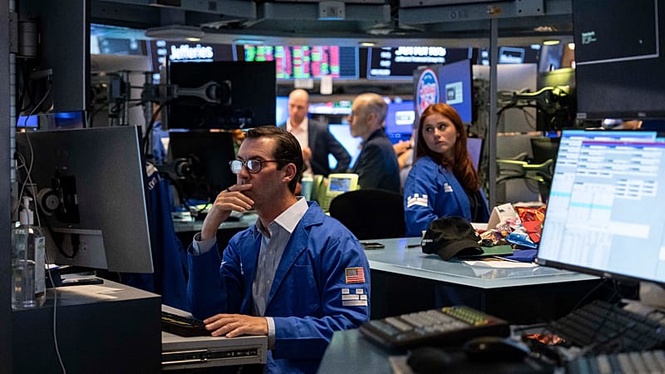
Major European stock markets opened slightly lower on Friday as investors took profits after Thursday’s rally and digested another round of monetary tightening by global central banks.
The pan-European STOXX 600 fell around 0.2% in early trading. The DAX lost 0.42%, the EURO STOXX 50 declined 0.19%, the CAC 40 fell 0.34%, and the FTSE 100 slipped 0.18%.
Investors were also focused on the latest economic data. UK retail sales volumes rose by 0.5% in August and by 2.4% compared with a year earlier, beating expectations. German producer prices increased by a stronger-than-expected 4.6% year on year.
Bond markets stabilised after their recent sell-off. The US 10-year Treasury yield retreated to around 4.94%, while Japan’s equivalent slipped to approximately 2.97%. Eurozone yields remained elevated, with Germany’s 10-year yield at around 3.49%, France’s at 4.47% and Italy’s at 4.36%.
Easing US and Japanese bond yields supported precious metals. Gold gained around 1.2% to trade close to $4,395 per troy ounce during the European morning, while silver rose approximately 2.8% to around $67 per ounce.
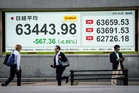
In Asia, Japan's benchmark Nikkei 225 gained 1.9% to 65,332.57 after the Bank of Japan raised its key interest rate from 1.0% to 1.25%, a 31-year high.
The move had been widely priced in, coming after the Federal Reserve also raised its key rate this week. Pressures have been coming from the US for Japan to raise rates because of concerns about the weakening yen.
RelatedThe nations intervened together recently to prop up the yen. But the efforts haven't had a big impact.
In currency trading, the euro was broadly flat against the dollar at around $1.148, while the pound gained approximately 0.1% to trade at about $1.337 in the European opening. The US dollar rose to 157.55 Japanese yen from 155.95 yen.
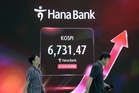
South Korea's Kospi jumped 2.3% to 6,866.83. Australia’s S&P/ASX 200 was little changed, slipping less than 0.1% to 8,731.50. Hong Kong's Hang Seng edged up nearly 0.7% to 24,769.80, while the Shanghai Composite added 1.0% to 3,916.08.
Falling oil prices and easing pressure from the bond market helped Wall Street reverse many of its losses from the prior day.
The S&P 500 jumped 1.1% for just its second rise in the last nine days. The Dow Jones Industrial Average added 316 points, or 0.6%, and the Nasdaq composite climbed 1.7%.
RelatedStocks received a boost after the price of a barrel ofBrent crude oil slid from the nearly $110 it reached earlier in the week on worries that the war with Iran will keep oil bottled up in the Middle East instead of going to customers worldwide.
During the European morning, Brent futures fell by more than 2% to $102.50 a barrel for next-month delivery. Benchmark US crude declined by nearly 2%, trading a few cents below $100 by 10:00 CEST.
Brent is still more expensive than the $72 per barrel that it cost earlier this summer.
RelatedThe Federal Reserve on Wednesday raised the short-term interest rate that it controls, the federal funds rate, by a quarter of a percentage point for its first hike in more than three years. Officials also hinted that they may raise the federal funds rate one more time this year as they try to get high inflation in the US under control.
The signals sent Wall Street on a roller coaster. Stocks initially remained higher for the day after the Fed made its announcement Wednesday. They then slid sharply before recovering a chunk of the losses before trading ended.
On the upside for markets, the shift to higher interest rates built confidence that the Fed is committed to getting inflation back to its target of 2%. On the downside for markets, higher rates undercut prices for stocks and other investments.