By Dr. Amarjeet Singh @ AJ
A story about a son, a husband and a father—and the love we sometimes forget to return.
At 5.15 in the morning, the house was still asleep.
He sat at the edge of the bed, waiting for the stiffness in his knees to ease. Beside him, his wife stirred.
“Already going?”
“Soon. Sleep a little more.”
In the kitchen, he filled the kettle, packed yesterday’s leftovers and checked his phone. A message from his mother had arrived late the previous night.
Son, when you are free, can you take your father to his appointment?
He looked at his work calendar.
Then he replied, Yes, Ma. I will arrange it.
Before leaving, he checked the back door, switched off a light and paused outside his children’s rooms.
They were sleeping peacefully.
He smiled, picked up his old work bag and stepped outside.
Nobody saw how slowly he walked down the stairs.
Scene One: The Boy in the Photograph
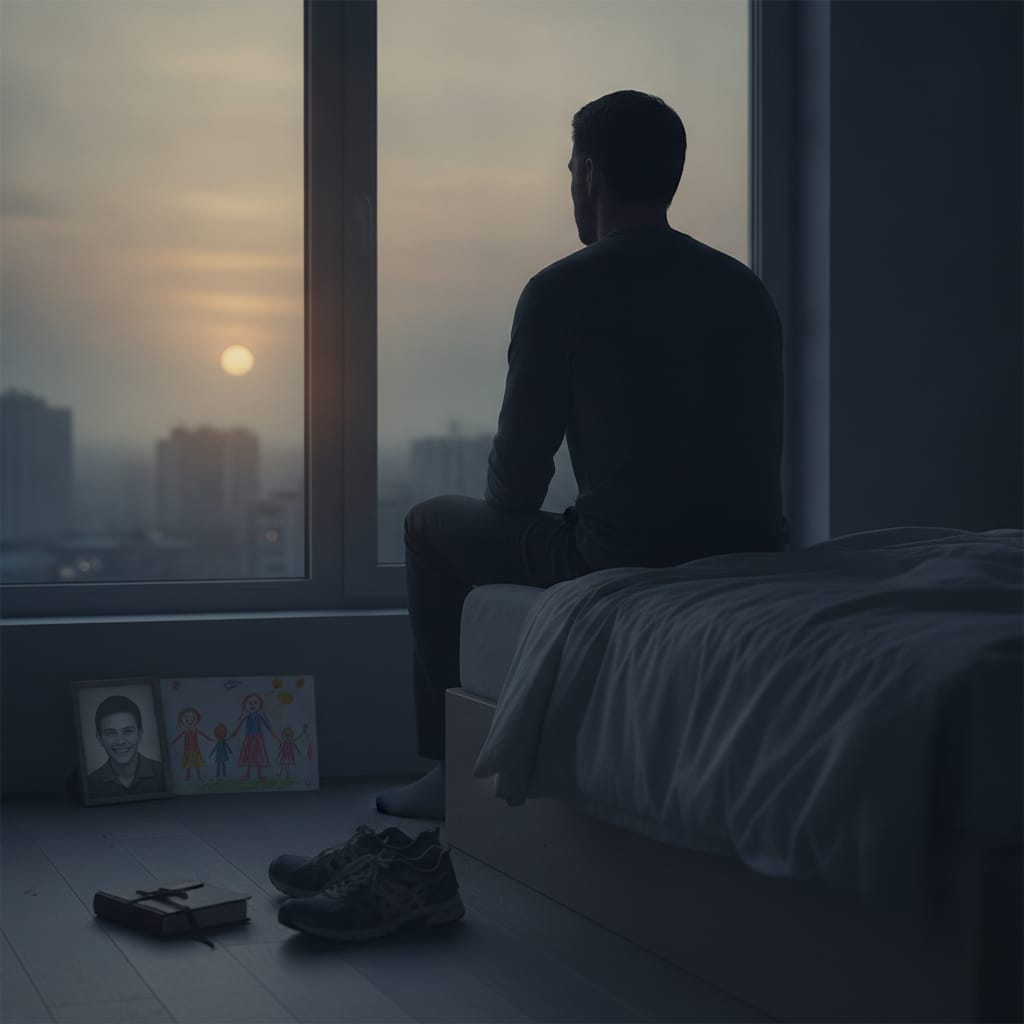
There was a photograph of him in an old family album.
Seventeen years old. Thick hair. A slightly crooked smile. One arm around a friend, the other holding a football.
His daughter once laughed at it.
“Dad! You actually looked cool!”
He laughed too.
“What do you mean, actually?”
She turned the page. He kept looking at the photograph.
There had been so much ahead of that boy.
He wanted to study further. Travel somewhere cold. Learn the guitar properly. Perhaps open a small business with his best friend.
He wanted to see what he could become.
Then his father’s income became uncertain. His mother began stretching the groceries. His younger siblings still needed books, uniforms and transport.
He found work.
“Just for a while,” he told his friend.
A while became another year.
His first salary arrived, and he brought home groceries, gave his mother some money and bought his brother a school bag.
For himself, he bought nothing.
That evening, his mother cooked his favourite meal.
He remembered that meal for years.
Scene Two: Learning to Say “Later”
As the eldest son, he became the person people called when something needed solving.
A bill. A broken motorcycle. A college deposit. A disagreement at home.
“Ask your brother.”
“He will know what to do.”
Sometimes he did know. Sometimes he sat alone trying to work it out before anyone discovered he was frightened too.
He learned to calculate before buying.
He learned to repair before replacing.
And he learned one word particularly well.
Later.
New shoes? Later.
A holiday with friends? Later.
The course he had been considering? Perhaps next year.
His siblings did not see every calculation. They saw a brother who usually managed.
Years later, when they thanked him, he waved it away.
“Family lah.”
But he remembered the night his younger sister graduated. Standing behind the others for a photograph, he wiped his eyes before anyone noticed.
Something he had helped make possible was standing right in front of him.
Scene Three: The Man Who Fell in Love
When he met the woman who would become his wife, he talked more.
He told her about the business he might open. The places he wanted to visit. The little house he hoped they could afford.
They shared simple meals and stayed talking long after the plates were cleared.
“What do you want from life?” she asked one evening.
He thought carefully.
“A peaceful home. People I love around me. Enough.”
She reached across the table and held his hand.
They built that home slowly.
There were cheap curtains, furniture bought one piece at a time and a refrigerator that needed a firm push to close.
They argued occasionally. They laughed often.
When money was tight, they sat together with a notebook and worked through it.
In those early days, she could usually tell when something troubled him.
As the years grew busier, both of them became tired. Their conversations filled with arrangements.
Who was collecting the children?
Had the payment gone through?
What time was the appointment?
They still loved each other.
Sometimes, though, love got buried beneath everything that needed doing.
Scene Four: The First Time Someone Called Him Dad
The first time he held his baby, he barely moved.
“Support the head,” the nurse reminded him.
“I am,” he whispered.
The baby’s fingers closed around one of his.
He had never felt so happy or so afraid.
On the drive home, he checked the mirror repeatedly, although his wife was sitting beside the baby.
“Watch the road,” she said, smiling.
That night, he stood beside the cot and listened to the little breaths.
He thought about milk, school, safety and all the years ahead.
He also thought about his own father.
For the first time, some of that man’s silences began to make sense.
In the morning, he called him.
“How are you, Pa?”
“Fine. How is the baby?”
They spoke about the child for several minutes.
Before hanging up, he said, awkwardly, “Thank you, Pa.”
His father went quiet.
Then came a soft reply.
“You will understand now.”
Scene Five: The Seat at the Dinner Table
Years passed in school runs, birthdays, repairs and bills.
At dinner, he served the children first.
“Take another piece.”
“You like this one, right?”
When his wife asked whether there was enough for him, he nodded.
“Enough.”
Sometimes it was enough. Sometimes he would have liked another helping.
Nobody deliberately denied him. Everyone had simply grown accustomed to his answer.
One evening, his daughter announced that she no longer liked a dish she had loved the previous month.
His son wanted something else.
Their mother sighed and got up.
He offered to fry eggs.
Later, while washing the pan, he tried to remember the last time someone had asked what he wanted for dinner.
He could not.
It seemed too small a thing to mention.
So he rinsed the pan and put it away.
Scene Six: The Car Outside the House
There were evenings when he reached home and remained in the car.
The engine was off. His hands rested on the steering wheel.
Upstairs were people he loved.
For a few minutes, he needed silence before he could join them.
At work, a younger colleague had been promoted. A client had spoken to him rudely. A payment he expected had been delayed.
He had spent the afternoon sounding calm.
Now he loosened his collar and closed his eyes.
His phone rang.
“Dad, where are you?”
“Downstairs. Coming.”
He checked his face in the mirror.
Inside, his son needed help with something. His wife wanted to discuss a bill. His mother had called twice.
He put down his bag.
“One at a time,” he said gently.
He was glad they trusted him.
He wished, occasionally, that someone would notice how much effort it took to keep answering.
Scene Seven: Between His Parents and His Children
His father began walking more slowly.
His mother repeated questions she would once have remembered without effort.
He took leave for appointments, collected medicine and listened carefully to instructions.
In the waiting room, his father apologised.
“Troubling you again.”
He shook his head.
“You took me everywhere when I was small.”
His father smiled, then looked away.
That afternoon, his daughter messaged about an expense for school. His brother called about their parents. His workplace asked when he would return.
He answered each one.
At the pharmacy, he realised he had missed lunch.
He bought a bun and ate it standing beside the car.
Then he helped his father into the passenger seat, making sure the seat belt lay comfortably across his chest.
“Hungry, Pa?”
“A little.”
“Come. We get something first.”
The bun wrapper stayed folded in his pocket until evening.
Scene Eight: When the Children See Only “No”
“Everyone else is going.”
His son stood in the doorway, angry about a trip the family could not comfortably afford.
He explained the cost.
His son folded his arms.
“You always talk about money.”
The words landed harder than he expected.
He wanted to explain everything: the household expenses, the support for his parents, the amount he was trying to keep aside.
Instead, he said, “We cannot manage it this month.”
The boy walked away.
That night, he opened the banking application again.
Could he reduce something? Delay something?
His wife found him looking at the screen.
“We have already discussed it,” she said.
“I know.”
“Then let him be disappointed. You don’t have to fix every disappointment.”
He put the phone down.
It was difficult advice to accept.
He had spent so much of his life trying to ensure that someone else would not have to go without.
Scene Nine: The Question Nobody Expected
It happened on an ordinary Sunday.
His daughter was helping clear a cupboard when she found a guitar catalogue tucked inside a folder.
“Whose is this?”
“Mine. Old already.”
“You wanted a guitar?”
“Long ago.”
“Why didn’t you buy one?”
He shrugged.
“Other things came first.”
She looked at the catalogue again.
Then she asked, “What else did you want to do?”
He opened his mouth, ready with a joke.
But she was waiting seriously.
So he told her about travelling. About the business idea. About playing football when his knees still allowed it.
His wife sat down nearby.
Some of the stories she knew. Others she had forgotten.
For half an hour, nobody asked him to solve anything.
They listened.
As he spoke, his face changed.
The children saw someone they had never quite met: the young man who had existed before their lives began.
Scene Ten: Love Learns to Notice
The next evening, his wife called before he left work.
“What would you like to eat?”
“Anything.”
“I’m asking you.”
He smiled.
He named a dish he had not requested in years.
At home, his son took the rubbish out without being reminded. His daughter sat beside him and asked how his day had gone.
“Okay,” he said.
She waited.
After a moment, he told her about the difficult client.
There was no dramatic speech. Nobody suddenly understood every sacrifice.
They began with small changes.
His siblings shared their parents’ appointments more fairly.
His wife reminded him to arrange time with his friends.
The children learned that needing something did not always mean needing it immediately.
And he began practising something unfamiliar.
Saying when he was tired.
Asking for help.
Answering honestly when someone asked whether he was all right.
Scene Eleven: A Place for Him Too
A few months later, a guitar appeared in the living room.
A modest one, bought together.
He stared at it.
“You all wasted money.”
His daughter laughed.
“Your turn, Dad.”
His first attempts were terrible.
His son recorded a short video. His wife complained, affectionately, that he kept playing the same few notes.
He laughed more that evening than he had in a long time.
There were still bills. His parents still needed him. Work remained demanding.
But something had shifted in the house.
His chair was no longer simply where the provider sat after everything else was done.
It belonged to a person whose happiness mattered.
He had room for a little of his own life again.
Before the House Falls Silent
Somewhere tonight, a man is checking whether his family has eaten while postponing his own meal.
Somewhere, a son is arranging care for his parents. A husband is worrying over tomorrow’s expenses. A father is wondering whether he has done enough.
Perhaps he is sitting beside you.
Ask about his day, then give him time to answer.
Learn what he enjoys eating. Find out what he still hopes to do. Share the work that can be shared.
His sacrifices need not become a debt his family carries. They can become a reason to care for him thoughtfully.
And if you are that man, let your loved ones know you.
Tell them when the load is heavy. Allow them to help. Make space for a wish you have postponed.
The people you love deserve your care.
You deserve to feel their care too.
By Dr. Amarjeet Singh @ AJ
Amarjeet Singh Sran (amarjeetsinghsran5@gmail.com) is a content creator under the Newswav Creator programme, where you get to express yourself, be a citizen journalist, and at the same time monetize your content & reach millions of users on Newswav. Log in to creator.newswav.com and become a Newswav Creator now!
The User Content (as defined on Newswav Terms of Use) above including the views expressed and media (pictures, videos, citations etc) were submitted & posted by the author. Newswav is solely an aggregation platform that hosts the User Content. If you have any questions about the content, copyright or other issues of the work, please contact creator@newswav.com.