By Amarjeet Singh @ AJ
There is something beautiful about a Malaysian neighbourhood during a festival.
A doorway becomes brighter. The kitchen becomes busier. Someone arranges the sweets while someone else reminds the children to leave enough for the guests. A neighbour calls out a greeting, and an invitation follows: “Come over. Have something to eat.”
During Deepavali, the lamps may belong to one household, but their warmth can reach the whole street.
Yet beyond the decorations and delicious food lies an opportunity to understand one another. What does this occasion mean to the people observing it? Why do some say Deepavali and others Diwali? And how can we share the happiness while respecting the faith behind it?
Two names, many family stories
Deepavali comes from the Sanskrit word dipavali, meaning a row of lamps. Diwali is a shortened form of the same name. Deepavali is particularly familiar in southern Indian traditions and in Malaysia; Diwali is widely used in northern India and elsewhere.
Neither greeting needs to become a competition over who is right.
Within Hindu traditions, the festival has several sacred associations. Many South Indian families remember Lord Krishna’s defeat of Narakasura. Many North Indian families associate it with Lord Rama’s return to Ayodhya after exile. These different traditions share the theme of goodness overcoming evil, symbolised by light overcoming darkness. Celebrating the Festival of Lights
But a lamp also asks something of us.
Have we brought more kindness into our homes? Have we made peace with someone? Have we allowed pride, jealousy or anger to darken the way we treat others?
The decoration is outside. The reflection begins within.
A relationship older than our modern borders
To appreciate this festival in Malaysia, it helps to look beyond the present.
Long before Malaysia existed as a modern nation, the seas around the Malay Peninsula connected communities across Asia. Traders brought goods, but people also carried languages, beliefs, artistic ideas and ways of living.
The archaeological remains of Lembah Bujang in Kedah bear witness to an early trading world linking local communities with Indian, Chinese and Arab merchants. Hindu and Buddhist remains form part of that heritage. Our shores were places of encounter. Department of Museums Malaysia
However, we should describe that history carefully. Indian cultural influence does not mean that a single Indian empire ruled the whole region now called ASEAN. Srivijaya and Majapahit were Southeast Asian powers that adapted Indian religious and political ideas within their own societies.
There were also military expeditions from the Indian subcontinent. Rajendra Chola’s attacks on Srivijayan ports in 1025 are a significant example. Such campaigns should be distinguished from centuries of trade, settlement and cultural exchange. Nagapattinam to Suvarnadwipa
This history belongs to our understanding of Malaysia. Learning about it should deepen our curiosity about one another and our appreciation of the many communities that helped shape this country.
The colours carry care
Look closely at a festive home and there is human effort behind every detail.
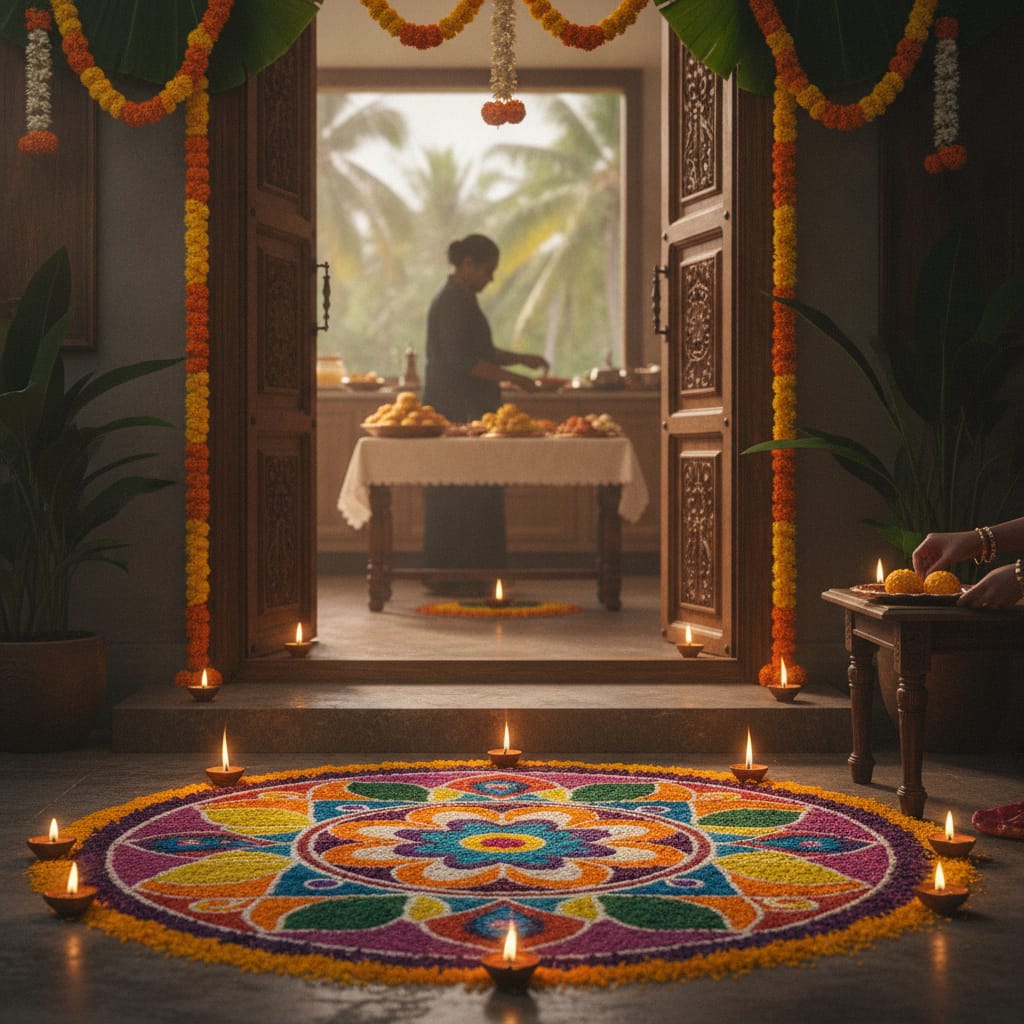
The kolam at the entrance takes patience. Its patterns welcome the visitor before a word is spoken. The sari chosen for the occasion, the neatly pressed clothes and the carefully arranged lamps reflect a family preparing to receive people with dignity.
Fresh clothes, prayers, visits and colourful kolam decorations are familiar parts of Malaysian Deepavali celebrations. Deepavali
In many Malaysian Hindu households, the morning begins with a traditional oil bath. Family customs may include applying sesame oil, offering prayers and seeking blessings from elders. Practices vary between households, but the attention to cleansing, gratitude and renewal carries deep meaning. Hindus To Celebrate Deepavali On Monday
Then come the visits, the conversation and the food.
Murukku is passed around. Someone insists that a guest try another sweet. An elder tells a story the younger generation has heard before—and may one day wish they had listened to more carefully.
The deepest inheritance is often carried in these ordinary moments: generosity, family memory and time made for one another.
We should also remember that celebrations differ according to means. A modest home with a few lamps deserves the same respect as a grand open house. No family should feel that love must be measured by spending.
For Sikhs: Bandi Chhor Divas
For many Malaysian Sikhs, this season also brings Bandi Chhor Divas — ਬੰਦੀ ਛੋੜ ਦਿਵਸ, commonly understood as the day of the release of prisoners.
It has a distinct Sikh meaning.
According to Sikh tradition, the occasion remembers Guru Hargobind Sahib Ji’s release from Gwalior Fort and his securing the freedom of 52 imprisoned rulers. The familiar account describes a specially made cloak whose ends they could hold as they left with him. Rubin Museum of Himalayan Art
The occasion brings families and congregations together through prayer, kirtan, sewa and langar.
Beyond the lights is a powerful moral lesson: our own freedom should move us to care about the freedom and dignity of others.
It asks us to notice people held back by injustice, hardship or exclusion. It encourages us to use whatever influence we possess to help someone else.
Calling the observance Bandi Chhor Divas recognises Sikh history. Offering Hindu neighbours a warm Deepavali greeting expresses friendship. Both can sit comfortably within a respectful Malaysian life.
Different faiths, different relationships with the occasion
For Jains, Diwali carries another sacred meaning: it commemorates Lord Mahavira’s attainment of final liberation, or moksha. Reflection, spiritual discipline and the light of wisdom are central to its significance. Rubin Museum of Himalayan Art
For Buddhists, practices vary by community and country. Deepavali is not a universal Buddhist religious observance, and sharing a cultural background does not mean sharing every festival.
Likewise, Malaysians who are Muslim, Christian, Buddhist, followers of traditional beliefs, or of no religion may relate to Deepavali through friendship, family connections and community life.
Ethnicity alone cannot tell us someone’s faith. Being Indian does not automatically mean being Hindu; being Chinese does not automatically mean being Buddhist. Sabah and Sarawak, too, remind us how much richer Malaysia is than a few broad labels.
The most respectful approach is simple: let people explain what the occasion means to them.
A sincere question can open a warmer conversation than a confident assumption.
The Malaysian open door
Our open-house tradition gives us a precious opportunity.
A colleague becomes a guest. A neighbour becomes a friend. Children discover that the family across the road has stories, elders and traditions worth knowing.
The invitation should come with consideration. Hosts can ask about dietary requirements and explain what is served. Guests can observe household customs and ask before photographing prayers or entering sacred spaces.
Everyone should be free to choose their level of participation according to their conscience and beliefs. Friendship grows through welcome, understanding and the absence of pressure.
This is how respect becomes practical.
It is in the food prepared thoughtfully. It is in making room for an elderly visitor. It is in remembering a colleague’s greeting and pronouncing it with care.
We need not make another person’s religious beliefs our own to value their friendship, recognise their dignity and wish their family well.
Keep the light after the festival
Harmony needs attention after the lamps are put away.
It needs us to question a cruel racial joke, check a claim before forwarding it and judge people fairly at work. It needs us to teach children that curiosity is welcome and humiliation is not.
We can begin with small acts: invite someone who may be alone, support a neighbourhood trader, share food with a struggling family, or take time to listen to an elder.
A festival can brighten a day. The way we treat one another can brighten a life.
So whether you say Deepavali or Diwali, say it with warmth. To Sikh friends observing Bandi Chhor Divas, recognise the message of freedom and service. To Jain friends, honour the occasion’s spiritual meaning.
And to every Malaysian, may this season remind us of the responsibility we share.
Let the lamps brighten our homes. Let our actions bring warmth to one another.
Selamat menyambut Deepavali to all who celebrate, and warm wishes for Bandi Chhor Divas to our Sikh community.
Amarjeet Singh Sran (amarjeetsinghsran5@gmail.com) is a content creator under the Newswav Creator programme, where you get to express yourself, be a citizen journalist, and at the same time monetize your content & reach millions of users on Newswav. Log in to creator.newswav.com and become a Newswav Creator now!
The User Content (as defined on Newswav Terms of Use) above including the views expressed and media (pictures, videos, citations etc) were submitted & posted by the author. Newswav is solely an aggregation platform that hosts the User Content. If you have any questions about the content, copyright or other issues of the work, please contact creator@newswav.com.