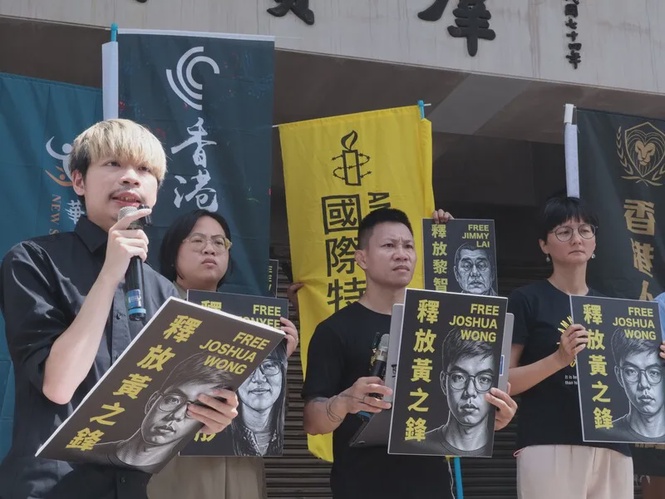
Joshua Wong, 29, walked into Hong Kong's High Court again on September 2. This time he was not there as a slogan-shouting street protester or a public advocate. He was there, nearly six years into a prison sentence, to face yet another charge under the Hong Kong national security law.
I remember an earlier version of that street. Back in 2018, working for a foreign outlet, I had a rare assignment in Hong Kong and came across Wong in the middle of a protest in Central. I asked him a few obligatory questions for the story I was filing that day. I never imagined that, eight years later, I would be writing about him again under such different circumstances.
News of the plea quickly became a trending topic on Chinese social media, though neither Beijing's Hong Kong and Macau Affairs Office nor the Hong Kong government had issued a statement by the time of writing. Wong had already indicated at a preliminary hearing in May that he intended to plead guilty, and he confirmed that plea in court on September 2. The court adjourned without setting a sentencing date. Under the national security law, conspiring to collude with foreign or external forces to endanger national security typically carries a sentence of three to ten years, rising to a range of ten years to life imprisonment if a court finds the offense especially serious. Wong is only the second defendant in Hong Kong charged under this specific provision, after media mogul Jimmy Lai.
Wong had originally been due for release in January 2027, at the end of a separate sentence for conspiring to subvert state power in the so-called "47 case". With this second guilty plea now confirmed, one number has become the focus of public attention: life imprisonment, the maximum the law allows.
From International Lobbying To A Shared Intent After The Security Law
The charge accuses Wong and former Demosisto chairman Nathan Law of conspiring, between July 1 and November 23, 2020, to request that foreign or overseas institutions, organizations or individuals impose sanctions, blockades or other hostile action against Hong Kong or China.
Prosecutors trace the alleged scheme back to Demosisto's founding in 2016, arguing the two men shared an early understanding that international lobbying could help achieve "democratic self-determination" for Hong Kong. They traveled to the United States, Germany and Italy, meeting figures including then House Minority Leader Nancy Pelosi and Senator Marco Rubio, and helped push the Hong Kong Human Rights and Democracy Act into law in November 2019, legislation that authorizes the United States to sanction officials found responsible for eroding Hong Kong's autonomy and requires an annual review of the city's status.
Demosisto disbanded on June 30, 2020, the day the national security law took effect, and Law left Hong Kong soon after. Wong's alleged conduct falls within the months immediately following the law's enactment. Prosecutors say Wong posted on Facebook that he would not delete his old posts or abandon his political positions and would continue seeking international support, while Law launched an overseas petition calling on the Israeli digital forensics firm Cellebrite to stop supplying products to the Hong Kong police, a campaign that eventually led the company to announce it would halt such sales. Even though the charge period begins only after the security law took effect, prosecutors argue the pair's "shared intent" never wavered, with one operating inside Hong Kong and the other abroad, using social media and foreign press to keep what they call the "international front" alive.
To Wong's supporters, this was simply an appeal to the international community for support of Hong Kong's democracy and human rights. Under the legal framework now applied by the Hong Kong and Chinese governments, however, activity that involves requesting sanctions or similar measures against China or Hong Kong from foreign governments can fall within the national security offense of "collusion with foreign forces."
Twenty Three At The Time, Nearly Six Years Behind Bars Already
Wong's defense team pointed out that he was only 23 when the alleged offense took place, and that he has now spent almost six years in custody, turning 30 next month. He has read more than 100 books in prison, his lawyers said, and has tried to stay positive, hoping one day to be released and care for his aging parents. The defense argued the case is far less serious than Jimmy Lai's, in which the court set a starting sentencing point of 15 years and ultimately imposed a 20 year term, with the collusion related portion carrying the heavier weighting. Wong's lawyers asked the court to instead apply the lower three to ten year starting range.
On November 19, 2024, a Hong Kong court had already convicted Wong of conspiracy to subvert state power in the pro-democracy camp's "35+" primary election case, sentencing him to four years and eight months. Under that sentence alone, Wong could have walked free as early as 2027. But in June 2025, while still in custody, he was arrested again by national security police and charged with the offense now before the court.
For Wong, the question is no longer simply which case put him behind bars. It is that the sentence from his first national security case has not yet run out, even as a second one moves toward its own sentencing.
From Street Protest To International Lobbying, Hong Kong's Last Line Of Defense
Wong was once among the most recognizable political figures of Hong Kong's Umbrella Generation. Around the time of the 2019 anti-extradition bill protests, he was something of a political idol to young people on the Chinese mainland who held out hope for reform. More than a decade ago he was still a student activist; after the 2014 Umbrella Movement he became one of the faces of Hong Kong's democracy camp most easily recognized by international media, and by 2019 he and fellow Demosisto members had helped carry Hong Kong's cause deep into Western political circles.
Roughly 40 people lined up outside the High Court before the hearing began on September 2, including former members of the student group Scholarism and old friends of Wong's. Louis Lee, who has known Wong for more than a decade, told reporters that although Wong appears to have faded from public view, "he has never given up on himself and keeps trying to become a better person," reading, learning guitar and exercising in prison. Another friend, Candy, said she expects the sentence could exceed ten years and hopes only that "he stays safe." Tsang Kin-shing, a former member of the League of Social Democrats, put it more bluntly, describing today's Hong Kong as a city where the state has the final word and where, in his words, calm has followed order at the cost of silence.
The United States State Department condemned the new charge when Wong was first arrested last year and called for it to be dropped, while China's Commissioner's Office in Hong Kong and the Hong Kong government pushed back strongly, accusing foreign forces of interfering in the judicial process. Sarah Brooks, Amnesty International's China Director, said the case underscores the authorities' fear of dissent and their determination to keep prominent pro-democracy figures locked up for as long as possible. Freedom House and the R.T. Weatherman Foundation have separately announced a joint initiative calling for Wong's unconditional release.
From A Student Movement To Possible Life Imprisonment, The End Of An Era?
Wong's personal trajectory reads almost like a condensed history of Hong Kong's democracy movement in the 2010s. He led Scholarism's opposition to a proposed national education curriculum while still in secondary school, became an internationally recognized face of the 2014 Umbrella Movement, co-founded Demosisto with Nathan Law and Agnes Chow in 2016 under the banner of "democratic self-determination," and chose to stay in Hong Kong even as the party dissolved on the eve of the national security law's enactment.
In his mitigation statement, Wong said he still believes he will be released one day. For many people who have followed Hong Kong's fortunes over the past decade, how far away that "one day" actually is has become a question with no easy answer. The court will announce a sentencing date separately, and the outcome remains unknown. But the guilty plea itself has already added one more footnote to this city's long and unfinished record of democratic memory.