China wants nearly everyone in its workforce paying into the state pension system, and it intends to use data to find those who are not. At a State Council Information Office briefing on October 10 on employment and social security during the 15th Five-Year Plan period, Vice Minister of Human Resources and Social Security Li Zhong put it bluntly: "Using data to find people is very important. There are still some people who have not enrolled. Where exactly are they? We need to find them through all kinds of means and mobilize them to enroll."
The goal is clear: keep basic pension insurance coverage above 95 percent through the 2026 to 2030 plan period. By the end of September, China had 1.079 billion people enrolled in basic pension insurance, 251 million in unemployment insurance and 327 million in work injury insurance, figures officials describe as the largest in the world. The next targets are flexible workers, migrant workers and people in new forms of employment, whom Beijing wants to move from the residents' pension scheme into the more demanding employee pension scheme.
From Persuasion To Data Driven Enforcement
Past efforts to widen social insurance coverage relied mostly on publicity and on monitoring employers' contributions. The explicit call to "use data to find people" signals a shift toward targeting individuals directly. Li noted that many flexible workers already participate in the residents' scheme, but said a key aim for the coming plan period is to bring as many as possible into employee insurance, with costs shared among employers, platform companies and workers.
The legal ground has already shifted. Since September 1, 2025, a judicial interpretation on labor dispute cases issued by China's Supreme People's Court has been in force. Its Article 19 states that any agreement between an employer and an employee not to pay social insurance, or a worker's pledge to waive it, is invalid. If an employer fails to pay, the worker may terminate the contract and claim economic compensation, and courts will support the claim.
China's social insurance covers basic pensions, basic medical insurance, unemployment, work injury and maternity. The scope, rates and contribution bases vary by locality, with employers and employees each bearing their share.
Why Small Businesses Feel The Squeeze
Many small and medium-sized businesses have never fully enrolled their staff. Instead, they reached an informal understanding with workers: no social insurance contributions in exchange for higher cash wages or a social insurance allowance. The practice carried legal risk, but in restaurants, retail, manufacturing and other labor-intensive industries it became a way for employers to control costs and for workers to take home more money.
Large companies may be able to absorb higher contributions through economies of scale, price increases or internal cost cuts. For street restaurants, small factories and sole proprietors already operating on thin margins, the added cost could wipe out profits.
With consumer demand weak and competition fierce, raising prices risks losing customers. Businesses that do not raise prices may cut wages, hours or headcount instead. A policy meant to protect workers could, in the short term, translate into pay cuts, fewer hires or smaller operations.
On Weibo and X, the phrase "find the people" was quickly read as a sign of mounting pressure. "Next step, a social insurance code? Turn red if you don't pay?" one user joked, recalling China's pandemic-era health codes. Others asked why people were not enrolling in the first place: "Is it because they have too much money?" and "Those with no job and no income, what are they supposed to pay with?"
Workers Who Do Not Want To Pay, Or Cannot
The Supreme People's Court itself acknowledged two phenomena in an August 2025 policy explanation: some employers skip contributions to cut labor costs, and some workers, especially younger ones, ask employers not to pay so they can receive cash allowances and boost their take-home pay.
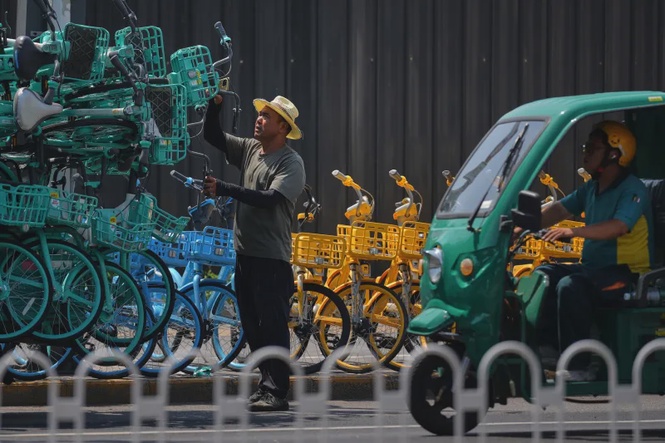
Official and industry estimates put China's flexible workforce at more than 200 million, with some estimates approaching 300 million. Yet only about 70.57 million had enrolled in the employee pension scheme by the end of 2024. They include food delivery riders, ride-hailing drivers, couriers, small business owners and freelancers, groups with unstable incomes and high mobility whose contributions have historically been the most likely to lapse.
Employee pension insurance is not cheap for flexible workers, who must cover the full rate of about 20 percent themselves, with 8 percent going to a personal account and 12 percent to the pooled fund. The contribution base is typically chosen between 60 and 300 percent of the local average wage from the previous year. In some cities, the minimum monthly pension contribution exceeds 1,100 yuan, and adding employee medical insurance often pushes the total above 1,600 yuan. For a delivery rider earning 3,000 or 4,000 yuan a month, often with unpredictable orders, that is a substantial fixed cost.
Officials have mentioned cost sharing by platforms and employers, but how that will work remains to be seen. Some localities have paid contributions on behalf of struggling groups in recent years, but the push to "find people" clearly signals stronger mobilization.
Losing a formal job does not mean a worker's need for social protection disappears, even if they still have gig, part-time or other income. If businesses cut formal hiring to reduce costs, workers could be pushed into even less stable arrangements, widening the gap between the protections on paper and the reality of work.
Why Beijing Is Tightening Enforcement Now
China faces an aging population, a shifting labor force and wide regional differences in how much social security spending local finances can bear. More retirees mean rising pension payouts, and if contributions and fund revenues fail to keep pace with spending, the system's long-term sustainability will be tested.
Whether stronger collection is aimed at a specific pension shortfall cannot be judged from the timing alone; it would depend on data about fund revenues and spending, fiscal subsidies and transfers between regions. What is clear is the trade-off facing workers. Residents' pension contributions are low, from a few hundred to a few thousand yuan a year, but so are the benefits. Employee insurance pays more but demands sustained, much higher contributions. For many people with unstable incomes, the move is less an upgrade in protection than a real financial burden.
Can Mandatory Coverage Actually Work
Some businesses may respond by cutting non-core positions, hiring less, restructuring pay or shifting work to staffing agencies. Others may shorten opening hours, automate more or rebalance full-time and part-time staff.
Outsourcing is not an unlimited safe harbor, however. Whether a company still bears responsibility depends on the actual working relationship, contracts and applicable law, and nominal outsourcing used to dodge statutory obligations may still carry legal risk.
If employers broadly shift to shorter-term, more flexible or indirect hiring, formal jobs could shrink and workers could lose protections that come with stable employment. Conversely, if enforcement is consistent, penalties are clear and businesses have enough time to adjust, the system could gradually reduce the risks workers have long borne on their own.
The debate ultimately points to a deeper question: is there too wide a gap between China's formal labor rules and the economic conditions businesses actually face? If some companies have kept costs low for years by not paying social insurance, their business models rest on not fully bearing the legal cost of employment, and stronger enforcement is needed to avoid penalizing law-abiding firms and workers. But where profits, demand and financing have already deteriorated, tougher enforcement alone cannot create the ability to pay.
Whether the policy succeeds should be judged not only by whether contributions rise, but by whether formal employment holds steady, workers' real incomes are protected and families are genuinely better equipped to face future risks. If expanding coverage goes hand in hand with business upgrading, rising household incomes and sustainable public finances, it could become an important step toward better labor protection and restoring consumer confidence in China.
YP