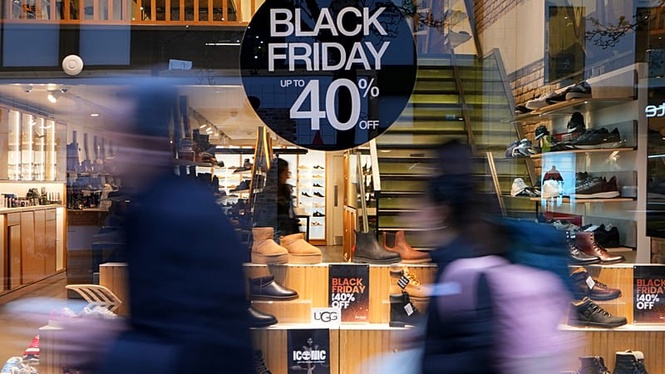
Black Friday falls on 27 November this year, but some retailers began running promotions at the start of the month.
For anyone looking for a bargain before Christmas, there may be deals to be found, but Portuguese consumer group DECO PROteste warns that some advertised discounts offer little or no saving.
On 2 and 3 November, the group checked prices at the online shops of four major retailers — Auchan, El Corte Inglés, Euronics and FNAC — and said it found several breaches of Portugal’s rules on price reductions.
"The rules are clear and say that the same shop has to apply the discount to the lowest price of the last 30 consecutive days before the start of the price reduction," Nuno Pais de Figueiredo, a spokesperson for DECO PROteste, told Euronews.
The group found that some products featured in the promotions had been cheaper before the sales began.
For example, FNAC listed a pair of Samsung earbuds at €249.99 on 2 November as part of its Black Friday campaign. According to DECO PROteste, the same online shop had sold them for €199.99 between 12 and 18 October, €50 less than the promotional price.
"What often happens is that a week, 10 days before Black Friday, product prices go up", the spokesperson explained. "What actually happens is that in the final accounts the retailer is not giving any discount, it is selling at precisely the same price", he stressed.
DECO PROteste also warned that some retailers used the recommended sale price set by the manufacturer, producer or supplier (PVPR) as the term of comparison in their advertisements, thereby misleading the consumers by giving the impression that they were saving money.
The group said this breaches Portugal’s price reduction rules when the advertised discount does not equal to the actual reduction.
Retailers must clearly display the new price and the lowest price previously charged. Showing the percentage discount is optional.
Shoppers who spot misleading promotions can complain through the shop’s official complaints book or raise the issue with DECO PROteste or ASAE, Portugal’s market watchdog, Figueiredo said.
'The fine pays off'
According to Figueiredo, irregularities during Black Friday campaigns affect a range of products and take different forms because "the fine pays off".
"The fine is not a deterrent and this is the problem most of the time," he said, adding that the group finds irregularities every year. "It is common and has not decreased, not by a long shot, because again, the amount companies have to pay is not sufficiently dissuasive."
The group advises shoppers to decide what they want to buy and check prices before the sales.
"Be suspicious first and look closely afterwards," the spokesperson said. "There are situations where we look at the prices and think: 'how do these people manage to make money, they're almost giving things away'. So you need to be careful."
"Everything depends on how people behave. By making an impulse purchase, the consumer risks falling for the trick behind those so-called 'super, mega, hyper promotions'," he said, underlining the need for consumers to know the product they intend to buy well. DECO even offers an online price comparison tool designed to help consumers make more informed decisions.
Shoppers can check how a product’s price has changed using DECO PROteste’s online tool (in Portuguese).
Figueiredo said there were still good deals for shoppers who knew what they wanted to buy and were wary of offers that seemed too good to be true.
"If you know what you are going to buy, and have clearly decided what you want, you will get good deals."
Black Friday originated in the United States and falls on the Friday after Thanksgiving. It traditionally marks the start of the Christmas shopping season.
Online shopping has helped Black Friday spread across Europe. In Portugal, some retailers start offering deals in early November, with promotions also running under labels such as Black Week and Cyber Monday.