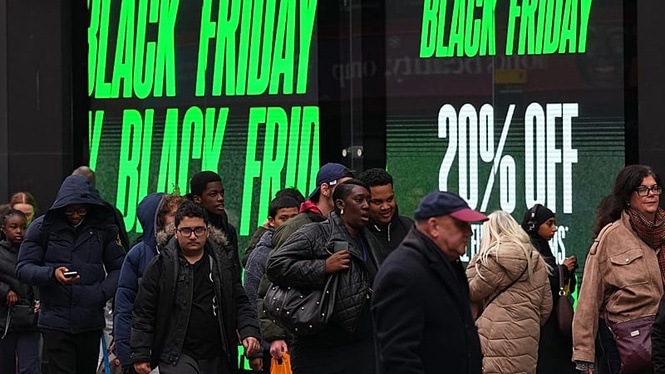
Shop windows across Europe are covered in discount signs today, from Lisbon to Warsaw. Whether people walk in and spend is another matter.
On the same day as Black Friday, the European Commission published its monthly survey of consumers, with a reading for each of the 27 EU countries. It asks households how they feel about their finances, what they expect for the wider economy and how much they plan to spend on big purchases over the next 12 months.
The confidence indicator averages the balances from four questions. A negative reading means negative answers carry more weight overall than positive ones.
For the euro area as a whole, confidence stood at -16.9 in November, confirming last week's early estimate. That is a one-point improvement on October, but still well below the historical average of -10.7.
The backdrop explains much of the caution. Prices in the euro area rose 4% in the year to October, according to Eurostat, the fastest pace since September 2023, driven by energy costs.
Averages hide a lot, though. Country by country, the mood ranges from cautious optimism in Malta to deep pessimism in Greece.
Consumer confidence across the EU, November 2026
Greece stands alone at the bottom
Greek consumers are by far the gloomiest in the EU. Their confidence reading fell to -50.5 in November from -48.9 in October.
No other country comes close. Romania, the next most pessimistic, stands at -29.7.
Greek households have rarely been cheerful, with a historical average of -40.5. Even so, November's reading sits ten points below that already low bar.
Prices are part of the story. Annual inflation in Greece reached 5.7% in October, the fourth-highest rate in the EU, while Romania recorded the highest at 7%, Eurostat figures show.
After Greece and Romania come Estonia (-29.2), Bulgaria (-28.4), and Italy and Portugal, both at -24.9.
Estonia is the most striking case. Its reading is almost 18 points below the country's own historical average, the widest gap anywhere in the EU.
Italians are holding back on big purchases
For retailers counting on Black Friday, one question in the survey matters more than most. It asks whether households plan to spend more or less on major purchases, such as furniture, appliances or electronics, than they did over the past 12 months.
In Italy, the answer turned sharply more negative. The balance dropped to -46.5 in November from -40.4 in October, far below the country's historical average of -25.1.
Only Romanian households are more reluctant, at -47.4. Greece follows at -43.9.
Italy's overall confidence also slipped to -24.9, its weakest reading in at least a year.
At the other end of the scale, Lithuania (5.0) and Malta (3.4) are the only EU countries where, on balance, households plan to spend more on big purchases over the next 12 months than they did over the past year.
Malta, Spain and Lithuania lead the optimists
Malta is the only EU country with a positive consumer confidence reading, at 2.9.
Spain comes second at -1.1, its best level in at least a year and above its own historical average of -2.4. Lithuania follows closely at -1.4.
Hungary (-5.1) and Sweden (-7.7) complete the top five.
Hungarian consumers tell a different kind of story. Their reading is still negative, but it sits 17 points above the country's historical average of -22.1, the biggest positive gap in the bloc.
In total, eight of the 27 member states now show confidence above their own long-term norms: Malta, Spain, Lithuania, Hungary, Czechia, Luxembourg, Croatia and Poland. Many of them are in central and eastern Europe.
Slovenia sits exactly on its average, while the remaining 18 countries are below theirs.
The big economies sit in the middle
Germany, the EU's largest economy, scored -14.3, a touch better than in October. France improved to -20.2 from -21.9, while the Netherlands slipped to -16.6 from -19.0.
National surveys published earlier this week point to the same cautious mood.
"Lower taxes on fuel are doing little to lift spirits among German consumers," Melanie Debono, senior Europe economist at Pantheon Macroeconomics, said in a note on Thursday, commenting on the GfK survey of German households.
In France, households grew less worried about their finances and jobs in November, but their willingness to spend on big items weakened further in the INSEE survey.
"The outlook for near-term spending is downbeat, based on these data," Claus Vistesen, chief eurozone economist at Pantheon Macroeconomics, said in a note on Wednesday.
Saving rather than spending
Across the euro area, households are leaning towards putting money aside. The survey's balance on savings intentions over the next 12 months rose to 10.0 from 8.9, compared with a historical average of -2.9.
Luxembourg leads at 52.6, while in Germany the balance rose to 23.2 from 20.8.
There is one piece of better news for shops. Consumers' expectations for price rises eased. The balance on price expectations for the next 12 months eased to 30.0 from 33.8 in the euro area, although it remains well above its average of 21.4.
The wider picture is not one of collapse. The Commission's broader economic sentiment indicator, which also covers businesses, fell to 95.8 in the euro area, dragged down by industry.
"Down sharply, but recession risks remain low," Vistesen said in a note on Friday.
For Europe's retailers, that may be the real Black Friday problem. Consumers are not in crisis, but many of them are in no hurry to spend.