
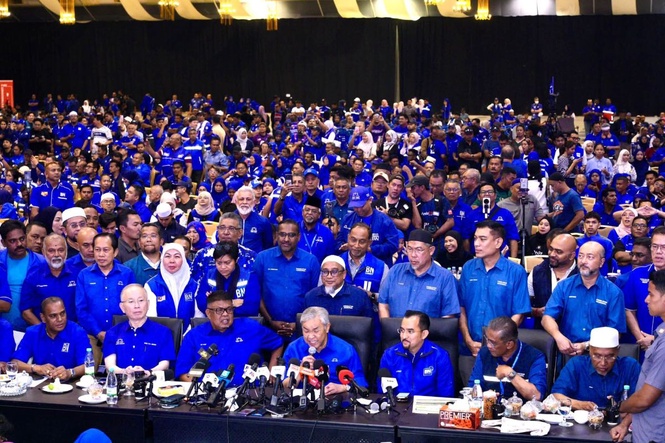
KUALA LUMPUR: Closer cooperation between Umno and Pas could give MCA and MIC an opportunity to regain electoral relevance ahead of the next general election, says a political analyst.
Associate Professor Dr Azeem Fazwan Ahmad Farouk, director of Universiti Sains Malaysia’s Centre for Policy Research, said recent state election results suggested that Malay voters were increasingly rallying behind Umno and Pas, potentially creating opportunities for their coalition partners to win seats in mixed constituencies.
In the Melaka state election on Nov 14, Umno and Pas secured a combined 21 seats. MCA retained both its seats through Datuk Ngwe Hee Sem in Machap Jaya and Datuk Lim Ban Hong in Klebang, while MIC held its sole seat through newcomer Nadarajah Sellappa in Gadek.
Pakatan Harapan (PH) was reduced to four seats, all won by DAP, while PKR and Amanah failed to win any of the 17 seats they contested.
A similar pattern emerged in Johor, where MCA won eight state seats, two more than DAP, while MIC captured four. PKR and Amanah secured one seat each, while Umno won 36.
MCA fared less well in Negeri Sembilan in August, winning two seats. One was Chennah, where Siow Kong Choon defeated DAP secretary-general Anthony Loke, who had held the seat for 13 years.
Umno emerged as the biggest winner in Negeri Sembilan with 16 seats, followed by DAP with nine, Pas with four and PKR with two. Amanah and MIC failed to win any seats.
Azeem said the results pointed to a gradual return to a political configuration resembling the pre-2018 arrangement, with one major difference – Pas could now become a key player in an alliance with Umno.
“In mixed-seat areas, say, if there are 40 per cent Malay voters, the combined forces of Umno and Pas can prop up candidates from MCA, MIC or even Gerakan, which is part of Perikatan Nasional,” he said.
“The political realignment will evolve towards a pre-2018 arrangement, with one distinction – Pas is likely to be part of that larger coalition, or they can decide to have a strategic alliance with Umno.
“The smaller Malay parties are fragmented. Bersatu and Amanah are not heavyweights in Malaysian politics. Amanah only has seven parliamentary seats. Not a single state in Malaysia is controlled by Amanah. Amanah is a small fry, for lack of a better word, and Bersatu without Pas is nothing.”
He said closer cooperation between the Malay-based parties could also help restore the confidence MCA and MIC had lost after their poor performances in the 2018 and 2022 general elections.
“This change is breathing new life into MCA and MIC. This is something many didn’t consider after what transpired in the last two general elections,” he said.
While PH’s declining electoral fortunes and efforts to regain support have attracted much attention, Azeem said winning back Malay voters would be a difficult task.
“It’s not going to be easy for PH to win back the hearts and minds of Malay voters. I think Malay voters have more or less made up their minds about which political coalition they want to support, at least the majority of them. This is reflected in the election results across three states,” he said.
He said the emergence of new political players, including Bersama, could further complicate PH’s efforts to recover lost ground.
“It can’t be done within a short period. Don’t forget there’s also Bersama. Even though the new party lost its deposits in Melaka, it might do well in urban seats in the coming elections,” he said.
“Bersama could cancel out whatever gains PKR might try to attain. As it stands, a lot of doors are closed for PKR under the current circumstances.”
Azeem also pointed to the upcoming Sarawak state election as another challenge for PKR, saying the state’s distinct political dynamics would make it difficult for the party to expand its influence.
“Sarawak is next, and the Sarawakians have their own mindset. I don’t think there is much hope for PKR over there. DAP might do better,” he said.
He said PH’s uneasy relationship with Umno was another major challenge. The two parties have longstanding political differences but are now compelled to work together in the unity government.
“That is one of the reasons BN and PN agreed to work together in Melaka. That could be the way forward for the next general election,” he said.
“As it stands, Barisan Nasional is in the driver’s seat. PKR and Pakatan Harapan need to find a way to regain lost ground, but time is not on their side.
“BN and Umno will make the government’s life difficult from now until GE16.”
Image: Facebook/MCA
