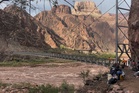
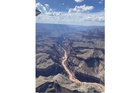
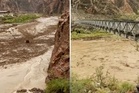
One person died and 15 people remained unaccounted for after “significant flash floods” in the Grand Canyon, according to park officials.
Flash flooding inundated Bright Angel Canyon, a popular hiking trail, and Phantom Ranch areas of the park starting around 2:30 p.m. Saturday.
The body of a 46-year-old man was recovered Sunday evening near Crystal Rapids along the Colorado River, the park service said without providing additional details. Officials from an Arizona coroner's office were on scene.
The flood pushed large boulders into the Colorado River and knocked out the sole water pipeline that serves tourists and residents, the National Park Service said Sunday.
“These were individuals either on a backcountry itinerary in the inner canyon or believed to be day hiking along the North Kaibab/Phantom Ranch area,” Grand Canyon National Park spokesperson Joelle Baird, a spokeswoman told The New York Times.
On Sunday morning, two helicopters from the National Park Service and Arizona Department of Public Safety searched the North Kaibab Trail and Colorado River from the mouth of Bright Angel Creek to Deer Creek Narrows.
The National Park Service initially said 20 or more people were missing or unaccounted for but later revised its count.
The flooding Saturday in Bright Angel Creek, which flows into the river, led to more than 60 people being airlifted from the depths of the canyon. The park service asked anyone with details about hikers or campers still unaccounted for to get in touch. The Arizona Department of Public Safety was helping with additional evacuations Sunday.
More evacuations were scheduled from Cottonwood Campground and Phantom Ranch.
“The NPS is conducting an air evacuation of approximately 50 individuals from the Phantom Ranch area,” an active NPS alert reads.
The flooding also knocked out the sole water pipeline serving the park.
“The flooding caused extensive damage to infrastructure in the inner canyon, including the Transcanyon Waterline, which supplies water from the canyon for use in the park,” the National Park Service said in a statement. “The waterline is currently not operational, leaving the park with limited water reserves and requiring significant water conservation measures to ensure available supplies can be maintained.”
The damage prompted organizers to cease overnight hotel accommodations beginning on Monday and order dry camping across the park.
The limited potable water supply because of the damaged pipeline means tourists won't be able to stay overnight at lodges and hotels within the park, starting Monday. Year-round residents are being asked to conserve water.
“These measures are crucial for ensuring the safety and sustainability of water resources,” the park said in a statement.
A flood watch has been issued in the park through the end of the day Monday. Showers and thunderstorms are expected to develop throughout Sunday afternoon and evening, with conditions expected to worsen overnight into Monday.
“Flash flooding will be possible in creeks, normally dry washes, swimming holes, and over recently burned areas,” the Park Service said. “Raging killer currents will be possible in side canyons and narrow slot canyons. Low-water crossings may be flooded.”
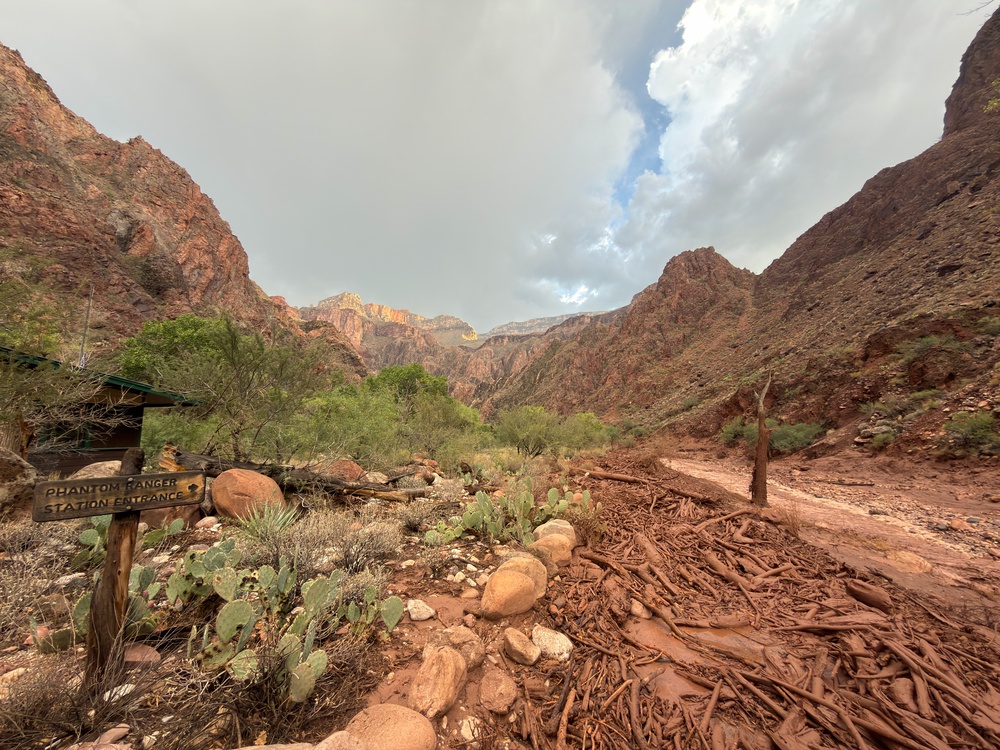
The entirety of the North Kaibab Trail, Phantom Ranch, and Silver and Black Bridges are closed until further notice.
“There is currently no estimated reopening date for these areas and other inner canyon closures may be necessary,” the Park Service said in a statement to The Washington Post.
The Colorado River is also closed due to debris.
Visiting the Grand Canyon, a crown jewel of the national park system, can be particularly dangerous in the summer because of the risk of flash flooding that accompanies the monsoon, or rainy season. Clear days can give way quickly to thunderstorms and downpours.
Parth Desai was hiking through a narrow passage in Bright Angel Canyon with fellow physicians and a park ranger when heavy rain started falling Saturday.
“We saw the creek flood, waterfalls coming up out of nowhere, boulders, mud, landslides happening everywhere,” he said.
Later, as they made their way toward Phantom Ranch, a colleague shouted “Up, Up, Up, Up!” as a 4-foot (1-meter) debris wall headed toward them and they ran up into a patch of cacti, he said. They were rescued by helicopter late Saturday after making it to the Phantom Ranch area, he said.
Prior to the flooding, three hikers died from extreme heat in the canyon in June.
Phantom Ranch is a historic lodge in the Grand Canyon National Park near the bottom of the Grand Canyon by Bright Angel Creek.
The flash floods totaled one-quarter to three-quarters of an inch in 30 minutes, the National Weather Service said.
Torrents of water wiped out footbridges over the creek and altered the landscape, widening the creek bed and extending an existing river rapid or creating a new one. The flood was a major blow to an enduring effort to modernize the pipeline that serves 6 million visitors a year and roughly 1,600 residents of Grand Canyon Village.
“Heaven help us if the whole thing down there at the bottom has to be reconstructed,” said Jack Schmidt, director of the Center for Colorado River Studies at Utah State University. “Where are they going to get the money?”
The rain caused flooding in and around the Bright Angel Creek Basin below the Dragon Bravo Fire scar, the weather service added. Heavy creek flow was ongoing as a result.
The American Red Cross also opened a shelter at Grand Canyon High School in Grand Canyon Village.