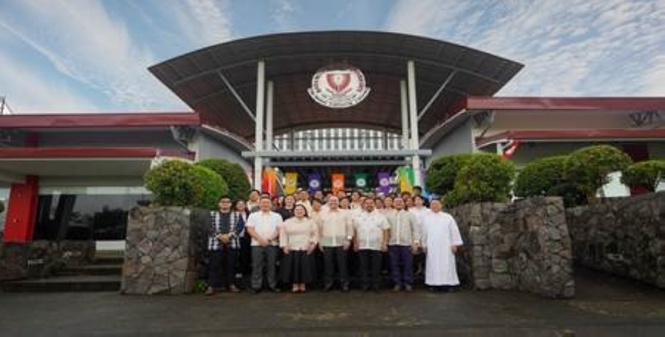
UNIVERSITIES, schools, and other educational institutions are among the landmarks that many developers usually point to in seeking to attract customers to purchase units in the residential communities they are marketing. In contrast, Aboitiz Economic Estates decided to partner with Batangas State University (BSU) to launch the LIMA Campus in Lipa-Malvar to attract more investment into the area. Their objective: to generate more jobs; employ more people, especially skilled graduates; and grow families who can buy their own homes.
The BSU-LIMA Campus is a “catalyst,” said Rafael Fernandez de Mesa, president and CEO of Aboitiz Economic Estates and Aboitiz Land during the press conference following the campus’ opening on Aug. 17, which added 800 first-year engineering students. He described their expectations: “We have the talent here in Lima, we expect more companies to invest here in Batangas. The job generation that will be created has a spillover effect on the economy.”
He emphasized that this venture is “very different probably from what you’re used to seeing when a developer brings a university into their township. Most of those townships are residential or commercial-based; the true intent really is to sell houses.”
He added, “Ours is very different. We’re putting a university here so we can attract more investment into the Philippines.”
The interim campus marks the first operational phase toward the planned 10-hectare Batangas State University-LIMA Campus, envisioned as the Philippines’ first learning hub for industry-based learning. The model brings engineering education closer to manufacturing, technology and actual workplace requirements, giving students opportunities to apply classroom learning in an environment shaped by evolving industry needs.
LIMA Estate, located in Lipa-Malvar, Batangas, is a 1,100-hectare industry-anchored development home to more than 200 companies and 75,000 workers. Its concentration of manufacturing and business activity provides a strong environment for connecting engineering education with the skills, technologies, and career opportunities shaping the region’s industrial growth.
De Mesa projected that LIMA Estate will grow by an additional 500 hectares over the next 10 years. The current industries hosted by the estate revolve around “electronics, semiconductors, automotive, food manufacturing, and the supply chains that service” them. About 40 percent of these companies come from Japan, 15 percent from China, another 15 percent from Taiwan, and the remaining 30 percent are a mix of European, American and Filipino companies.
Workforce capabilities and their ability to upgrade are among the first things that locators look at before they make that decision to move into a region. BSU University President Dr. Tirso Ronquillo listed some of their questions: “Can I recruit the scale my operations require? Do workers have the capabilities that I need today? As technology and production processes evolve, can my workforce evolve with them? Can I continue building and sustaining that capability over the long term?”
All those concerns “affect productivity, expansion decisions, operating continuity and ultimately the attractiveness of a location for investment,” Ronquillo added. “By locating a university campus inside an economic estate, we are bringing education much closer to the industries that will eventually employ many of the students.”
While manufacturing and engineering remain the anchor of both the campus’ education focus and the employment thrust of the locators, careers are also emerging across industries like IT-Business Process Management (IT-BPM), retail, hospitality and education.
The Lima Estate acquired another 40 hectares to expand its business district or BizHub, said Malcolm Santiago, who heads the operations and the commercial business unit of the Aboitiz Economic Estates. Located within it is the 11-story LIMA Tower 1 which has a 50 percent occupancy rate, with about 95 percent of the companies belonging to the IT-BPM industry. Construction of Tower 2 will begin once Tower 1 reaches an occupancy rate of 80 to 85 percent.
The original plan was to build seven buildings, at the rate of one building over two years, during the next decade. Each of the buildings is expected to cost P1 billion.
Lima Exchange, the commercial side of BizHub, is expected to attain a 100 percent occupancy rate this year. The 7,000-square-meter commercial space hosts banks, a supermarket, restaurants and bookstores; it experiences foot traffic of 22,000-23,000 individuals a day.
“Industrial competitiveness increasingly depends not only on infrastructure and investment capacity, but on whether companies can access the skills they need as technologies and production requirements evolve,” De Mesa said. “The Batangas State University-LIMA Campus is one way we are responding to that challenge by bringing education closer to industry and building a stronger, more sustainable talent pipeline for the businesses and communities growing alongside LIMA Estate.”