.png)
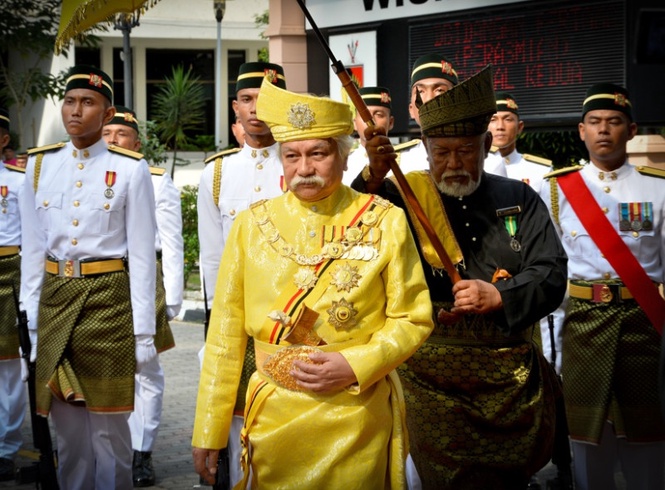
RECENTLY, there were unprecedented attempts to remove His Royal Highness Tuanku Muhriz Tuanku Munawir as the Yang di-Pertuan Besar of Negeri Sembilan. The imbroglio is unfolding into not just matters of internal dispute concerning the institutions of the Yang di-Pertuan Besar and the Undangs, but a serious constitutional crisis which raises fundamental questions concerning the rule of law, the limits of constitutional powers and the existence and extent of royal prerogatives.
HRH Tuanku Muhriz has served as the Yang di-Pertuan Besar of Negeri Sembilan for almost 18 years. During this period, he has conducted himself with the dignity, restraint and propriety expected of a respected constitutional Ruler.
The Dewan Keadilan dan Undang (DKU) Negeri, a body established under Article 16 of the State Constitution of Negeri Sembilan (State Constitution), had declared that the 19 April 2026 purported proclamation to depose HRH Tuanku Muhriz was unconstitutional, null and void. It found that three of the four individuals behind the purported proclamation had no valid customary standing to speak for the Luaks of Sungei Ujong, Rembau and Jelebu.
The DKU also pointed out that no complete enquiry as required by Article 10(1) of the Constitution of the State of Negeri Sembilan was ever conducted; and that the Menteri Besar at the material time (Datuk Seri Utama Aminuddin Harun) had refused to sign the invalid purported proclamation by reason of its deficiencies. The DKU had unequivocally affirmed that HRH Tuanku Muhriz remains the lawful Yang di-Pertuan Besar. The DKU declared that under the State Constitution, the State Executive Council (State Exco) has no authority to determine who is the lawful Yang di-Pertuan Besar.
Article 10 of the State Constitution provides a specific constitutional framework governing the disqualification and removal of the Yang di-Pertuan Besar, including defined grounds, procedures and safeguards.
The Attorney-General's Chambers (AGC) has also stated in its media statement that the purported proclamation of April 19 was invalid for failing to comply with Article 10, in that there was no evidence that any of the disqualifying factors under Article 10(1) applied to HRH Tuanku Muhriz. There was also no evidence that the procedures prescribed by the said Article had been complied with.
Accordingly, the AGC declared that the current Menteri Besar (Datuk Ismail Lasim) and members of the State Executive Council have no power to unilaterally remove or declare vacant the office of the Yang di-Pertuan Besar. The AGC further stated that the State Executive Council's subsequent announcement purporting to recognise HRH Tuanku Muhriz's removal had no legal effect.
The Menteri Besar had taken an oath of loyalty before His Royal Highness on Aug 2, 2026, upon his appointment as Menteri Besar, yet the very next day (Aug 3) and unbeknownst to His Royal Highness, he had signed a purported proclamation calling for the abdication of His Royal Highness. This was not made known to the public — not until Sept 5, when there was an announcement by the four Undangs that the Menteri Besar Datuk Ismail Lasim had signed the purported proclamation.
The legitimacy of three of the Undangs — Datuk Mubarak Thahak (Sungai Ujong), Datuk Maarof Mat Rashad (Jelebu) and Datuk Abd Rahim Yasin (Rembau)— is contested, as the DKU has deposed them and installed successors.
However, about a month later, on Sept 9, the Menteri Besar issued a statement to the effect that he had affixed his signature to the purported proclamation not voluntarily but "upon duress" and had lodged a police report. He also asserted that the purported proclamation was invalid by reason of non-compliance with the State Constitution.
Yet, more perplexing still, on Sept 16, the Menteri Besar and members of his State Executive Council (State Exco members) issued a public statement recognising the validity of the purported proclamation of April 19 and calling for the abdication of His Royal Highness.
This prompted the AGC to issue a media statement on Sept 17 declaring that the Negeri Sembilan State Exco’s decision recognising the removal of Tuanku Muhriz Tuanku Munawir as the State Ruler was invalid and had no legal effect. The AGC said the Menteri Besar and State Executive Council members did not have unilateral powers to terminate or vacate the ruler’s office, adding that the proclamation’s validity and effect must be determined through lawful constitutional and legal process.
Subsequently, the appointments of the members of the State Executive Council were revoked by His Royal Highness pursuant to Article 38(5) of the State Constitution with effect from Sept 20, 2026 and has been gazetted by the State administration via Negeri Sembilan State Gazette N.S P.U. 18 dated Sept 24, 2026. The revocations were done by reason of violations of their oaths of office.
But the Menteri Besar and the members of the State Executive Council were adamant and had refused to recognise the revocation, and had publicly announced their defiance. As a consequence, the State administration acted to lock out the State Exco members from entering their respective offices so as to prevent them from carrying out official duties because their appointments had been revoked.
The act of calling for the deposition of a Ruler is a serious crime. It is the crime of treason. Under section 121B of the Penal Code, the act of treason is punishable with mandatory imprisonment for a minimum of 30 years and not more than 40 years. It is also a crime of sedition under section 4 of the Sedition Act of 1948.
Now, Article 38(5) of the Constitution of the State of Negeri Sembilan provides –
(5) Subject to Clause (4), a member of the Executive Council other than the Menteri Besar shall hold office at the Ruler’s pleasure, unless the appointment of any member of the Executive Council shall have been revoked by the Ruler on the advice of the Menteri Besar, but any member of the Council may at any time resign his office.
The question arises: Can the Yang di-Pertuan Besar of Negeri Sembilan lawfully revoke the appointments of the members of the State Executive Council?
The learned Attorney General, Tan Sri Mohd Dusuki Mokhtar, in his media statement, takes the position that the revocation of the appointments of the 10 Negeri Sembilan Exco members was valid under the State Constitution (New Straits Times Sept 26, 2026). This is because a State exco member, apart from the Menteri Besar, holds office at the pleasure of the Yang di-Pertuan Besar.
The Negeri Sembilan Menteri Besar, Datuk Ismail Lasim, disputed the legality of the revocation of the State Exco members’ appointments by the Yang di-Pertuan Besar. He asserted that the Yang di-Pertuan Besar could not unilaterally terminate an Exco member’s tenure, arguing that such an action must be made on the advice or request of the Menteri Besar.
I concur with the position as taken by the AGC.
In my view, the Yang di-Pertuan Besar has the power to revoke the appointments of the 10 Exco members since they had violated their oaths of office which they had taken before His Royal Highness on the day of their appointments. The oaths were taken pursuant to Article 39 read with Part I of the Schedule of the State Constitution.
Not only had the 10 State Exco members violated their oaths of office: they had also committed acts of treason and of sedition against His Royal Highness. Such a power of revocation on the part of the Yang di-Pertuan Besar exists by reason of the royal prerogative conferred upon His Royal Highness by Article 38(5) of the State Constitution of Negeri Sembilan. Such prerogative is housed in the phrase "…shall hold office at the Ruler’s pleasure…".
His Royal Highness has the royal prerogative to revoke their appointments when faced with such an extraordinary and rebellious situation. The 10 State Exco members whom he had appointed had, a few days later after pledging an oath of loyalty, illegally and unconstitutionally called for the removal of His Royal Highness as the State ruler. An unthinkable conduct. As mentioned earlier, such an act was a crime of treason. It was also a crime of Sedition.
To my mind, it is absurd to suggest that under such extreme and extraordinary circumstances His Royal Highness was legally helpless and could only dismiss the exco members upon the advice of the Menteri Besar, when the Menteri Besar himself had also advocated for his removal.
Such power of royal prerogative of the Ruler, as aforesaid, housed in Article 38(5), is preserved by the State Constitution in Article 79 which states –
Prerogatives of the Ruler reserved.
LXXIX. Except as expressed herein, this Constitution shall not affect the prerogatives, powers and jurisdiction of His Highness and the Ruling Chiefs.
In my opinion, the words –
unless the appointment of any member of the Executive Council shall have been revoked by the Ruler on the advice of the Menteri Besar
as found in Article 38(5), should only mean that the Ruler must revoke the appointment of a State Exco if he is so advised by the Menteri Besar. But this constitutional obligation on the part of the Ruler to act on the advice of the Menteri Besar cannot be interpreted to mean that, whatever the circumstances is, the Ruler could only revoke the appointment of an Exco member on the advice of the Menteri Besar; meaning that in the absence of such advice by the Menteri Besar, members of the State Exco are at liberty to violate their oaths of office; and could commit acts of treason and sedition against the State ruler with impunity. Such an interpretation cannot be correct and would only lead to anarchy.
In my view, such aforesaid words of Article 38(5), as mentioned in the preceding paragraph, do not take away the royal prerogative vested in His Royal Highness by the preceding words –
…shall hold office at the Ruler’s pleasure…
Royal prerogatives of a constitutional monarch are inherent in modern constitutions to deal with unusual and pressing situations, but to be resorted to only sparingly to maintain justice and the Rule of Law. Of course, there have to be checks and balances: the use of the power of prerogatives will be controlled by the Courts. In the case of Negeri Sembilan, such royal prerogatives are preserved by Article 79. In the context of the current Negeri Sembilan constitutional crisis, royal prerogative power was appropriately and wisely exercised by His Royal Highness for the good of the State.
Datuk Seri Mohd Hishamudin Yunus
Former judge of the Court of Appeal
(This Opinion piece first appeared in The Edge )


.jpeg)