In April 1999, one of India’s most celebrated police officers arrived in Chandigarh as its new Inspector General of Police, rationalised VIP security, announced reforms and clashed spectacularly with the administration — all in 44 days, before being transferred out.
Kiran Bedi’s lightning tenure as Chandigarh IGP remains one of the most-talked-about episodes in the force’s history. Twenty-seven years later, as Chandigarh Police marks its Diamond Jubilee and unveils its logo for 60 years of service, it does so as a force unrecognisable from the one that couldn’t contain its own IGP — now the holder of India’s fastest emergency response record, a 6,000-strong tech-driven outfit that Dr Sagar Preet Hooda, a man who first served here as a young ASP in 1997, now heads as DGP.
On Thursday, Dr Hooda unveiled the Diamond Jubilee logo at a ceremony that signalled the launch of a year-long series of commemorative events. The occasion also saw the felicitation of school students who had participated in a logo design competition, with the winning entry becoming the official emblem for all Diamond Jubilee activities.
Born of bifurcation
Chandigarh Police was formed as a distinct law enforcement agency on November 1, 1966, upon Chandigarh’s designation as a Union Territory and joint capital of Punjab and Haryana, following the Punjab Reorganisation Act, 1966, which bifurcated Punjab to create Haryana. Prior to that date, policing in the planned city — under construction since the early 1950s as Punjab’s new capital — was administered by the Punjab Police. The inaugural head was Senior Superintendent of Police VK Kalia, overseeing an initial force adapted to the territory’s unique urban layout and administrative status.
The post of Inspector General of Police was created in 1981, with 17 IGPs serving in that role over the ensuing decades. The force’s most storied — and shortest — top command came in 1999, when celebrated IPS officer Dr Kiran Bedi was posted as Chandigarh IGP, though she remained in the post for only 40 days before a public disagreement with the administration led to her transfer. The posting, brief as it was, underscored the force’s national visibility even in its early decades.
The rank structure was elevated significantly in 2017, when the position of Director General of Police was created on February 20, with Tajender Singh Luthra, becoming the first appointee.
From 16 stations to a 6,000-strong force
Chandigarh Police today operates 16 police stations and 18 police posts, with a staff strength of approximately 6,000 men and women. The force is structured around specialised wings covering operations, crime, security, traffic, training, and crimes against women and children. With 5,295.6 policemen per 100 sq km, Chandigarh has the highest police density among all states and Union Territories in India.
The force’s annual budget stands at over Rs 508 crore, and its jurisdiction covers 114 sq km of the UT — a compact but densely populated urban canvas that demands round-the-clock, high-precision policing.
Technology comes to the fore
Modernisation has been a recurring theme across the decades. The Crime and Criminal Tracking Network and Systems (CCTNS), a national platform to facilitate information sharing among police stations, was rolled out in Chandigarh with all 16 stations provided leased-line connectivity and records of the past 10 years digitised. An automated fingerprint identification system and a cybercrime reporting portal followed in subsequent years.
More recently, cybercrime enforcement expanded significantly, with 150 cyber fraud cases registered and 147 accused arrested across multiple states in 2025 alone. Police froze or blocked Rs 11.21 crore of cheated money, blocked hundreds of suspicious mobile numbers and conducted raids across high-risk regions, with major breakthroughs including the busting of transnational “digital arrest” syndicates, fake trading platforms and high-value impersonation scams.
Community policing programmes such as Samavesh, Cyber Swachhta Mission and SWAYAM self-defence camps have become signature initiatives, extending the force’s outreach deep into schools, colleges, women’s groups and senior citizen communities.
Pioneers of the new criminal laws
The Diamond Jubilee also coincides with another landmark. Chandigarh was the first in the country to fully implement all three new criminal laws when they came into effect on July 1, 2024 — the Bharatiya Nyaya Sanhita (BNS), Bharatiya Nagarik Suraksha Sanhita (BNSS) and Bharatiya Sakshya Adhiniyam (BSA), which replaced the colonial-era Indian Penal Code, the Code of Criminal Procedure and the Indian Evidence Act, respectively. Every police station in Chandigarh was equipped with special tablets built on blockchain technology, ensuring that audio-visual evidence recorded through them remains tamper-proof, with the server integrated with the Central Government’s DigiLocker platform. The early adoption has already yielded measurable results: between July 2024 and June 2025, a total of 3,154 FIRs were registered under the new laws, nearly half of them filed online, with 758 charge sheets submitted and 71 convictions secured out of 78 decided cases — a conviction rate of over 91 per cent. The average time to conviction dropped sharply from 300 days to 110, attributed to better coordination and digital case management.
A national benchmark on emergency response
Perhaps the most tangible metric of the force’s recent transformation is its emergency response record. Chandigarh Police set a national benchmark by recording the fastest average emergency response time in India at 5.6 minutes in 2025, improving upon its own previous record of 6.31 minutes. According to Union Home Ministry data, this placed Chandigarh well ahead of the national average of 18.61 minutes.
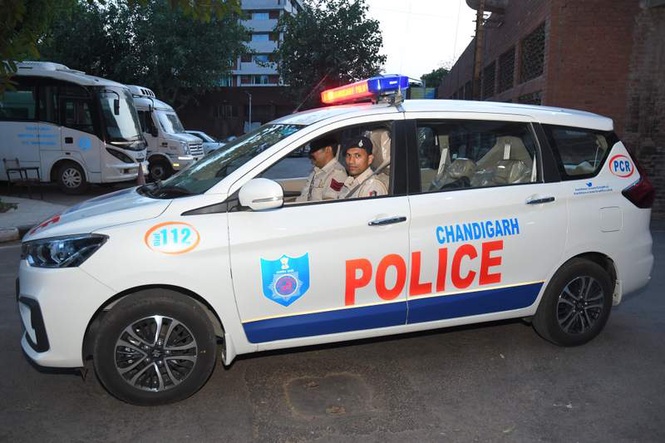
The achievement was driven by upgrading the Police Control Room fleet with 26 new Maruti Ertiga vehicles added to an existing fleet of 78 vehicles, along with GPS-enabled monitoring and enhanced quick response teams. The PCR’s response time has improved steadily over five years — from 7.09 minutes in 2021 to the current 5.6-minute record.
Heinous crimes dipped from 418 cases in 2024 to 412 in 2025, even as 88.6 per cent of such offences — including murder, attempt to murder, rape, kidnapping, robbery and extortion — were worked out.
The man who grew with the force
The Diamond Jubilee has a particularly personal resonance for the officer presiding over it. Dr Hooda, a Haryana native, joined the AGMUT cadre of the Indian Police Service in August 1997 and was posted as Assistant Superintendent of Police in Chandigarh Police straight out of the academy, making the City Beautiful the very first canvas of his policing career. Twenty-eight years later, he returned to the same force — this time as its Director General — having been appointed to the top post on July 15, 2025. In the intervening decades, he rose through a distinguished arc that included stints as Joint Commissioner of Police, Special Commissioner (Law and Order), and Special Commissioner of Police (Intelligence) in Delhi, with additional charge of the Perception Management and Media Cell, the Special Police Unit for Women and Children, and the Special Police Unit for the North-Eastern Region. Simple and unassuming, Dr Hooda told The Tribune in his first interview that he was committed to implementing new legislation, strengthening intelligence-led crime prevention, expanding community engagement and leveraging smart policing technologies — with particular dedication to improving safety frameworks for women, senior citizens and children, and elevating cyber surveillance to address emerging threats. A Panjab University alumnus who holds multiple degrees from universities abroad, he turns 57 this August 30 — heading a force he first served at 28, now steering it through its Diamond Jubilee year.
Youth connect at the jubilee
As part of the Diamond Jubilee launch, Chandigarh Police had organised a logo design competition for students of government and private schools across the city, drawing participation from approximately 450 students. The first prize went to Bhuvnesh Sharma of Class X, Ryan International School; the second to Meenakshi of Class XII, GMSSS Sector 23; and the third to Rakshit Kumar of Class IX, GMSSS Karsan. The winning logo will serve as the official Diamond Jubilee emblem across all events through the year.
Speaking at the ceremony, DGP Dr Hooda said the six decades represented a continuous evolution — from a force built to police a newly-planned city of a few lakh residents to one managing the complex demands of a metropolis with a population exceeding one million. The Diamond Jubilee, he said, was both a moment to take stock and a reaffirmation of the force’s commitment to professional excellence and public trust.
A series of public outreach programmes, sporting events, cultural activities and awareness campaigns are planned through the jubilee year.