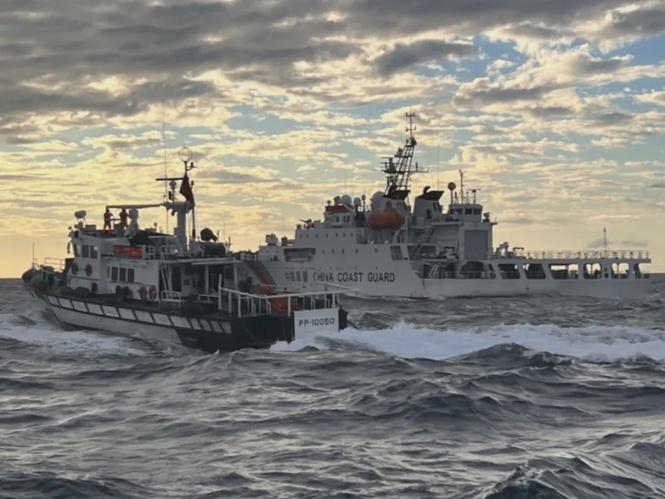
China Coast Guard ship 2503, the Zhujiajian, has become a familiar presence in the waters east of Taiwan. Lu Wen-hao, a researcher at the Chinese Society for Strategic Studies, argues that the ship deserves more attention than a routine patrol report suggests. In his view, the Zhujiajian is the clearest sign yet that China's coast guard is no longer just adding hulls. It is absorbing the engineering of China's most capable destroyers and using it to push law enforcement operations farther out to sea.
A Gray Zone That Is Shifting From The Navy To The Coast Guard
Lu wrote four pieces for Storm Media in June arguing that Beijing would use the joint maritime delimitation effort between Japan and the Philippines east of Taiwan as a pretext to make patrols by its coast guard, maritime agencies and research ships a regular feature of the area. He says events since then have borne that out. Some scholars quoted in recent media reports have reached a similar conclusion, describing a shift in the Taiwan Strait from naval gray zone activity toward the expansion of jurisdiction and patrolled waters by China's coast guard, maritime and research fleets.
The military pressure has not eased. Ahead of Taiwan's National Day on October 10, Lu predicted that the People's Liberation Army (PLA) would hold an October "joint combat readiness patrol," as it did on October 7 last year. On October 6, beginning at 2:54 p.m., 14 Chinese military aircraft sorties were detected, nine of which crossed the median line into Taiwan's northern and central airspace, alongside seven PLA warships. This time the PLA added a second round. From 8:52 a.m. on October 9, it sent 19 sorties, including J-16, J-11 and Su-30 fighters, JH-7 fighter bombers, KJ-500 early warning aircraft, Y-8 electronic warfare aircraft and drones. Thirteen crossed the median line into Taiwan's northern, central and southwest airspace, supported by seven warships.
A defense ministry report on the morning of October 13 still showed five Chinese aircraft over the strait and in a broad area northeast of the Pratas Islands, including what Lu believes was an army helicopter crossing the median line southeast of Pingtan Island. Six PLA warships and four Chinese government vessels remained around Taiwan. With the northeast monsoon strengthening, Lu expects a third joint patrol this week involving fewer than 20 aircraft, and possibly an early PLA response to the US and Japan's Keen Sword exercise starting October 19 and Japan's planned deployment of long range shore based anti ship missiles on Yonaguni.
The Incident That Put Ship 2503 In Focus
What drew Lu to the Zhujiajian was an episode in early October. Media reports said that on October 1 the Philippine Coast Guard sent its largest patrol ship, the BRP Melchora Aquino, and an aircraft to waters off Ibayat Island in the Batanes to drive away the Chinese survey ship Jia Hai Ke 7. A chart released by Taiwan's defense ministry for that day showed three Chinese sorties between 3:20 a.m. and 12:45 p.m. west of the strait. One, which Lu identifies as a drone, flew from south of Kinmen past southwest of Penghu, down to south of Eluanbi and on to the southern edge of Taiwan's air defense identification zone, turning back near the airspace over Ibayat. Chinese sources said the Zhujiajian, which patrols east of Taiwan on a regular basis, was immediately sent to support.
The ship had already made headlines. On February 10 it led a formation on what China called a "rights protection patrol" near the Diaoyutai Islands. On September 29, the China Coast Guard officially announced that the Zhujiajian formation was conducting "regular law enforcement patrols" east of Taiwan and said it had been tightening control of the area since September. Taiwan's Coast Guard Administration said the same day that it was tracking the Zhujiajian and the Chongming (1401).
How The Analysis Was Built
Lu stresses that the question is not what to call ship 2503, but what its design says about how China now builds coast guard ships. To answer that, he cross checks five indicators: hull lineage, tonnage, shipyard and design source, mission equipment, and actual deployment. Hull lineage shows whether a ship is a purpose built coast guard design, a converted retired warship, a warship derived design or a repurposed survey or maritime vessel. Tonnage tracks the growth of ocean going capability. The design source shows how much technology the navy and coast guard shipbuilding programs share. Mission equipment separates combat systems from law enforcement, rescue, aviation and boarding gear. Finally, records of activity east of Taiwan and in surrounding waters from June to the end of September 2026 test whether new ships have entered routine service.
This framework, Lu argues, avoids the trap of treating any coast guard ship with a military hull as a warship. A retired Type 056 corvette handed to the coast guard is a converted warship. The coast guard's Type 818 is derived from the navy's Type 054A frigate design. Ship 2503, with a full load displacement of up to 6,500 tons, closely follows the navy's Type 052D destroyer, which displaces more than 7,000 tons fully loaded. Lu describes it as a redesigned coast guard platform, which he calls the "Type 501," built after absorbing the 052D's hull and design thinking. All three have military lineage, but they were built differently and serve different roles.
From Retired Warships To Purpose Built Patrol Ships
Over the past decade and more, China's coast guard has moved well beyond a coastal fleet. Its early ships were small and medium vessels for patrol, boarding, fisheries protection and nearshore enforcement. After 2014, large ships of several thousand tons began appearing in numbers. The service then received Type 818 ships based on the 054A frigate, took in retired Type 053H2G frigates and Type 056 corvettes, and from 2025 to 2026 added a large platform derived from the 052D destroyer.
The transfer of retired warships was the first major turning point. A warship hull has already been proven for speed, seakeeping, long deployments, communications, radar and handling. Media reports say 22 Type 056 corvettes were converted for coast guard use in 2021 and 2022, with missiles and fire control systems removed and large display screens and water cannons added. A coast guard does not need a full suite of anti ship and air defense weapons, Lu notes, but it does need endurance, speed to close on targets, the ability to sail in formation, room for boarding teams and small boats, and some means of self defense.
Retired ships come with limits, however. Their age, machinery, maintenance cycles and internal layout are all bound by their original military design. That pushed the coast guard from reusing old warships toward building new ships on warship designs. The Type 818, at roughly 3,500 to 3,800 tons, has a superstructure, aviation facilities and enforcement equipment redesigned for coast guard missions. Lu sees a clear path running from conversion to derivation to specialization, and that path leads to ship 2503.
Bigger Ships Stretch The Coast Guard's Reach
The second major stage was the rise of large ocean going ships as the backbone of the fleet. As missions expanded from fisheries management, port inspections and rescue to the East China Sea, the South China Sea and beyond, ships needed more fuel, water, food, spare parts, crew and small boats, along with helicopter decks, hangars and better communications. Ships 1401, 2501 and 2502 typify this stage. The 1401 class has a full load displacement of about 5,196 tons, a range of about 12,000 nautical miles and an endurance of about 45 days, while the 2501 class is around 5,500 tons or larger.
These ships are now operating for long stretches east of Taiwan. On July 4, Taiwan's Coast Guard Administration confirmed that China Coast Guard ships 2305 and 1401 were about 54 nautical miles east of Hualien. On July 31, both were still in waters off eastern Taiwan, with 2305 about 151 nautical miles east of Orchid Island and 1401 about 43 nautical miles northeast of it. On September 3, Taiwan tracked ships 1306 and 2502 about 105 and 74 nautical miles east of Green Island. Beijing said at the time that the Putuoshan formation was conducting regular patrols east of Taiwan and had stepped up control of the area since August.
For Lu, this shows the deployments are no longer occasional voyages but have begun to rotate, confirming his earlier forecast. Larger ships are not simply heavier, he notes. They stretch the distances over which the coast guard can operate. Once that becomes routine, the next demands are higher speed, larger aviation facilities, better radar, stronger seakeeping and greater resilience in rough weather. That sets the stage for a 052D derived design.
What The Type 052D Lineage Brings To Ship 2503
The navy's Type 052D is a large, high performance destroyer built around a big hull, phased array radar, vertical launch cells, ocean going range and shipborne aviation. Chinese state broadcaster CCTV reported on May 31 that the newest 052D, the Tongchuan (177), had joined the Southern Theater Command's navy as a frontline combat ship.
Ship 2503 brings that design thinking into the coast guard. Its hull proportions, bridge and mast arrangement show clear warship traits, but the superstructure has been redesigned and the stern flight deck greatly enlarged. Lu estimates the deck at about 40 meters long, compared with about 26 meters on the coast guard's 054A derived ships. The vertical launch system and the four panel phased array radar have been removed, the 130 mm main gun has been replaced by a 76 mm gun, and a Type 382 three dimensional search radar has been fitted. The propulsion has been left untouched: two GT-25000 gas turbines and two diesel engines in an alternating arrangement give the ship a top speed of more than 30 knots.
The bigger flight deck matters most, Lu argues, because it moves the ship from ship to ship enforcement toward combined air and sea enforcement. A coast guard helicopter can conduct long range searches, rescues, target identification, personnel transfers and maritime surveillance. Paired with long endurance and ample communications space, that allows the ship to serve as the command node of an ocean going patrol group. He sums up the shift as a move from repurposing warship platforms to turning warship engineering into coast guard capability.
East Of Taiwan Becomes A Testing Ground
Lu argues that the ship's significance became complete only when it entered service. China announced on June 1 that its coast guard had begun a new round of regular patrols east of Taiwan, and Taiwan's coast guard reported Chinese ships east of Orchid Island. The pairings since then form a clear timeline. In June, it was 2502 Daishan with 2304 Baita. In July, 2305 Xiushan with 1401 Chongming. In September, 1306 Putuoshan with 2502 Daishan. By late September, 2503 Zhujiajian with 1401 Chongming. What stands out, he says, is the steadily growing share of high performance ships.
The September 29 statements from both sides confirm that ship 2503 was not on a one off showcase voyage but operating in a working formation with 1401. Lu lists six things to watch: whether 2503 appears east of Taiwan on a fixed basis; whether it pairs regularly with large ships such as 1401 and 2502; whether a fixed rotation cycle emerges; whether helicopter operations increase; whether it works with other maritime, rescue and survey vessels; and whether its operations extend from eastern Taiwan to the southeast, the Pratas Islands and beyond. If these patterns persist, he says, China's coast guard will have moved from being a large fleet to an integrated ocean going enforcement force.
Geography adds weight to the trend. Unlike the Taiwan Strait, the waters off eastern Taiwan are deep and open directly onto the Western Pacific. Large coast guard ships there gain experience in long voyages, rough seas, formation communications and helicopter operations. Lu expects the lessons China's coast guard learned from fisheries enforcement patrols on the North Pacific high seas to be applied increasingly in the Western Pacific east of Taiwan. Operations there, he argues, provide both evidence of deployment and a real world test of the new hulls.
A Layered Fleet Rather Than A Navy In Disguise
Lu stresses that these stages overlap. Large purpose built ships such as 2502 and 1401 will keep being built and used. Converted Type 056 and 053H2G ships may still serve. The Type 818 remains an important force, and ship 2503 adds a new high performance tier on top. The result is a layered fleet: general enforcement ships close to shore, many medium ships in nearby seas, 054A derived ships for demanding missions, large ships such as 1401 and 2502 for distant waters, and 052D derived ships such as 2503 for the longest and most demanding deployments. This lets the coast guard match its ships to the waters, missions and sea conditions at hand.
That is why ship 2503 matters, Lu writes, though he cautions against overreading it. It does not mean the coast guard has become the navy, and its hull alone does not prove the coast guard has full combat capability. What it shows is that the engineering, hull technology and shipbuilding capacity behind China's best surface combatants are spilling over into the coast guard more deeply than before.
What Taiwan Should Watch Next
Lu argues that the old yardsticks, the number of ships and their tonnage, are no longer enough. Analysts should also track hull lineage, ocean going endurance, aviation capability, radar and sensors, formation command, patrol rotation and how far ships actually deploy. Key questions include whether more ships of the 2503 type appear, whether they are built as a series, whether they form fixed groups with 1401 and 2502, and whether their activity east of Taiwan and in the Western Pacific grows.
His conclusion is that China's coast guard is turning from a law enforcement fleet into a system of large, ocean going, multi role enforcement platforms, and that ship 2503 is the most telling example so far. This does not mean the missions of the coast guard and navy have merged, or that coast guard ships can replace warships. It means the lines between hull performance, shipbuilding technology, distant water operations and maritime law enforcement are being redrawn.
For Taiwan, Lu says, China's path offers lessons, but Taipei should be careful about simply adopting a strategy of using small forces against a larger rival. The first task is to solve the problem of detecting targets early in maritime law enforcement. And the question worth tracking over the long term is no longer how many Chinese coast guard ships show up, but what kind of ships they are, in lineage, tonnage, aviation capability and ocean going performance, and how they are rotated and grouped.
Lu Wen-hao is a researcher at the Chinese Society for Strategic Studies. The views expressed are the author's own.