FUZHOU, China — China called on international media to report on the gains and benefits of the Belt and Road Initiative (BRI) program to participating countries.
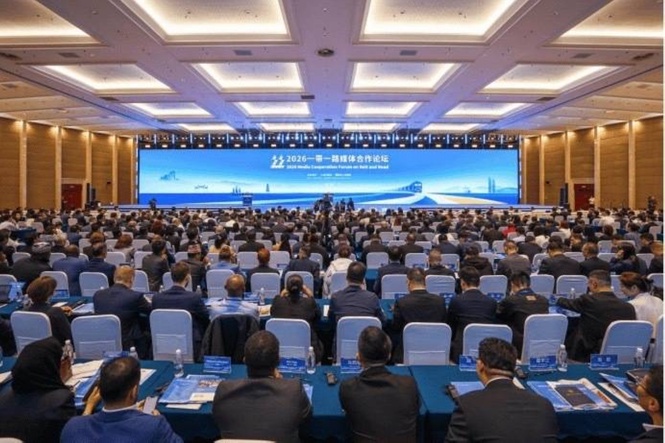
At the opening of the 2026 Media Cooperation Forum on Belt and Road here on Tuesday, Chinese officials and business leaders cited the need for global action in what they called “the world’s largest international platform for economic cooperation in terms of scale, reach and impact.”
Xian Hui, vice chairman of the National Communist of the Chinese People’s Political Consultative Conference (CPPC), said the BRI, which President Xi Jinping started in 2013, was no longer just focused on development and investment initiatives originally intended to link East Asia and Europe through physical infrastructure.
He said it has evolved into “modernist socialization,” which called for a “deeper alignment of development strategies, improving connectivity networks and balancing development with security by providing an environment that would bring peace, prosperity, openness and civilization.” Hu Heping, the executive deputy head of publicity for the department of the CPC Central Committee, said that amid the “rise of conflicts, unilateralism and challenges of copyright infringements,” there was a need to “build a consensus for development, tell stories that benefit people and deepen exchanges of cooperation by building bridges of communication.”
Zhang Tao, president of the China National Nuclear Corp.; Wang Jihang, president of the Agricultural Bank of China; Oleg Kopylov, deputy secretary general, Shanghai Cooperation Organization; Miao Jiianmin, chairman, China Merchants Group; Zhao Fei, board member and general manager, China Changan Automobile Group; Xu Siwei, chairman, China Reform Holdings Corp.; and Zhang Wenwu, vice chairman and president, CITIC Group Corp., were among the business leaders who pushed for greater “connectivity” through the media to help boost international cooperation by sharing “people-to-people experiences, cultural and financial integration.”
The event brought together over 200 foreign representatives from 100 countries, as well as international and regional organizations, and 182 media outlets and institutions, People’s Daily, China’s English-language newspaper, said.
BRI, sometimes referred to as the New Silk Road, is considered “one of the most ambitious infrastructure projects ever conceived.”
To date, about 150 countries were known to have signed memoranda of understanding with China.
The Philippines became a member of the BRI in 2018 under then-president Rodrigo Duterte, linking Chinese foreign investments to the administration’s “Build, Build, Build” program.
The initiative involved proposed and active transport, water and energy projects — such as the Binondo-Intramuros Bridge, the Chico River Pump Irrigation Project, and the New Centennial Water Source (Kaliwa Dam).
Under President Ferdinand Marcos Jr., however, enthusiasm for the BRI waned over tensions in the South China Sea.