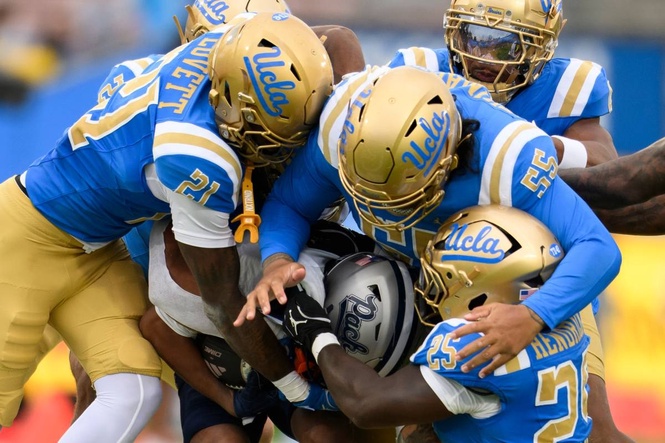
COLLEGE football will expand its playoff to 24 teams beginning next year, a move that lends an NFL flavor to its postseason while resetting decades of tradition surrounding a once all-important regular season and dumping conference championship showdowns that used to be among the sport's marquee events.
The announcement from the College Football Playoff and ESPN on Monday made official a deal that's been in the works for months. The network reported it would pay an additional $1.7 billion over five years on top of the original $7.8 billion contract that runs through the 2031 season.
The new format will grant the Power Four conference champions automatic spots and give one more to the best team from the Group of Six. But that slot and the other 19 will be decided by a selection committee that will serve as the latest edition in college football's long history of polls and opinions having lasting impacts on teams' fates.
The move marks a seismic shift in college football that even ESPN conceded comes with some question marks. The network pays billions to televise regular-season games that might — or might not — have more meaning.
“In all honesty, it's impossible to know for sure,” ESPN senior vice president Nick Dawson said in a conference call.
The revenue generated from the playoff expansion will presumably make up for the estimated $345 million the Power Four conferences generated in TV money for their title games. ESPN would then not be on the hook for $140 million of the extra money due to cancellation of the title games, the network reported.
How an expanded CFP will workThe top eight seeds will receive first-round byes in the new format and the playoff will start on the second weekend in December, with the first two rounds of games on campus. The traditional Army-Navy game will be played on the first weekend in December, which used to be reserved for conference title games.
Both the Southeastern and Big Ten conferences, whose approval was needed to adopt this change, and their Power Four brethren — the Big 12 and Atlantic Coast Conference — are banking that most of the additional spots will go to their members so their second-tier teams will have new motivation to keep spending big in an era of NIL payments and $50 million football rosters.
“I think it will be healthy for teams like our current situation, building to try to get to that point,” said coach Barry Odom, who is trying to rebuild at Purdue.
The first final for the 24-team playoff remains set for Jan. 24, 2028, in New Orleans. Traditional bowl games will still host the quarterfinal and semifinal rounds.
As for the rest of the bowls, most of them operated or televised by ESPN: “No decisions have been made at this time,” Dawson said.
As part of the expansion, the CFP is requiring Power Four teams to play at least 10 regular-season games against conference foes, other Power Four opponents and Notre Dame. Group of Six teams will have to play 10 games against conference opponents.
In theory, these requirements will keep everyone in the same ballpark when it comes to strength of schedule, which figures to play a huge role in the selection committee's considerations.
Special treatment vanishes for Notre DameNotre Dame didn't receive any guarantees, the way it did this year when, if it’s ranked in the top 12 by the CFP for what will be the last year of the 12-team postseason, it will get a spot.
Coach Marcus Freeman said he looks at the change as a net positive, in part because a team like his can now presumably afford more than one loss, and in part because of the new scheduling requirements. Notre Dame is one of only two independents left in major college football.
“I don’t want this to be like March Madness and have 60-something teams making the playoff,” he said. “But the more opportunities we have to make the playoff, it helps us.”
The new schedule also guarantees two off weeks during a regular season that will begin the week before Labor Day.