THE fossil fuel crisis, along with rising electricity costs, is pushing companies to explore renewable energy as an alternative power source. At the same time, these organizations are weighing the price they would have to pay for this transition, such as expenses for infrastructure transformation and training of their personnel. Their leaders are also asking if the resultant return on investment is worth it.
One solution, touted by its advocates as the next frontier of clean energy generation, is 24/7 Carbon-free Electricity (24/7 CFE). The international association Global Renewables Alliance (GRA) describes it as an approach that accelerates “storage, grid modernization and flexible capacity.” 24/7 CFE is said to provide a sounder foundation when it comes to policymaking, investment decisions and measuring carbon reduction because it is based on a thorough understanding of how power systems actually operate.
Perhaps what makes 24/7 CFE more feasible, practical and cost-effective for organizations is its alignment of “electricity consumption with renewable generation on an hourly basis.”
In an interview with The Manila Times, GRA Corporate Sourcing head Trigya Singh identified “hourly matching” as a critical component for the process: “The consumer is accounting for every hour of electricity, saying that this [use comes from] renewable; it is not fossil fuel, coal and gas.”
The consumed renewable energy is procured from a localized grid that is tapping into alternative sources of energy such as wind, solar, geothermal, hydrogen and green hydrogen. “This is a way of accounting and making sure that fossil fuel is not seeping in through your electricity mix,” Singh added.
The GRA report names some benefits in using 24/7 CFE: reduced power costs; a more granular understanding of the usage of power that can lead to more efficient practices; the potential to adapt to and meet increasing renewable-friendly energy regulations; and transparent, credible data presented to the more eco-conscious consumers.
Another stronger appeal, given the Middle East crisis, is lessened vulnerability to economic shocks. Power costs that rely on renewables are more predictable and can be planned for. “When you do a 10-year or 15-year 24/7 CFE PPA (power purchase agreement), your electricity price is not volatile to market conditions,” said Singh. “The pricing is then fixed, which means it has safeguards. You already know what to expect, rather than the price being changed and suddenly you are not able to secure it.”
The Philippine landscape
The global corporate sector is positioning itself to reduce its risks. Last year, it signed 63.3 gigawatts (GW) of offsite corporate PPAs, including growing volumes of clean firm power and co-located, hybrid projects.
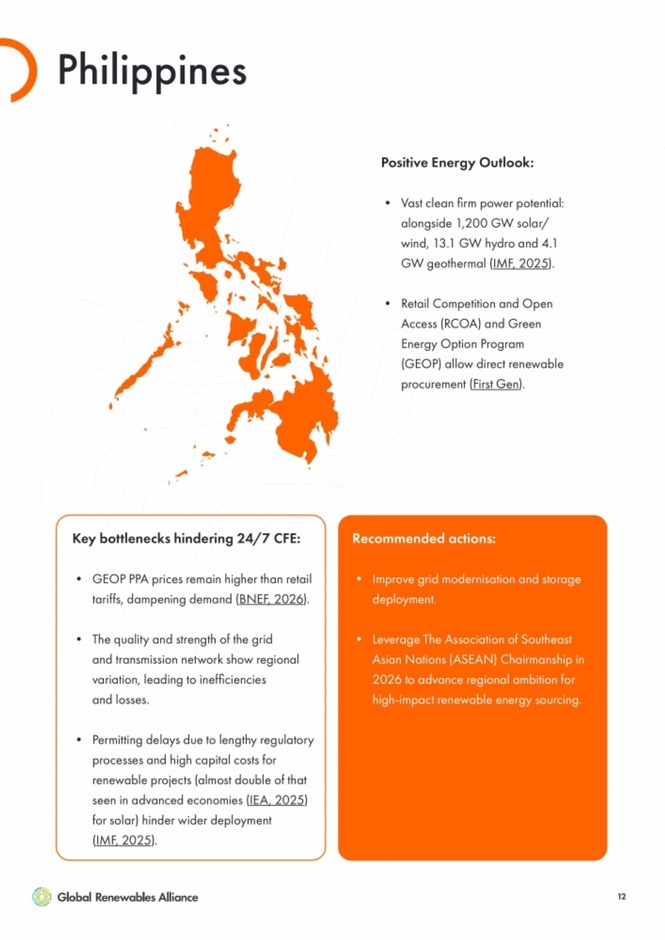
The Philippines offers a promising landscape when it comes to renewable energy adoption. Its vast clean firm power potential consists of 1,200-GW solar/wind; 13.1-GW hydro; and 4.1-GW geothermal. Investment in renewables grew 163 percent annually from 2022 to 2024, while wholesale prices declined from P5.58 to P4.14 per kilowatt-hour in 2024. About 82-megawatt-scale corporate PPAs were signed in 2025, and 65 percent of them were on-site.
As of 2022, another 65 renewable energy projects (17.84 GW) were unlocked through Republic Act 11659, which allows 100-percent foreign ownership and control of renewable energy companies.
The Philippines is still at an early stage of corporate 24/7 CFE adoption. Singh named the country’s market foundations, which are essential for more granular clean-energy procurement: a liberalized wholesale electricity market; five-minute Wholesale Electricity Spot Market dispatch; and corporate renewable procurement mechanisms through the Green Energy Option Program. It also has a national Renewable Energy Certificate platform used to issue, track, buy and sell certificates that prove electricity generation from clean sources.
Singh forecasted that the next wave of demand will come from electricity-intensive and internationally exposed businesses, including data centers, technology companies and export-oriented manufacturers, “where continuous electricity demand and global supply-chain and carbon-accounting requirements create a stronger incentive to demonstrate more credible clean-energy consumption.”
She advised companies that want to try 24/7 CFE to ask their renewable energy supplier for data like the location of the grid, the kind of power it sources, and how it will calculate the cost of power per hour. The transition can be gradual, as many companies start with 10-percent 24/7 CFE, then grow their consumption to 30 to 50 percent.
“It is a journey and not something you do overnight unless you have very massive pockets,” said Singh. Meanwhile, in the long term, 24/7 CFE can lead to “better energy security, lower electricity costs and clean energy skills. That is what your contribution can be when you start using this concept — it goes beyond basic electricity prices.”