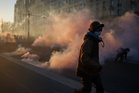
Authorities in France are bracing for another potentially tense day of protests, with a source close to the country's Interior Ministry warning of a "very high risk of public disorder" on Saturday.
Around 70,000 police officers have been deployed nationwide as trade unions, students and yellow vest protesters take to the streets for a third consecutive weekend to march against the cost-of-living crisis and school conditions.
This comes days after the French government presented several policies addressing student grievances on Monday, which unions have branded as insufficient.
Authorities are rolling out a ramped-up security operation, as they did on 24 October, in response to the widespread violence and looting that overshadowed otherwise peaceful demonstrations on 17 October.
The source close to the Interior Ministry warned on Friday that "calls for undeclared gatherings in public squares across France have proliferated," along with "plans for unauthorised marches towards places of power and state institutions."
On Thursday, France's Interior Minister Laurent Nuñez declared that protests in city centres had been banned and that only those "on the outskirts of cities" would be permitted. He added that organisers had been asked to "provide guarantees" that demonstrations would occur in "good conditions."
For their part, trade unions and the yellow vest movement have criticised these measures. In a joint statement issued on Wednesday, major unions said they would explore "all possible avenues of appeal against this general and disproportionate ban on the exercise of a public freedom that is essential in a democracy."
Halloween could heighten unrest
Nuñez also said on Thursday that the fact that protests coincided with Halloween could encourage unrest, which may run into the night. He warned that gatherings seeking to pass off as Halloween celebrations would be banned, while also calling out social media posts from groups including "ultra-left circles" that have urged individuals to back a "revolution" and "insurrection."
The heightened security measures come amid as human rights groups continue to accuse French law enforcement of using excessive force against protesters.
A number of law enforcement officers who were on leave had been called back to duty across France, while others have had their rest days cancelled.
Meanwhile, Paris police imposed a curfew on Saturday and Sunday night in districts that experienced significant unrest on 17 October.
The final route for the march in Paris on Saturday has been set for the eastern outskirts of the capital, from Porte de Bagnolet to Porte de Charenton, after the Council of State (Conseil d'État)overturned an administrative court's decision that had authorised a demonstration between Bastille and Nation.
Jean-Luc Mélenchon, the leader of the hard-left France Unbowed party, said on Saturday that he would join protesters at Porte de Bagnolet.
"We want to uphold the right to demonstrate peacefully at a time when Macron’s government is drifting towards authoritarianism and the far right seeks to hold the country to ransom with threats of attacks," he wrote in a post on X.
France's student protest movement began in mid-September, after pupils staged demonstrations against school conditions in the Parisian suburbs. The movement rapidly spread nationwide, leading unions and political forces to join.
The demonstrations - which come around six months before France's presidential elections - have since expanded into a broader social movement against the cost-of-living crisis and rising fuel prices.