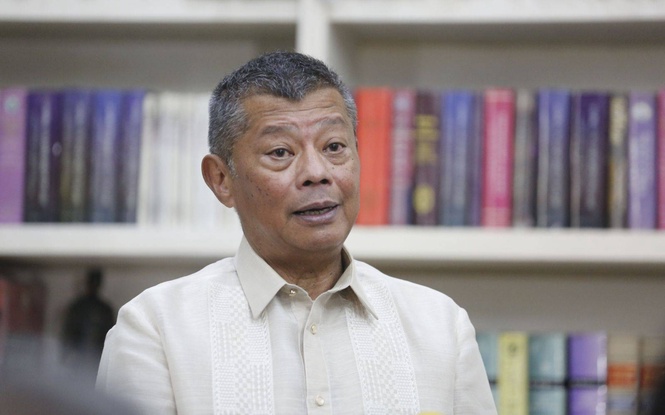
OMBUDSMAN Jesus Crispin Remulla on Tuesday identified Davao City as the “epicenter” of the flood control corruption ecosystem before the Marcos administration, as his office continues to investigate anomalies in government flood control projects.
“The epicenter of flood control [corruption] before the Marcos administration was Davao City,” Remulla told the House Committee on Appropriations during its hearing on the Office of the Ombudsman’s proposed 2027 budget.
The Ombudsman, however, has yet to establish the full extent of the alleged corruption, with Remulla noting the difficulty of penetrating the ecosystem and obtaining information because many people were reluctant to speak.
He quickly tempered the characterization, refusing to draw a conclusion before investigators establish what the evidence shows on the ground.
“I will not draw that conclusion immediately. We are still studying this because what is important is that we see the evidence on the ground,” Remulla said.
Among the matters being examined are the large amounts of funds that allegedly went into flood control projects in Davao.
“Davao is the ecosystem we are referring to. There were many funds that allegedly went into flood control. That is what we are thoroughly gathering,” Remulla said.
The investigation is not limited to Davao, with the Ombudsman also looking into other provinces to determine patterns and identify where the alleged corruption began.
Davao probe draws lawmakers’ questions
The revelation came after ACT Teachers Party-list Rep. Antonio Tinio asked whether the Ombudsman was investigating alleged flood control corruption during the previous administration, including projects in Davao City.
Tinio noted that the House and its previous investigative mechanisms like Independent Commission for Infrastructure and Senate Blue Ribbon Committee were no longer pursuing some of the issues, leaving the Ombudsman the sole investigative body.
Remulla assured lawmakers that the Ombudsman would not spare officials if evidence established wrongdoing, including Cabinet officials and even the president.
“All of that is based on evidence. We will not spare anyone here,” he said.
The Ombudsman said investigators were gathering information on the funds that went into flood control projects in Davao while also examining other provinces for possible patterns.
The probe, he stressed, remains evidence-driven and investigators have yet to make a final determination on the scope or origins of the alleged corruption.
Ombudsman seeks contempt powers
Beyond the Davao investigation, Remulla cited institutional difficulties facing the Ombudsman in obtaining documents and cooperation needed to build cases.
Remulla said his office had begun issuing subpoenas but encountered delays in obtaining information from several government agencies.
He identified the Bureau of Internal Revenue (BIR) as one of the agencies whose cooperation had been slow, while the Land Registration Authority and Anti-Money Laundering Council were also cited as sources of difficulty in obtaining records.
“Probably, the one law that we need is the contempt powers that will be given to the Office of the Ombudsman,” Remulla said.
Remulla said stronger enforcement powers would allow the Ombudsman to compel compliance with its investigations and prevent delays that could hamper case buildup.
The issue was also raised in the context of the Ombudsman’s use of statements of assets, liabilities and net worth waivers to obtain government records.
“Because of that waiver, the BIR should cooperate with us. But, of course, the cooperation of the BIR is somewhat slow. That is one of our problems, one of our headaches,” Remulla said.
Pulong Duterte challenges Davao characterization
The Ombudsman’s characterization of Davao drew a sharp response from former president Rodrigo Duterte’s son, Davao City 1st District Rep. Paolo “Pulong” Duterte.
Duterte urged Remulla to examine Department of Public Works and Highways (DPWH) records before declaring Davao City the “epicenter” of flood control corruption during the Duterte administration.
He said the DPWH Davao regional office had furnished him with a list of completed projects covering 2020 to 2022 when he assumed office as congressman in 2019.
He offered to provide Remulla with his copy of the records, saying both sides should be looking at the same documents.
Remulla emphasized the need for the Ombudsman to maintain confidentiality while investigations are ongoing.
He said publicly disclosing every investigative step could alert the people being investigated and compromise case buildup.
“If we state everything we are doing, then those we are following will know what we are doing,” Remulla said, adding that “there must be a time when we are quiet about a case.”
Chua backs Ombudsman marshals
The Ombudsman’s proposed enforcement arm also received support from Manila 3rd District Rep. Joel Chua, chairman of the House Committee on Good Government and Public Accountability.
Chua said he fully supported Remulla’s proposal to establish Ombudsman Marshals patterned after the Supreme Court’s Judiciary Marshals.
Chua said the proposed marshals could perform enforcement and security functions, including serving subpoenas and other official processes, enforcing suspension orders, securing officials and offices, and protecting evidence.
He also supported additional funding for the Ombudsman’s monitoring and investigation of government project implementation.
Chua specifically cited the need for financial-forensics specialists, fraud investigators and information technology experts to strengthen the agency’s ability to investigate possible irregularities in government projects.