
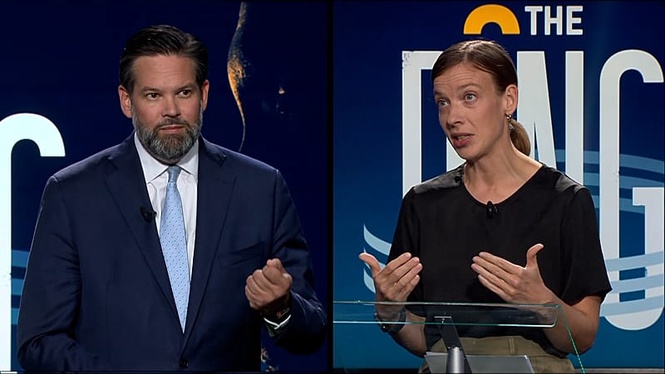
Just hours after European Commission President Ursula von der Leyen took the floor in the Parliament in Strasbourg for her annual State of the European Union address, two members went head to head to analyze the speech on The Ring: Lina Andersson (The Left, Finland) and Lukas Mandl (EPP, Austria).
With Europe facing mounting pressure on security, competitiveness, migration and its relationship with the United States, von der Leyen laid out her vision for the future of Europe.
What did she promise — and what can she actually deliver? What does Europe really need? What should citizens expect from the Commission and the Parliament in the months and years ahead?
From Ukraine and European defence to the AI challenge and energy policy and the EU’s response to a rapidly changing world, the speech came at a crucial moment for the Union.
The European Commission president offered to create a tailor-made status of "associate membership" to bring Canada ever closer to the bloc.
"We share one ocean, one set of values, one way of seeing the world. And we will now build our shared future as well," she told Canadian Prime Minister Mark Carney, who flew from Ottawa to Strasbourg to attend the speech as guest of honour.
She hailed the dawn of an "alliance for the future" to deepen EU-Canada cooperation in areas such as economic security, intelligent manufacturing, cutting-edge technology, defence, energy, critical minerals and batteries, as well as the Arctic region.
In addition, von der Leyen framed the summer of 2026 as the "summer of truth", pointing to wildfires, retreating glaciers, water shortages, crop losses and extreme heat that have wreaked havoc across the continent.
Her Commission is set to present a new climate resilience framework next month, already expected, that will identify 100 of the bloc's most vulnerable territories, assess their risks and determine the appropriate level of responsibility for managing them.
As expected, defence featured high in the speech, which came amid a string of hybrid attacks, some of which were attributed to Russia, that have rattled Europe.
Von der Leyen proposed a new mechanism fashioned on NATO's Article 4 that member states would trigger in the event of a hybrid attack. This would launch political consultations to "coordinate" an EU response and "deter further escalation".
Article 4 in the NATO context means that any country of the 32-strong alliance can call for an urgent meeting to discuss a new threat. It is the precursor to collective defence under Article 5, which stipulates that an attack on one is an attack on all.
Von der Leyen also pitched creating a "European Security Council" to bring together the leaders of Ukraine, the UK, Norway, Canada and other democratic partners.


