By Dr. Amarjeet Singh @ AJ
“Come early, ah. Don’t eat before you come!”
For many Malaysians, that familiar invitation signals the arrival of Deepavali. We think of an open door, a generous table and a host who somehow believes that a full plate still has room for another helping.
But by the time we arrive, a family has already lived through days of preparation and a morning filled with meaning.
To understand the Festival of Lights, let us imagine stepping into a Malaysian Hindu home a few days before the celebration. This is a picture drawn from familiar traditions; customs differ between households, communities and generations.
A few days before: the house comes alive
The preparations begin with a list that seems to grow every time someone looks at it.
Clean the house. Buy the groceries. Check the lamps. Collect the clothes. Call the relatives. And somewhere in between, make sure there are enough containers for all the snacks.
Furniture is moved. Shelves are wiped. The prayer space is carefully cleaned. Children may discover that their contribution to the festival involves considerably more sweeping than they expected.
There is laughter, a little tiredness and the occasional disagreement about where something belongs.
Cleaning becomes an act of making room: for a fresh beginning, for returning family members and for the people who will soon walk through the door. Tourism Malaysia describes preparations that can begin weeks ahead, with the whole family involved. Deepavali
Outside, festive shopping brings its own excitement. Imagine the colours of saris, the search for a well-fitting kurta, the fragrance of flowers and someone deciding, after visiting several shops, that the first outfit was the best after all.
For children, new clothes may be the greatest excitement. For parents, there is the quieter satisfaction of seeing everyone ready.
Yet celebration should remain within a family’s means. A clean home, sincere prayers and a warm welcome can carry enormous joy.
In the kitchen, memories take shape
Then comes the kitchen.
Picture a tray waiting beside the stove, dough being prepared and a container that seems to lose a few pieces every time a child passes.
Murukku is a familiar favourite at Malaysian Deepavali celebrations, alongside sweets such as laddoo, halwa and athirasam. The selection varies, but every family seems to have something that guests look forward to. www.malaysia.travel
There is often someone who knows the recipe by touch.
“A little more flour.”
“How much?”
“Enough. You will know.”
Those instructions can frustrate the younger cook. One day, they may become the very words that bring back a beloved parent or grandparent.
Recipes preserve more than ingredients. They preserve gestures, voices and the memory of working together.
This is also where family responsibility matters. Preparing a celebration should be shared. Those who chop, wash, stir, carry and clean help create the warmth that guests later enjoy.
The evening before: a different kind of excitement
As the day approaches, the house begins to look ready.
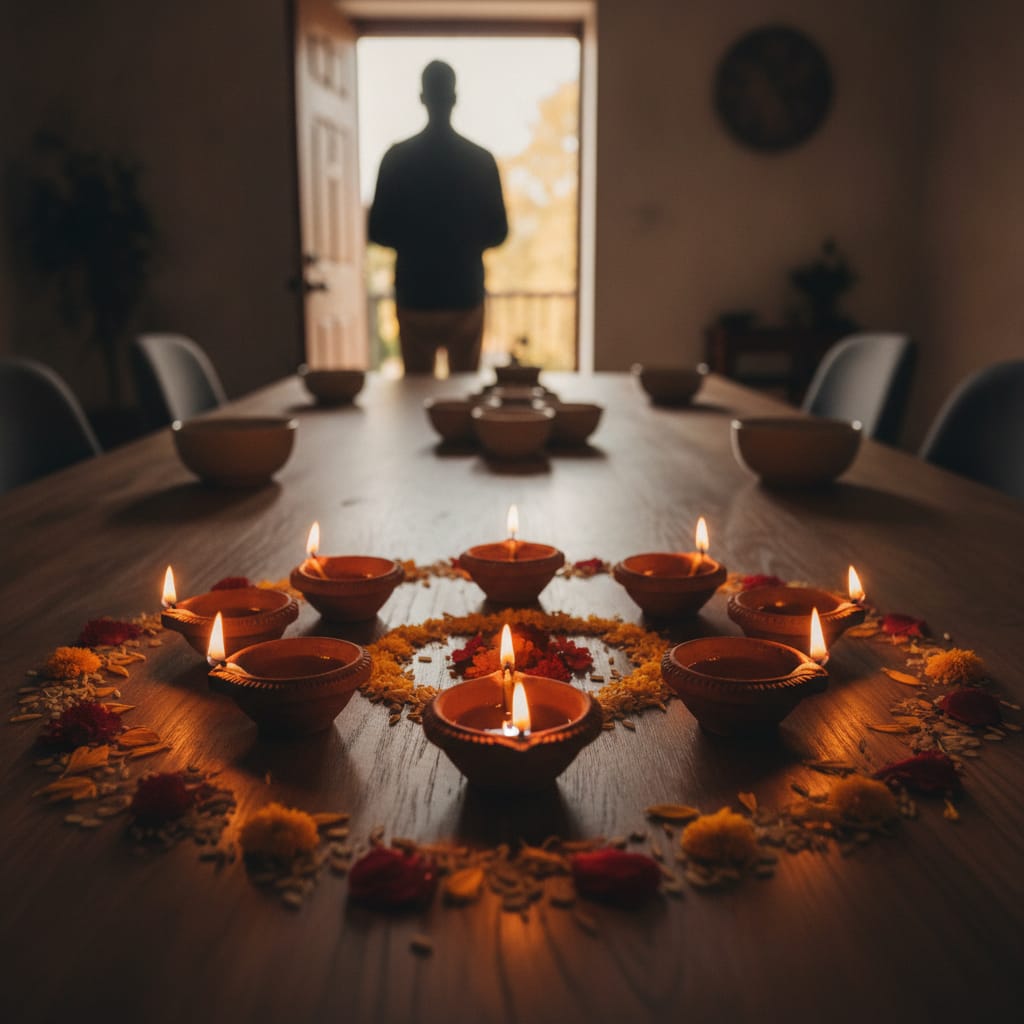
Clothes are laid out. Serving dishes are counted. Lamps are prepared. A kolam may take shape at the entrance, its careful patterns adding colour and welcome.
Some families use rice flour; others use coloured powders or different materials. The form may be simple or elaborate. Either way, someone has given time and care to it.
An elder checks the morning arrangements. A younger family member checks the photographs.
Both, in their own way, want to remember the occasion.
Behind the anticipation may also be a tender thought: someone who once helped prepare this home is no longer here.
Festivals can hold happiness and longing together. Making their favourite sweet or remembering their advice can keep that person close.
Before sunrise: a morning of renewal
Deepavali morning begins early in many Malaysian Hindu households.
The traditional oil bath, often called Ganga Snanam, is an important observance. Sesame, or gingelly, oil may be applied before bathing, sometimes by a parent or elder. Within the tradition, it carries meanings of purification and blessing. Hindus To Celebrate Deepavali On Monday
For a child, it may begin with sleepy eyes and a protest about the hour.
For an elder, it may carry decades of memory.
After bathing, family members dress in fresh clothes and prepare for prayers. In some homes, new clothes, fruit and sweets are first placed before the household shrine. lifestyle.bernama.com
Younger family members may seek blessings from their elders. The sequence and details differ, but the morning gives families a chance to pause together.
Before the visitors, before the feast, there is gratitude.
At the temple: beginning with prayer
For families who visit a temple, the morning continues in a place of devotion.
Imagine arriving in fresh clothes, with children guided gently through the gathering. There are flowers, lamps and prayers; greetings pass between familiar faces.
Here, families come to worship, give thanks and seek blessings.
Some may be thinking of health. Others of a child’s future, a difficult year or a loved one far away.
Malaysian Deepavali reporting regularly records this movement from the early oil bath to morning temple prayers. It reminds us that the festival’s public colour grows from a deeply personal religious life. Joyful Deepavali Celebrations Nationwide
A visitor unfamiliar with the customs can ask politely and follow the temple’s guidance. Respect begins with recognising that this is a sacred space.
Then comes the famous open house
Back home, the pace changes.
The kitchen becomes busy again. Someone checks the rice. Someone arranges the drinks. Someone calls from the doorway:
“They’re here!”
Suddenly, the house is full of greetings.
“Happy Deepavali!”
“Selamat Deepavali!”
“Come in, come in!”
This is the part many Malaysians know and love: relatives, neighbours, colleagues and friends gathering around a table.
The menu depends on the household. Some serve a vegetarian feast, perhaps rice with dhal, vegetable curries, sambar, chutneys and crispy accompaniments. Others may offer biryani, chicken or mutton dishes alongside vegetables and family specialities.
There is no single compulsory Deepavali menu. Dietary practices and family traditions deserve consideration. Hosts can explain the food and ask about guests’ needs; guests can ask graciously.
Then there are the snacks and sweets.
A crunchy murukku. A small laddoo. Perhaps a spoonful of payasam, or another dessert the family loves.
And, inevitably, the invitation to take more.
“You hardly ate!”
The guest looks down at a plate that tells a different story.
The abundance is enjoyable, but so is the conversation: an old school story, news of someone’s children, laughter between colleagues who usually meet across a desk.
For a while, people have time for one another.
The hands behind the hospitality
When we praise an open house, let us remember the work behind it.
Someone planned the shopping, stood over a hot stove and made sure the older guests were comfortable. Someone will still be washing dishes after everyone else has left.
A thoughtful guest notices.
Thank the people who cooked. Take a portion you can finish. Keep an eye on the children. Offer to help, and respect the host’s answer.
Hospitality becomes warmer when appreciation travels both ways.
There is room, too, to remember people whose celebrations are quieter: an elderly neighbour living alone, a family facing financial difficulty or a friend unable to travel home.
An invitation or a small parcel of food may mean more than we realise.
When evening comes
As the day settles, lamps glow and conversations soften.
The children are tired. The serving dishes are lighter. Someone finally sits down with a cup of tea.
Look around that home and the meaning of the celebration becomes clearer.
It lives in faith, in the blessing of an elder, in the patience of preparation and in the welcome extended to another person.
For guests of other backgrounds, accepting that welcome brings a responsibility: to understand a little more, appreciate sincerely and carry the friendship beyond the festival.
Deepavali begins before the first guest arrives. Its warmth can last long after the last guest leaves.
May the lamps bring light to our doorways, and may the care we give one another bring warmth to our homes.
Selamat Deepavali to all who celebrate.
Amarjeet Singh Sran (amarjeetsinghsran5@gmail.com) is a content creator under the Newswav Creator programme, where you get to express yourself, be a citizen journalist, and at the same time monetize your content & reach millions of users on Newswav. Log in to creator.newswav.com and become a Newswav Creator now!
The User Content (as defined on Newswav Terms of Use) above including the views expressed and media (pictures, videos, citations etc) were submitted & posted by the author. Newswav is solely an aggregation platform that hosts the User Content. If you have any questions about the content, copyright or other issues of the work, please contact creator@newswav.com.