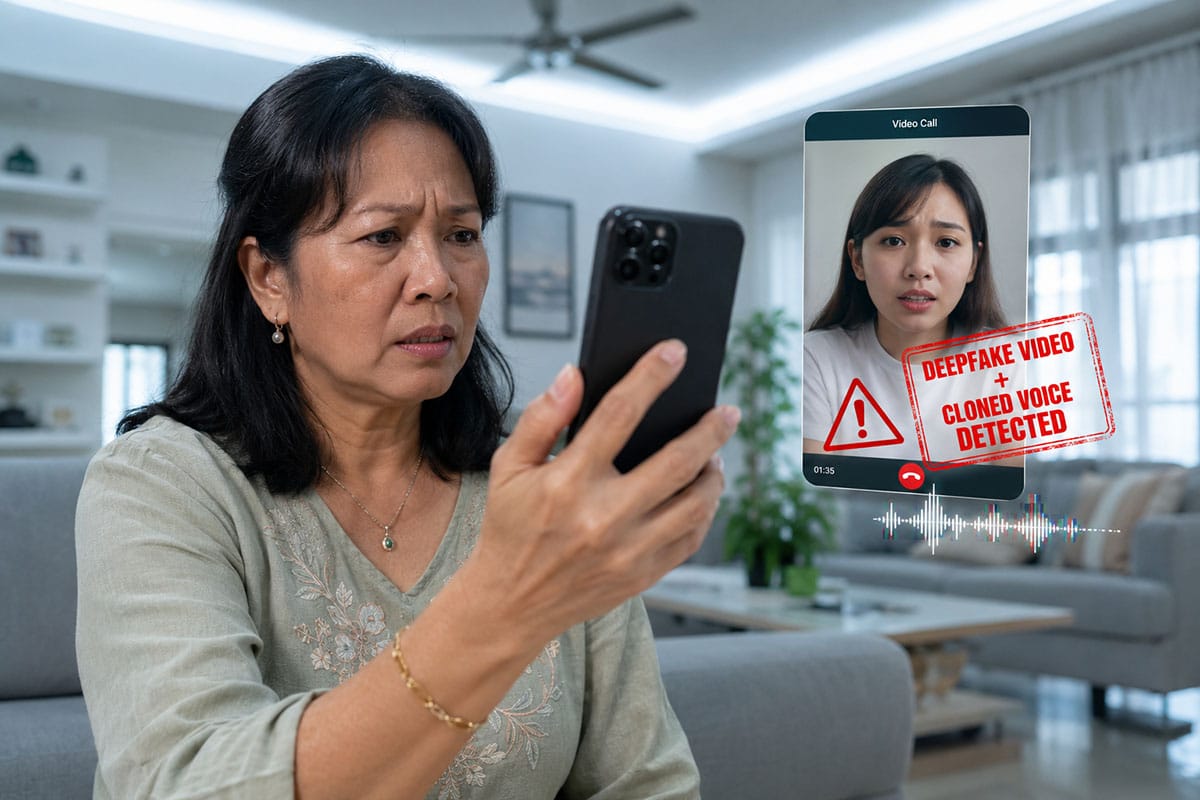
Back in an earlier piece, the warning was that AI scams were getting scary good and most of us were not ready. That warning has aged badly, in the worst possible way. We are now less ready than before, and the scale of the problem has grown far faster than anyone expected.
Malaysia's Deputy Communications Minister confirmed it plainly in Parliament: deepfake and AI voice cloning cases have surged eightfold compared to the same period last year. Not a modest increase. An eightfold jump, and increasingly, it is families, not just banks and corporations, sitting in the crosshairs.
The Numbers Behind the Surge
According to the Ministry, Malaysia recorded a sharp escalation in AI-generated scam content over the past year, with deepfake technology now being weaponised specifically to impersonate voices, faces, and even video calls convincingly enough to bypass the natural scepticism people usually rely on. The government has responded by introducing a Risk Mitigation Code under the Online Safety Act 2025, targeting platforms and requiring stronger safeguards against AI-generated impersonation content circulating unchecked.
Regulation is catching up, but the reality on the ground has already shifted. This is no longer a scam that targets the technologically naive. It is a scam engineered specifically to defeat critical thinking itself, by exploiting the one thing humans have trusted implicitly for our entire existence: the sound of a loved one's voice.
The New Playbook Targeting Malaysian Families
The mechanics are almost identical across every documented case worldwide, and Malaysia is no exception. A short audio clip, sometimes just a few seconds pulled from a TikTok video, a voicemail greeting, or an old Facebook clip, is enough for modern AI tools to clone a voice convincingly. Scammers then call a parent, spouse, or sibling claiming an emergency: an accident, an arrest, a kidnapping, a hospital admission. The cloned voice pleads, sometimes crying, sometimes panicked, and a second "authority" voice, a lawyer, a police officer, a doctor, frequently joins the call to lock the story into place.
The entire scheme depends on speed and panic. Victims are pressured to send money immediately, often through wire transfers, cryptocurrency, or gift cards, specifically because these payment methods are nearly impossible to reverse once sent. The scammer does not need a flawless performance. They only need you to recognise a tone, a phrase, an emotional cue familiar enough that your brain fills in the rest and stops questioning the details.
The Malaysian Communications and Multimedia Commission has already flagged a related tactic circulating locally: silent calls used specifically to harvest voice samples for cloning. Answer, stay quiet or say a few words trying to figure out who's calling, and that brief audio may be exactly what a scammer needs to build a convincing clone later. Several Malaysians have already come forward describing waves of follow-up calls from different numbers, local, mobile, international, after answering one of these silent calls.
Why This Specifically Targets Families
Corporate deepfake fraud tends to target finance departments and executives, chasing large wire transfers through impersonated CEOs or senior staff. One documented case saw an engineering firm lose $25.6 million after an employee attended a staged video conference featuring deepfake versions of multiple colleagues. Family-targeted voice cloning works differently. It does not need corporate access or insider knowledge. It only needs love, urgency, and a public social media clip.
This is precisely why parents and grandparents remain the most heavily targeted group globally. Scammers understand that a parent hearing what sounds exactly like their child in distress will act on instinct before verifying anything. The emotional override built into these calls is deliberate, engineered specifically to bypass the part of the brain that would normally pause and check.
The One Defence That Actually Works
Security researchers and consumer protection bodies worldwide converge on the same solution, and it costs nothing to set up: a family safe word.
The idea is simple. Agree privately, in person, on a word or phrase that only close family members know, something boring enough that it would never appear in a social media post, a voicemail, or a public video. If a call comes in claiming an emergency, ask for the safe word before doing anything else. A cloned voice, however convincing, cannot produce information it was never trained on.
Beyond the safe word, the same core principles apply every time: never send money on the first call, no matter how urgent or emotional the story sounds. Hang up and call the family member back directly, using a number already saved in your phone, never a number the caller provides. If a second family member or friend can confirm the person's actual whereabouts, use that verification before doing anything else. And be mindful of how much audio of your own voice, and your family's voices, ends up publicly posted online. Every video, every voice note, every casual clip is potential raw material for a scammer building a convincing fake.
My Take
I have already had my own brush with a scam call, a Macau-style VoIP scam where the tell-tale audio lag gave it away before any real damage was done. That experience made me cautious, but caution alone will not be enough against a threat this sophisticated. My family does not currently have a safe word or a formal verification habit in place, and after digging into how fast this eightfold surge has moved, I know that needs to change immediately.
What worries me most is how little effort this now takes on the scammer's side. It used to require some sophistication to pull off a convincing scam. Now it just requires a few seconds of publicly available audio and access to freely available AI tools. That gap between effort and damage has never been this wide, and it is only going to widen further as the technology keeps improving.
If there is one thing every Malaysian family should do after reading this, it is simple: sit down together this week and agree on a safe word. Keep it boring, keep it private, and treat any emergency call that cannot produce it as a scam until proven otherwise. It costs nothing, takes five minutes, and might be the single most useful thing your family does all year.
Kamarul Azwan (k.azwan@gmail.com) is a content creator under the Newswav Creator programme, where you get to express yourself, be a citizen journalist, and at the same time monetize your content & reach millions of users on Newswav. Log in to creator.newswav.com and become a Newswav Creator now!
The User Content (as defined on Newswav Terms of Use) above including the views expressed and media (pictures, videos, citations etc) were submitted & posted by the author. Newswav is solely an aggregation platform that hosts the User Content. If you have any questions about the content, copyright or other issues of the work, please contact creator@newswav.com.