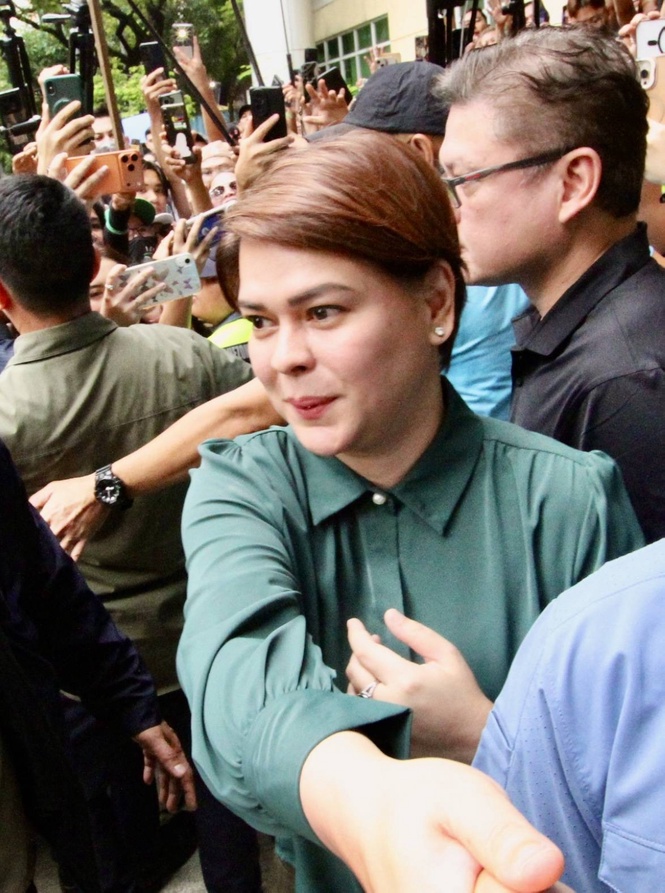
VICE President Sara Duterte could take the witness stand in her impeachment trial, but her lawyers have not sent any formal notice of her appearance, the Senate impeachment court’s spokesman, Reginald Tongol, said Sunday.
In an interview on DWIZ radio, Tongol said Duterte would not have to be subpoenaed if her lawyers decide to call her as a witness when the trial resumes on Nov. 9.
He cited a difference “between presenting witnesses for the prosecution and calling the adverse party, in this case, respondent Vice President Sara Duterte, to testify.”
“The prosecution would need a subpoena because her appearance would not be voluntary,” Tongol said.
The defense team, led by Michael Poa, has not informed the court if Duterte would testify in response to the remaining impeachment charge concerning her alleged unexplained wealth.
Tongol said the process would be different for other witnesses, particularly government officials whose attendance might have to be compelled.
He said the court expects the defense to seek subpoenas for such witnesses to ensure their appearance during the proceedings.
The prosecution has rested its case, and the defense is expected to present its case when the trial resumes next month.
Article II of the impeachment complaint accuses Duterte of unexplained wealth, inaccuracies in her statements of assets, liabilities and net worth (SALNs), and alleged violations involving prohibited business interests and the constitutional requirement for public officials to divest from private business interests when necessary.
The prosecution places Duterte’s alleged unexplained wealth at P817.87 million, amassed from 2022 to 2025.
Financial forensic analyst Alexander Cabrera told the court the amount could reach as much as P1.5 billion.
The allegations that became the focus of the prosecution’s case after the three other articles involving alleged misuse of confidential funds, bribery in the Department of Education and grave threats were dropped.
The defense has challenged the dropping of the three other articles, saying it was denied the chance to respond to them.
Tongol said the court is preparing to review the prosecution’s evidence and resolve pending procedural matters before proceedings resume.
He said the prosecution must submit its formal offer of evidence by Oct. 23, after which the defense will have 10 days to examine the documents and submit its comments.
The defense’s comments are expected around Nov. 3 or 4, leaving the presiding officer and the court’s clerk of court only a few days to rule on which documents will be admitted as evidence.
Tongol said the Senate secretariat had begun organizing the court’s records and preparing an inventory of the documents in anticipation of the submissions.
The prosecution is preparing for the cross-examination of witnesses the defense will present, a member of the prosecution panel, Manila 2nd District Rep. Joel Chua, said in a weekend forum.
Makati Business Club (MBC) Chairman Edgar Chua is hoping the trial of the vice president will not extend into 2027.
“We want it completed as soon as possible, [with the process] still being fair,” Chua told reporters.
He said it would be better if Duterte were able to show up to defend herself.
He said he thinks the vice president should welcome the development, saying it makes the process simpler.
“Maybe she also wants this to end — it should — then the [impeachment court] should just pursue one [article of impeachment],” Chua said.
He said the trial is a distraction at a time when the Senate should be reviewing the proposed 2027 budget.
He noted that experts have noted that the proposed budgets for critical sectors like health, education, transportation, facilities and infrastructure have been slashed, while appropriations for cash aid under the Assistance to Individuals in Crisis Situations (AICS) have been increased.
“That’s wrong because that [would lead to] patronage politics,” he said.
Chua said the only workable financial assistance is conditional cash transfers like the Pantawid Pamilyang Pilipino Program (4Ps) that require families to keep their children in school to receive aid from the government.