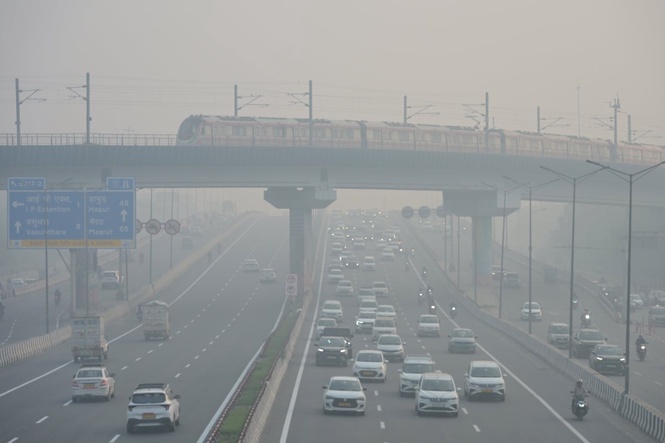
Delhi’s air quality fell into the "very poor" category this week, days before the Hindu festival of Diwali was expected to make it worse.
The Central Pollution Control Board classes readings of 301 to 400 as "very poor" and beyond 400 as "severe".
The deterioration in air quality came after the Indian capital saw the lowest average AQI for October in eight years, at 166, and north-westerly winds carrying smoke from crop burning in neighbouring states returned after a storm.
The Commission for Air Quality Management, which coordinates pollution control across the National Capital Region, invokes Stage II of the Graded Response Action Plan on Monday. Stage II involves the use of measures such as more mechanical sweeping and water sprinkling to control road dust, higher parking charges to discourage private vehicle use, restrictions on the use of coal and firewood in open eateries and restaurants, stricter rules on diesel generators, and more inspections of construction and demolition sites. The commission also asked governments and municipal bodies to consider staggered working hours for public offices.
The Delhi state government's Winter Action Plan also came into force this week. It bars vehicles that don’t meet Bharat Stage VI, India's latest vehicle emissions standard, from entering the capital until 31 January, with authorities turning back 1,539 such vehicles at Delhi's borders and issuing fines of more than 6.8 million rupees (£58,000) on the first day.
The air pollution is expected to worsen over the weekend as many people celebrating Diwali burst fireworks, as they do almost every year.
The Supreme Court ruled earlier this week that people celebrating Diwali could use certified green fireworks, carrying QR codes for buyers and authorities to verify the manufacturer, in Delhi and its neighbouring areas on 7 and 8 November between 6am and 7am and between 8pm and 10pm local time, but not within 300 metres of hospitals, care homes, schools, or other silence zones.
The order requires police to patrol designated sales areas, carry out random QR-code checks and seize illegal fireworks.
Wind and particle map
Past week and forecast
Why is Delhi's winter air pollution so bad?
The most harmful air pollutant is PM2.5, fine particulate matter measuring less than 2.5 micrometres across that can penetrate deep into the lungs.
The largest single source of winter PM2.5 in Delhi, at 27 per cent, is particles that form in the air from gaseous emissions, known as secondary particulate matter, according to a January 2026 report by the Indian government’s commission on air quality. Transport makes up about 23 per cent of the particulate matter, burning of crop residue, waste and other biomass 20 per cent, dust 15 per cent and industry 9 per cent.
Cold weather keeps the pollutants close to the ground, with temperatures and winds at their lowest and the layer of air near the surface in which pollutants can spread at its thinnest.
Farmers still burn crop residue because it is a cheap and fast way to clear fields, despite government schemes to manage stubble. Biomass burning also includes municipal and residential waste.
What are the health impacts of air pollution?
Air pollution kills millions of people a year, mostly through heart disease and stroke.
The World Health Organisation estimated that outdoor air pollution caused 4.2 million premature deaths globally in 2019, of which 68 per cent were from heart disease and stroke, 14 per cent from chronic obstructive pulmonary disease, 14 per cent from acute infections of the lower airways and 4 per cent from lung cancer.
A study published in 2024 in The Lancet Planetary Health estimated that 3.8 million deaths in India between 2009 and 2019 were linked to air pollution.
Long-term exposure to PM2.5 raises the risk of respiratory infections, heart diseases and lung cancer. Emerging evidence also links exposure to pregnancy and birth outcomes, fertility and type 2 diabetes, although those links are less firmly established.
People who are ill, children, older people, and the poor are more susceptible to the worst effects. The WHO describes air pollution as "one of the greatest environmental risks to child health".
What can you do to protect yourself from air pollution?
Sensitive groups like children, older adults, and people with heart or lung diseases, should avoid all outdoor activity once the air quality index passes 100, and everyone should avoid outdoor exercise once it passes 150, the Swiss air quality monitor IQAir advises.
Above 200, sensitive groups should stay indoors and restrict their activities. Above 300, everyone should avoid exercise and stay indoors, IQAir says. At these levels it also advises keeping windows closed and running an air purifier indoors.
Can ‘green’ fireworks really prevent Diwali air pollution bomb in Delhi?
Bollywood star calling for fireworks-free Diwali sparks political row in India
Restrictions in place as toxic air pollution spikes across India and Pakistan
Bus driver fatally pushed from moving vehicle
Abdul El-Sayed’s Indian in-laws celebrates historic US midterms win
Elon Musk’s X says takedown notices targeting Indian free-speech groups were fake