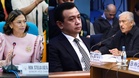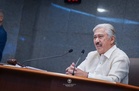
WHEN video footage and images surfaced earlier this month showing Sen. Jinggoy Estrada’s Senate office stripped bare before its turnover to incoming Senate President Pro Tempore Vicente Sotto III, the initial sense of incredulity that many in the public felt quickly turned into indignation.
Why would any senator of the land order his staff to remove floor tiles, wall paneling, light fixtures, wall sockets, a sink and a toilet bowl, leaving the room looking like an unfinished construction site before its turnover to its next designated occupant?
Estrada’s office confirmed that the senator — who is now in jail awaiting trial for plunder — had directed the staff to strip and transfer the items.
Statements from Estrada and his camp said the fixtures, furnishings and materials installed in the vacated office had been bought or paid for using personal funds or his office budget during his tenure.
Estrada’s camp defended the move by asserting that removing custom fixtures and bringing personal property to a newly assigned office space is a “standard practice” whenever senators swap or move offices following a leadership reorganization in the Senate.
Estrada also maintained that his staff had notified Sotto’s office beforehand that the installed fixtures, furniture and materials would be removed and moved to his new office space. He also argued that transferring these items to his new Senate space avoided wasting resources and saved money on purchasing new fittings.
But Senate officials and auditors pointed out that once fixtures — such as floor tiles, electrical sockets, and plumbing — are physically integrated into a government building, removing them damages public property. Removing permanently attached utilities goes far beyond taking movable personal furniture.
Senate President Sherwin Gatchalian explicitly denied that leaving an office in a destroyed condition is standard practice. Senate leaders noted that true standard practice is to leave the space clean, functional and ready for the incoming occupant.
Moreover, Sotto’s office said it received no prior written correspondence or warning about extensive structural dismantling.
Finally, Senate administrators noted that tearing down fixtures left behind exposed wiring, broken plaster, and unusable plumbing. Far from saving money, restoring these basic utilities forces the Senate to spend substantial taxpayer funds on structural repairs, cleanup and basic restoration.
Beyond the immediate spectacle, the episode is a stark reminder that electing principled leaders to office is essential.
Public office is a trust, not personal property. When an elected official treats a government office like a private possession — going so far as to strip tiles, electrical sockets, and plumbing fixtures — it signals a deep-seated mindset of entitlement rather than public stewardship.
A candidate’s personal integrity and respect for government institutions directly dictate how they will conduct themselves in office. Voters must look past name recognition or political dynasties and elect individuals who understand that public resources belong to the Filipino people, not to the incumbent.
In this case, restoring basic plumbing, repairing walls and rewiring electrical systems forces the government — and ultimately taxpayers — to spend additional funds simply to bring a public facility back to a basic functional standard.
Electing leaders with a track record of fiscal responsibility and respect for public property prevents the unnecessary waste of taxpayer money on petty repairs or administrative cleanup.
Stripping an office bare following a routine leadership reshuffle disrupts legislative operations, delaying the incoming official’s ability to set up their team and get to work. The country needs statesmen and stateswomen who recognize that continuous governance takes priority over personal grievances or political spats, so that government institutions function smoothly, regardless of political shifts.
When high-ranking public officials normalize destructive behavior under the guise of “standard practice,” it erodes public trust in democratic institutions. It sends a message to the public that those in power can act with impunity and disregard basic decorum.
The stripping of the Senate office is a reminder that elections have tangible consequences — not just in the laws that get passed, but in the political culture and values that govern state institutions. One of the painful lessons of the last decade is that we pay a disastrous price when we elect gangsters, thugs and buffoons to high office in the belief that “they are just like us” because they speak plainly.
Speaking the language of the streets — literally or figuratively — is not a qualification for leadership. True public leadership demands reverence for the office, respect for the taxpayer, and a commitment to leave every institution better, cleaner and stronger than it was before.