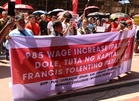
MANILA, Philippines — Wage increases vary across regions because wage boards consider local economic conditions, inflation and employers' capacity to pay, Labor Secretary Francis Tolentino said Monday.
Tolentino said regional wage boards consult workers, employers and government representatives before deciding on adjustments, taking into account the economic conditions in each area.
"In all provinces, there was a public hearing; the last one was in Lipa. Lucena was also included. There was one in Antipolo. There was one in Calamba. There was one in Batangas. Almost all, everyone had one. The public hearings for consultation were excessive. All of these are documented," Tolentino said in Filipino and English during an ambush interview at the Department of Labor and Employment (DOLE) central office in Intramuros.
He said wage reviews are conducted based on the anniversary dates of existing wage orders, with consultations held before regional wage boards decide on new adjustments.
The amount of an increase depends on the region's socioeconomic conditions, including inflation and the ability of businesses to absorb higher labor costs.
Tolentino said wage boards must balance workers' need for higher pay with employers' capacity to sustain their businesses and retain workers.
Meanwhile, a new wage order in the CALABARZON region includes a P750 increase for domestic workers, or kasambahays, effective Oct. 26, according to Tolentino's remarks during the interview.
The labor department said consultations are also lined up in Central Luzon, including Pampanga, Bulacan, Clark, Subic and Zambales. Wage adjustments in these areas will depend on the respective wage boards' decisions and the wage orders they issue after consultations.